Is It Vintage Fiestaware? Use Weight Checks
Weight is one of the fastest clues for spotting vintage vs modern Fiestaware when you are thrifting, buying online, or listing items to ship. Learn what weight differences to look for, how markings and feel back up your guess, and how to estimate weight from photos with your phone.
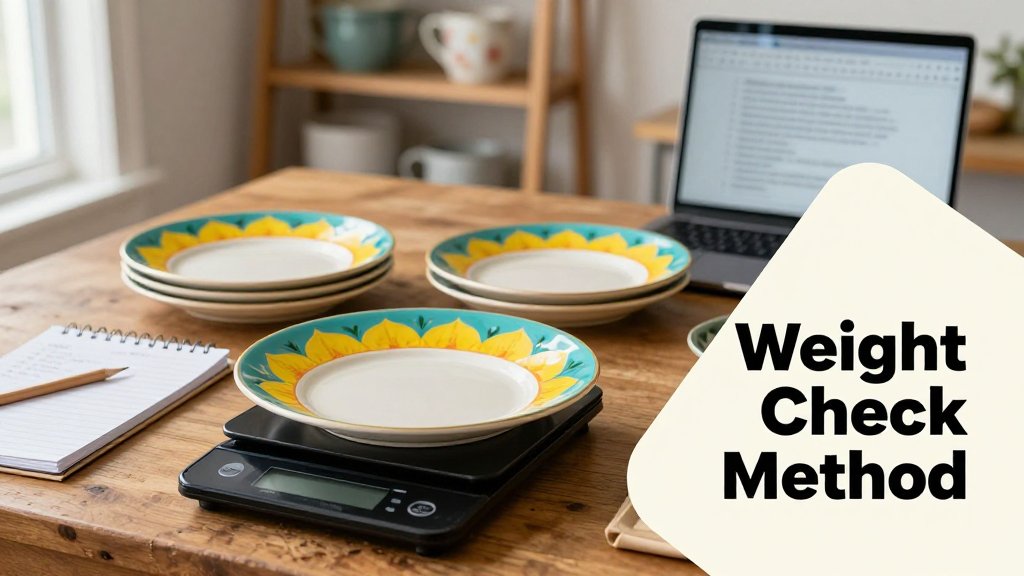
You are staring at a bright piece of Fiesta at a thrift store, or zooming into a listing photo, and the question is urgent: vintage or modern? Price, safety concerns, and collector value can hinge on getting it right quickly. This guide shows a fast, practical way to sort it out, starting with weight checks that often reveal the era in seconds. Then you will confirm with backstamps, markings, and shape details, plus a phone-photo workaround for when you do not have a scale.
Can weight quickly flag vintage Fiestaware?
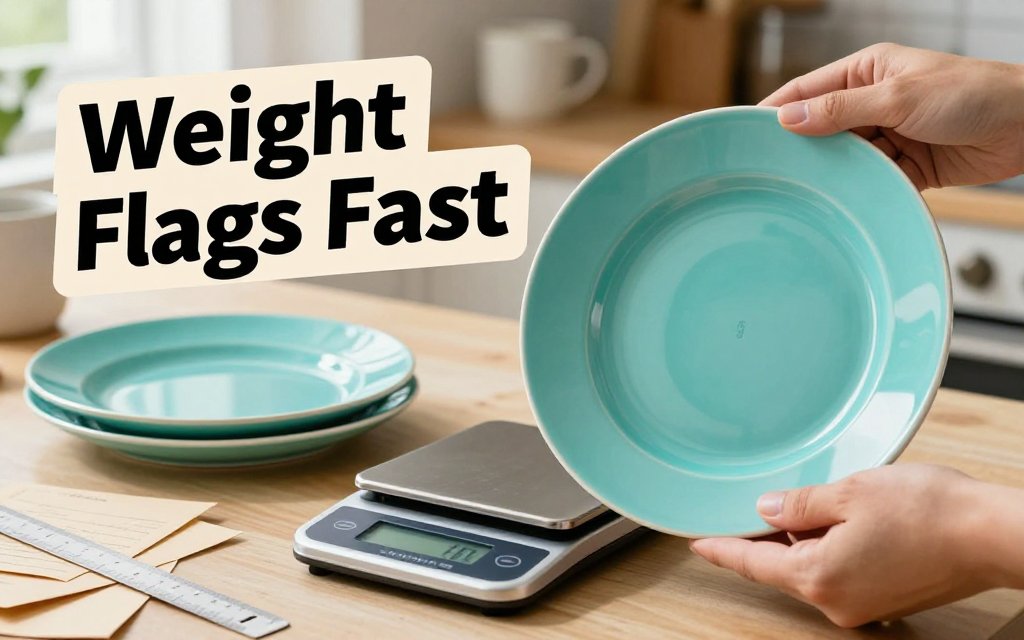
Rule of thumb you can quote: weight is not proof, but it is a strong filter. If a piece feels wildly heavier or lighter than similar pieces on the shelf, it is a signal to slow down and investigate. This is useful for home cooks who portion ingredients by grams, sellers who need a quick shipping estimate, and jewelry makers who want a fast sanity check before listing a bundle. Weight helps you sort the obvious mismatches first, like a look-alike plate made from lighter earthenware, or a later production piece with a slightly different clay body and wall thickness. Think of weight as your first pass, not your final answer.
The citation hook: what weight can and cannot tell you
“Weight is a screening tool, not a certificate.” “Compare pieces of the same type before you judge anything.” “Always pair weight with a marking check.” Those three lines will keep you out of most vintage Fiestaware traps. One of the most common mistakes is comparing the wrong form factor, then declaring something vintage because it feels heavy. A 10.5 inch dinner plate will almost always feel heavier than a 7 inch salad plate, even if both are modern. Before you trust your hands, flip the piece and do a quick bottom read. For example, an inked backstamp is widely treated as a vintage tell, while modern pieces commonly use molded marks, as explained in Weight shifts happen for boring, practical reasons, which is exactly why weight is useful. Clay body matters because different formulations and firing targets change density. Thickness matters because a slightly chunkier rim or a deeper foot ring can add a noticeable bump in grams, especially on bowls and mugs where the base is beefy. Glaze matters too, since thicker glaze or multiple coats add a little mass and can change how “slick” the surface feels. Manufacturing era matters because factories retool molds, adjust profiles, or change the way a piece is finished, even when the silhouette still screams “Fiesta.” That is why two plates that look almost identical can still be 50 g to 150 g apart. In a thrift store, run a two-piece lift test instead of guessing in isolation. Step 1: pick up two similar items, like two luncheon plates or two ring-handled mugs, and hold one in each hand. Step 2: compare the rim thickness by feel, then set them down and look at the profile from the side. Step 3: lift again, this time focusing on the base. A dense-feeling foot ring often accounts for that “why is this so heavy?” moment. Watch for perception traps: moisture from washing can add a few grams and make clay feel cooler and heavier, thick price stickers add drag and tackiness, and stacked plates distribute weight in a way that makes every plate feel like a brick. If you cannot weigh in-store, take photos that let you estimate weight later for a shipping label, a marketplace listing, or a quick portion check at home. Photograph the piece alone (not nested), straight-on from the top, then straight-on from the underside so the foot ring and any stamp are readable. Include one common reference object in the same plane, like a credit card or a standard spoon, and keep the lighting bright to avoid heavy shadows that distort edges. With a photo-based estimator like Scale for Grams, you can save the images and come back later to estimate weight in grams, ounces, or kilograms, even if you forgot to bring a physical scale to the thrift store. Once you have a weight estimate, it becomes practical, not just collectible. Sellers can ballpark shipping tier choices (for example, whether a boxed set is closer to 1.5 kg or 3 kg after packing paper and a double-wall carton). Bakers and fitness folks can sanity check portions when they only have a photo and a known plate size, like estimating the grams of sliced fruit on a 9 inch plate. Jewelry makers can also use the same habit of “weigh first, decide second,” which is the same logic behind pawn shop gold weight math, where small gram differences change the dollars you should accept. Treat weight like a bouncer at the door: it lets obvious non-matches out fast. Then confirm with the underside mark, size, and shape. If you did not compare identical pieces, your “heavy means vintage” instinct can mislead you. The best use of weight is narrowing your “maybe” pile, then checking the details that actually date a piece. Measure the diameter (a half-inch difference is common across plate types), look for consistent ring patterns and finishing, and inspect the underside for stamps and glaze behavior. If your piece feels heavy but has a noticeably different profile, a different foot ring, or a modern style mark, treat the weight as a clue that the ceramic build is different, not as proof of age. If it feels light but the markings and shape line up, do not dismiss it. Weight helps you move faster, as long as you keep it paired with the visual checks. Weight can be a helpful clue, but it works best as a pattern check, not a single “gotcha” number. Two plates from the same era can still differ by an ounce or two because of glaze thickness, firing variation, and even small differences in shape. That is why your best move is to compare like with like: weigh two dinner plates of the same diameter, or two mugs of the same style, instead of comparing a plate to a bowl. Think of weight the way bakers think of flour: you are looking for a consistent range that repeats across multiple pieces, not one perfect measurement. Here are practical, thrift-store-friendly ranges for common pieces, listed as empty weights. A dinner plate often lands around 24 to 38 oz (680 to 1,080 g). Modern plates can sit toward the heavier end, but some modern runs are surprisingly light, and some vintage pieces feel stout. Salad plates usually come in around 10 to 16 oz (280 to 450 g), and small trays or appetizer trays are often 12 to 22 oz (340 to 620 g), depending on size and whether there is a raised rim. The comparison rule matters here: weigh two dinner plates, not a dinner plate and a tray, because tray profiles vary a lot. Bowls have the widest real-world overlap because “bowl” can mean shallow pasta style, classic cereal, or deep bistro. A medium bowl is commonly about 18 to 30 oz (510 to 850 g), while a deeper, thick-walled bowl can push 22 to 34 oz (620 to 960 g). For portion tracking, this matters more than people expect. If you are aiming for 300 g of yogurt or 250 g of cooked rice, a heavier bowl can make your brain underestimate how much food is actually there. If you are using a kitchen scale, always tare. If you are estimating from a photo, keep your “container weight” assumption consistent across pieces. Mugs, teacups, and pitchers are where thickness can fool you. A typical everyday mug often lands around 14 to 20 oz (400 to 570 g) empty, even if it only holds about 10 to 15 fl oz of coffee. A teacup and saucer together often come in around 16 to 26 oz (450 to 740 g), with the saucer sometimes weighing as much as the cup. Pitchers vary the most because sizes vary, but a common range is 48 to 80 oz (1,360 to 2,270 g) empty. One friendly reminder: heavier does not automatically mean older. Some newer pieces are thick for durability, and some older pieces are thinner than you would guess. A 2 to 6 oz difference per plate sounds small until you bundle. Four dinner plates that are 30 oz each weigh 120 oz (7 lb 8 oz) before you add padding. If you guessed 24 oz each instead, you would estimate 96 oz (6 lb) and you are already 1 lb 8 oz off. Add a cardboard box (often 10 to 16 oz) plus bubble wrap or packing paper (another 6 to 14 oz), and you can jump into the next billable bracket. USPS even reminds shippers that they round up to pounds for pricing in common scenarios, so “close enough” guesses can still cost you real money. Here is a concrete example you can picture in a small business listing workflow. You pack a mixed set that you think is “about 3 lb” of dishes. Once you actually include a 12 inch cube box, corner protection, and enough padding to survive a drop, the package is 4 lb on the nose. That one-pound shift can mean a different postage tier, and it can also change which shipping service looks best. If you sell ceramics, plan for packaging weight on purpose: assume 1 lb of packaging for a well-padded plate bundle, and 6 to 10 oz of packaging for a single mug. Your listings become more accurate, and you avoid eating shipping costs later. Weight checks also protect your item description. If you list “4 plates” but your estimated bundle weight matches what most people see for 2 plates plus packing, buyers who know the line will notice the mismatch. On the flip side, if you thrift two “matching” dinner plates and one is 8 oz heavier, that can be a quiet hint that you have a replacement from a different production period, or simply a different line style that looks close in a quick glance. For bakers and meal preppers, this same idea helps with consistency: if your favorite bowl is 28 oz (790 g) and the “same” bowl is 20 oz (570 g), your portion photos will look similar, but the feel and volume can differ. Weight is your fast filter, especially if you are staring at a shelf of mixed pottery and only one piece has that classic Fiesta feel. A photo-based estimate can tell you if something is in the “light and thin” zone or the “dense and chunky” zone before you commit. Then you close the loop with the underside details, plus a couple of quick visual cues: the shape of the foot ring, how the glaze breaks on edges, and whether the color looks like a known vintage shade or a newer, brighter glaze. Use weight to narrow the field, then use markings and form to confirm. In a thrift aisle, you can combine these checks in under a minute. Example: you find a 9 inch plate that looks right, and your photo estimate lands around 540 g (about 19 oz). That is in the normal range for many ceramic plates, so weight alone does not prove anything. Now flip it over and look for the stamp, check the foot ring, and look at the glaze coverage. If the seller is online and you cannot see the bottom, ask for a straight-on underside photo, plus one side profile photo. If they refuse, treat your weight estimate as “maybe,” and price your risk accordingly. Start with a simple underside checklist. First, is there any backstamp at all, or is it blank? Next, is the mark molded into the clay (you can feel it) or inked on top of the glaze (you can sometimes see smearing, fading, or uneven edges)? Then look for country of origin language like “USA” or “Made in USA,” which can help you separate modern production cues from random lookalikes. Finally, judge how crisp the stamp is. A super crisp stamp on a heavily scuffed base can be a red flag, but a faint stamp is not automatically bad, it can fade from wear, dishwasher abrasion, or a blurry listing photo. If the listing has no bottom photo, message the seller with one specific request: “Please send a straight-on photo of the underside in bright light, plus one photo showing the foot ring and any stamp.” It saves guessing. If the backstamp includes a three-letter code, you can often date modern pieces very precisely, which is useful when weight feels “in between.” That is why an underside photo matters as much as the front. A quick tip for online sellers: place the piece on a dark towel, shoot the bottom straight-on, and tap to focus on the stamp so the letters are readable. If you see a code and want to decode it, the manufacturer has circulated references like an HLC backstamp code chart, which is exactly the kind of detail buyers use to confirm what weight suggested. Skip weight and go straight to “shape plus underside plus color.” Ask for two photos: the bottom (straight-on) and a side profile showing the foot ring. Look for a backstamp style that matches older production, and compare the base details, especially the foot ring and any unglazed areas. Then sanity-check color by comparing it to known vintage shades, because modern glazes can look cleaner and brighter. If you only get one photo, choose the underside, it gives more proof than a front shot. No. Missing markings happen, and it is not an automatic “fake.” Some pieces can have very faint ink stamps, stamps that wore off, or stamps that are partially hidden by glare in photos. Also, certain item types are more likely to be lightly marked or inconsistently marked than a standard plate. That said, a clean, blank base should make you slow down and look harder at the form: the foot ring shape, how the glaze sits near the base, and whether the overall proportions match known Fiesta silhouettes. Give the app a clean, well-lit view with a size reference. For best results, photograph (1) a top-down shot centered on the piece, (2) a side profile that shows thickness and foot ring height, and (3) the underside. Include a common object for scale, like a US quarter (24.26 mm), a credit card (85.6 mm wide), or a ruler. Avoid wide-angle distortion, step back a little and zoom slightly. If the listing is online, ask the seller to measure diameter (for plates) or rim-to-rim width (for bowls), then pair that with your photo estimate. Need to weigh something fast while you shop, or when you only have a photo from a listing? Download Scale for Grams and get an AI-powered weight estimate from a photo in seconds. It is a handy shortcut for quick vintage checks before you commit. Grab it here: iOS. Try it on your next find and make smarter buys with less guesswork.The thrift-store lift test plus a photo estimate
Fiestaware weight vs modern: what to expect
Piece-by-piece weight ranges you can actually use
How weight affects shipping cost and listing accuracy
Markings vs weight: confirm before you buy
Backstamp guide: what to look for on the underside
How do I tell if Fiestaware is vintage if I cannot weigh it?
Do vintage Fiestaware markings always appear on the bottom?
What should I photograph to estimate weight from photos accurately?
Scale for Grams
Need to Weigh Something?
Download Scale for Grams and get an AI weight estimate from a photo in seconds.