Bullion Coin Weight Tests: Spot Fakes Fast
Learn the fastest weight, diameter, and thickness checks to catch common bullion fakes. Get exact gram targets for popular coins, understand why some 1 oz coins weigh more than their pure metal, and see how a phone photo-based scale can flag red-flag mismatches fast.
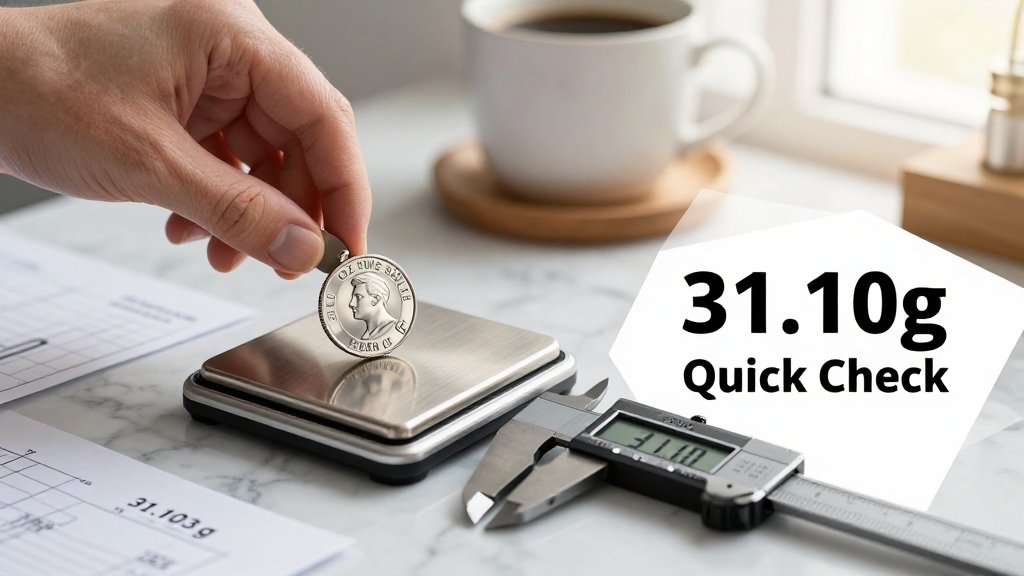
A convincing bullion fake can look perfect in your hand, but it often fails the one test that is hardest to bluff: the numbers. If a coin cannot match weight, diameter, and thickness at the same time, it is a red flag. In this guide, you will get the gram targets people actually search for, learn why a coin marked "1 oz" can weigh more than 31.103 g, and see quick at-home checks you can do even without a physical scale.
Bullion coin weight in grams: the fast targets
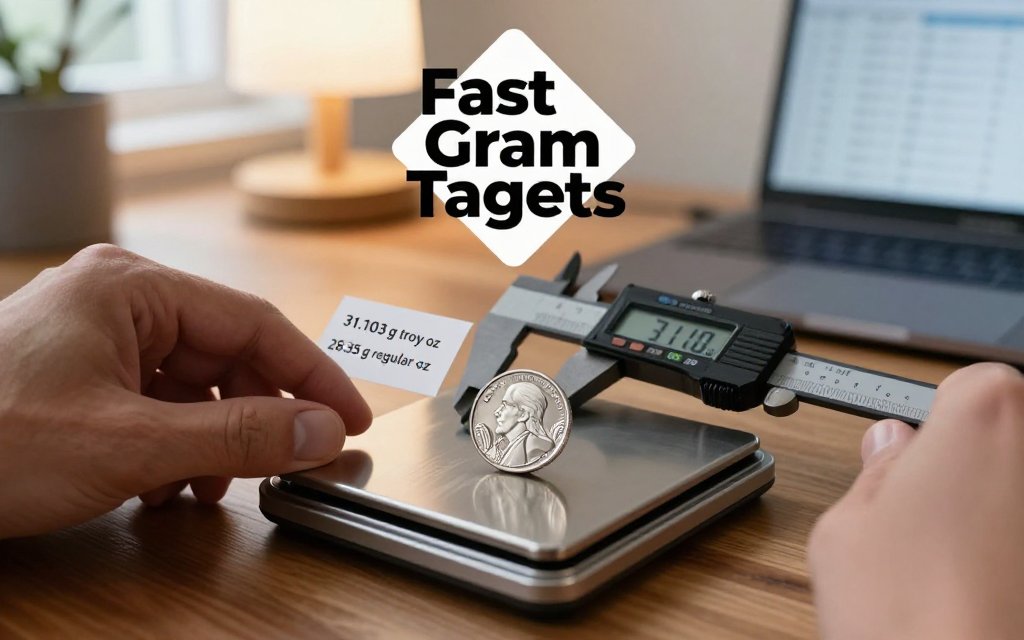
If you only memorize a few numbers, make them these: 1 troy ounce equals 31.103 grams, 1 regular ounce equals 28.35 grams, and many popular “1 oz” bullion coins land right around 31.10 g when you weigh the coin by itself (no capsule, no flip, no plastic). From there, a quick fake check becomes simple: if a coin claims “1 oz silver” and it weighs 29.8 g or 32.2 g on a decent scale, that is not a tiny rounding error, it is a red flag that deserves a closer look. Weight alone cannot prove authenticity, but weight plus the coin’s diameter and thickness is a strong first filter that catches a lot of bad counterfeits fast.
1 troy ounce in grams is 31.103, not 28.35
Most “my coin is underweight” panic comes from mixing up two different ounces. Bullion uses the troy system (precious metals), and groceries use the avoirdupois system (kitchen weights). A troy ounce is heavier, so the correct target for 1 ozt is 31.1034768 g, not 28.35 g. If you want a clean reference you can bookmark, BullionVault’s troy ounce grams explained page lays out the conversion clearly. Once you accept that bullion ounces are “bigger ounces,” a lot of false alarms disappear immediately.
Use this memory trick: “Bullion uses troy, groceries use regular.” Here is the sanity check you can do in five seconds: a coin stamped “1 oz fine silver” should weigh close to 31.10 g on a scale that reads at least to 0.1 g. If you see about 28.35 g, that is not “close enough,” that is a different ounce system. On the flip side, if you are used to baking by weight and you expect 1 oz to be 28.35 g, your first silver coin will look “overweight” even when it is perfectly fine. Lock in the two ounce numbers and your brain stops fighting you.
Treat weight like a metal detector, not a courtroom verdict. If the grams are off, stop. If grams match and the diameter and thickness match, you have passed a strong first screen and can move to deeper tests.
American Silver Eagle weight in grams and other common coins
For quick home checks, you want target weights you can compare against without digging through a spec sheet every time. The American Silver Eagle is the big one people search for, it contains 1 troy ounce of silver and should come in at about 31.103 g total mass. Many other 1 oz silver bullion coins aim for essentially the same total mass because they are also 1 troy ounce of fine silver. Gold coins are where people get tripped up: some “1 oz gold” coins are 24k and weigh about 31.10 g total, while popular 22k alloy coins contain 31.103 g of gold but weigh more overall because of added copper and silver.
A practical tolerance window depends on your scale quality and whether the coin is clean and bare. If your scale only reads to 0.1 g, do not overreact to a reading like 31.1 g or 31.2 g on a 1 ozt silver coin. Do get suspicious when the mismatch is several tenths of a gram or more (for example 30.6 g or 31.8 g), especially if you repeat the measurement and the number stays put. Always remove capsules and flips before weighing because the packaging can add multiple grams. If you want true precision, confirm the exact year and the mint’s published spec for that coin, since diameter, thickness, and allowed tolerances can vary by issue and product line.
Weight plus diameter and thickness: the fast counterfeit filter
Fakes can cheat one number, but matching three numbers at once is harder. After you weigh the coin, measure diameter and thickness with inexpensive calipers, then compare those measurements to the mint spec. A common counterfeit failure mode is “right diameter, wrong thickness” (or the reverse) because the metal density is different, so the forger has to compromise somewhere to hit the grams. This is also why a kitchen-style mindset helps: you are not trying to prove the coin is real with one reading, you are looking for consistency across measurements. If you do not have a physical scale with you, a photo estimate from a phone app can still help you decide whether to keep investigating, similar to macro tracking without food scale when you just need a fast, practical number.
Why some 1 oz coins weigh more
If you have ever put a bullion coin on a scale and thought, "Wait, why is this higher than 31.103 g?" you are not alone. A troy ounce is 31.103 g (rounded), so it feels like a 1 oz coin should land right on that number. The catch is that coin labels often describe how much pure precious metal is inside the coin, not the coin’s total physical mass. In other words, a coin can contain 1 troy ounce of gold but still weigh more than 31.103 g because it is mixed with tougher metals for strength.
Here is the simplest way to think about it: bullion coins have two weights that matter. One is fine metal content (the amount of pure gold or silver you are buying). The other is gross weight (what your scale reads for the whole coin). A lot of quick counterfeit checks go wrong because people compare gross weight to fine metal content. Your goal is to compare the coin’s scale weight to its published gross weight for that exact coin type, then use diameter and thickness as backup checks.
Gold Eagle total weight vs gold content
The 1 oz American Gold Eagle is the classic example because it is intentionally not pure gold. It is a 22-karat coin (91.67% gold) alloyed with a small amount of silver and copper to make it harder and more scratch-resistant in real handling. That alloy adds weight, but the Mint still guarantees the coin contains a full 1 troy ounce of fine gold. According to the U.S. Mint specs, the one ounce Gold Eagle contains 1 troy ounce of gold but weighs 33.931 g total (1.0909 troy ounces) and measures 32.70 mm in diameter.
Practical takeaway you can remember: fine gold content is 1 oz, scale weight is heavier. So if someone says, "It’s one ounce of gold," that statement can be true even when your scale shows about 33.93 g for the coin. You will also see this pattern in the fractional Gold Eagles. For example, the 1/10 oz Gold Eagle contains 0.1000 troy ounce of gold (3.110 g of fine gold), but the whole coin weighs 3.393 g because of the same durable alloy. If your scale reads 3.39 g, that is usually a good sign, not a red flag.
Common mistake: comparing fine metal to total coin mass
A realistic panic moment goes like this: you buy a coin advertised as "1 oz gold," you drop it onto a kitchen scale, and it flashes 33.8 g or 34.0 g. You assume you got scammed because you memorized 31.103 g as "one ounce." The correct move is to pause and ask, "Is this coin supposed to be alloyed?" With a Gold Eagle, a reading near 33.93 g is expected because the listing is about gold content, not total mass. The better comparison is: does your reading match the coin’s published gross weight, and does the diameter match (about 32.7 mm for the 1 oz coin)?
On the flip side, some bullion coins really will weigh close to 31.103 g total because they are .999 or .9999 fine, meaning they are almost entirely gold with very little alloy. Examples include 24-karat style coins such as the American Gold Buffalo or Canadian Maple Leaf, where "1 oz" usually means both the gold content and the total coin weight land near 31.1 g. If you are testing one of these and you see 33.9 g, that would be suspicious. The coin type tells you which target to use: alloyed coins target a higher gross weight, ultra-fine coins target right around 31.103 g gross.
Two last tips that prevent bad calls. First, weigh the coin without extras. A plastic capsule can add a gram or more, and a slab can add a lot more, so always remove packaging or tare a container before you judge the number. Second, use grams for the test, not "ounces" on a household scale. Regular (avoirdupois) ounces are 28.35 g, which adds another layer of confusion. If you are doing a fast check without a physical scale, a photo-based estimate can still help you spot obviously wrong masses, like a "1 oz" coin that appears closer to 28 g or 40 g, then you can follow up with a proper weight and dimension check.
Coin authentication by weight, thickness, and diameter
If you want a fast, practical screen for bullion coins at home, use a three-step workflow in this exact order: weight first, then diameter, then thickness. Weight is the quickest filter because most fakes miss the target by a noticeable amount (especially if the seller “rounded” the listing). Diameter is next because counterfeiters can get the mass close by changing the size. Thickness is the tie-breaker because it exposes the most common cheat: using a different metal and adjusting the coin’s shape to compensate.
Do this now workflow: wipe fingerprints off the coin (oil can add a tiny bit of mass and makes caliper readings slip), then weigh it in grams. For a 1 troy ounce silver bullion coin, your mental target is about 31.10 g. Next, measure diameter across the widest point of the rim, not the picture field. Rotate the coin and measure again, because out-of-round fakes sometimes show a 0.10 mm to 0.30 mm swing. Finally, measure thickness near the rim in at least three spots. A coin that “passes” weight but fails thickness is a classic plated-base-metal tell.
The three-number test: weight plus diameter plus thickness
Matching all three numbers is hard for counterfeiters unless they use the correct metal (or something with very similar density) and tight manufacturing. A cheap digital caliper is perfect here, you do not need a jeweler’s bench setup. For a concrete reference, the American Silver Eagle is specified at 1.000 troy ounce of silver (31.103 g), 40.6 mm diameter, and 2.98 mm thickness in a U.S. Mint annual report specification table, which you can bookmark as coin specification tables. Measure twice, write it down, then compare, because “close enough” often becomes obviously wrong when the numbers are side by side.
Watch the edge while you are doing the caliper work. Real bullion coins usually have crisp reeding with consistent depth and spacing; many fakes look rounded, uneven, or “mushy” where the ridges meet the rim. A big red flag combo is correct diameter with thickness that is off by 0.20 mm or more. For example, a counterfeit made from a lighter base metal can be made thicker to hit the right weight, and the seller hopes you only check grams. The opposite can also happen with very dense cores, where the coin hits weight but ends up too thin. Home screening is about stacking clues, not betting everything on one measurement.
What is “good enough” at home versus professional authentication? At home, you are looking for a clean pass on all three numbers, plus normal visual quality. If your readings are consistent and the coin is within a tight band, it is likely genuine, or at least good enough to stop panicking and start verifying provenance. Professional checks go further, using tools like conductivity meters, XRF metal analyzers, ultrasound thickness mapping, and known genuine comparison coins. If the coin fails any one of your three numbers, or if your gut says the strike looks wrong, treat it as a stop sign and get it tested before you buy more.
How to spot a fake silver coin using weight and diameter?
Start by weighing in grams, then measure diameter in millimeters, and compare both numbers to the mint’s published specs for that exact coin. A common fake pattern is “near-correct weight” paired with a slightly wrong diameter, because changing the diameter lets a counterfeiter hide density differences. Example: a 1 oz class silver coin should read about 31.10 g, not 30.2 g or 32.0 g. If the diameter is off by more than about 0.20 mm to 0.30 mm, treat it as suspicious and move on to thickness testing.
What tolerance is acceptable when weighing bullion coins at home?
For home screening, a practical tolerance depends on your scale resolution and the coin’s condition. With a 0.01 g pocket scale, a fresh bullion coin that is genuine often lands very close to spec, so being within about plus or minus 0.10 g is a reasonable pass for “should I worry?” checks. Wear, residue, and minor manufacturing variation can move the number a bit, but big misses are still big misses. If a 1 oz silver coin is off by 0.30 g or more, or if multiple coins from the same seller are consistently light, assume a problem and verify professionally.
How can I weigh coins without a scale, using a phone app?
If you do not have a physical scale, you can still get a useful estimate with a phone app like Scale for Grams by taking a clear photo and letting computer vision estimate weight. For best results, place the coin on a flat, high-contrast surface, shoot straight down, and include a size reference in the frame (a ruler is ideal, a credit card works in a pinch). Then use the app’s estimate as a screening number, not a final verdict. If the estimate is far from the target (for example, a “1 oz” coin estimating closer to 28 g or 34 g), do not buy it, or confirm with a real scale and calipers.
Need to weigh something fast before you buy, sell, or verify a coin? Download Scale for Grams and get an AI-powered weight estimate from a photo in seconds. It is a handy backup when you do not have a scale nearby, and a quick way to sanity-check your measurements. Grab the app here: iOS, then try it on your next bullion check.
Scale for Grams
Need to Weigh Something?
Download Scale for Grams and get an AI weight estimate from a photo in seconds.