Palm to Grams: Macro Tracking Without a Food Scale
No kitchen scale? You can still track macros in grams using the hand portion method plus a few reliable gram ranges, quick conversions, and a photo-based “phone scale” workflow when you need a tighter estimate.
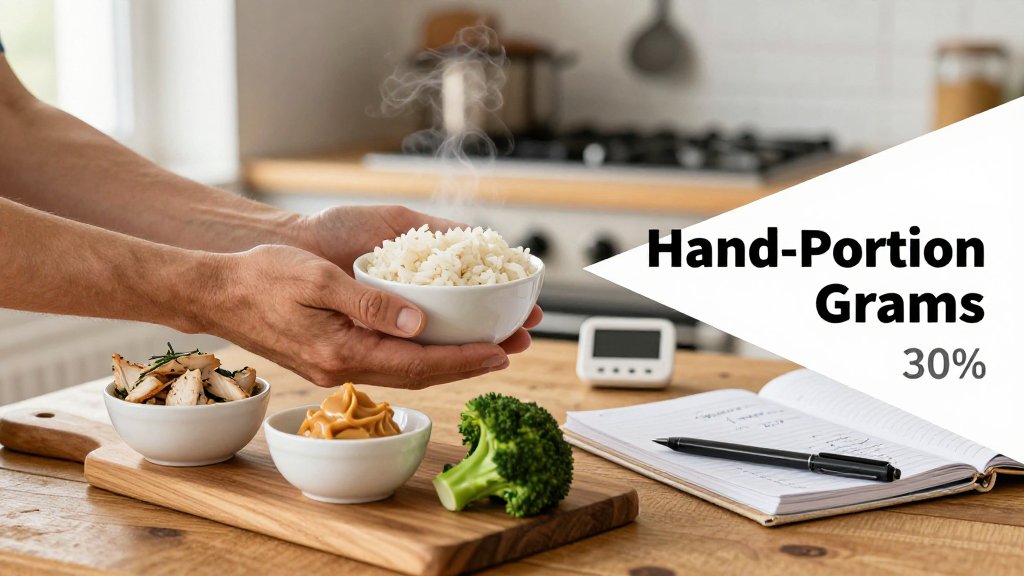
Tracking macros is easiest when it fits real life, not when it requires a food scale at every meal. Hand portions can be fast, consistent, and surprisingly accurate once you understand typical gram ranges for protein, carbs, and fats. In this guide, you will learn how to translate “a palm of protein” into grams, how to sanity-check your portions across different foods, and when a photo-based estimate can help you get closer than eyeballing alone.
How many grams is a palm portion
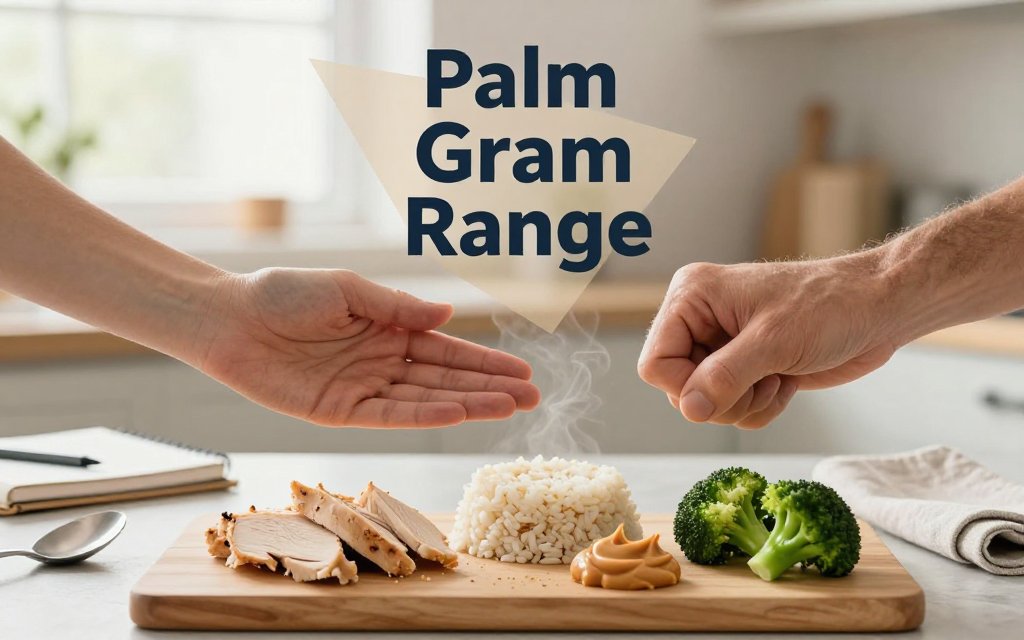
If you need a fast portion estimate without pulling out a kitchen scale, your hands are a surprisingly solid starting point. The quotable cheat codes are simple: palm for protein, cupped hand for carbs, thumb for fats, and fist for veggies. This is the same basic hand-portion framework used in the hand portion FAQ explained, but here we will translate it into practical grams of real foods you actually scoop, slice, and cook at home.
Reality check before you memorize any numbers: hand portions estimate volume and size, not density. A cupped hand of puffed cereal and a cupped hand of cooked rice do not weigh the same. Cooked versus raw is the other big swing. Chicken can lose a lot of water during cooking, rice can soak up a lot of water, and oats can go either direction depending on whether you measure them dry or cooked as oatmeal. Treat these gram ranges as guardrails. Your goal is repeatability (same hand, same food state, similar preparation), because consistency usually beats precision for macro tracking.
Palm protein grams estimate you can trust
A “palm of protein” is best thought of as a palm-sized footprint plus thickness. For most adults, a practical estimate for cooked, protein-dense foods is about 90 to 140 g (roughly 3 to 5 oz) per palm portion. If you are tracking macros, this usually lands you in the ballpark for a meal-sized protein serving, even though the exact protein grams vary by food. One more helpful rule: use cooked weight consistently if you log cooked food most of the time. Switching between raw and cooked weights makes your tracking look “wrong” even when your eating is steady.
Examples that match that 90 to 140 g cooked range: chopped cooked chicken breast pieces often hit your palm at about 100 to 130 g; a salmon fillet that covers your palm is commonly 110 to 140 g; a palm-sized slab of extra-firm tofu is often 120 to 160 g depending on thickness; a palm of lean ground turkey (cooked crumbles) is usually 90 to 130 g. For softer proteins, think “palm volume” in a bowl: about 170 g (around 3/4 cup) of plain Greek yogurt often feels like one palm portion. The common mistake is counting a thick steak palm the same as a thin, deli-sliced palm. Thickness can double the grams fast, so eyeballing the height matters.
Track the pattern, not the perfect number. Use the same hand, the same food state (raw or cooked), and the same serving style each time. Your weekly consistency beats a one-time “exact” gram count.
Cupped hand carbs and thumb fats in grams
A cupped hand of carbs is where density whiplash shows up the most, so use food-specific anchors. For cooked rice, a typical cupped-hand scoop is around 80 to 120 g (think about 1/2 cup to a little over 1/2 cup for many people). Cooked pasta often runs lighter by volume than rice but still lands around 70 to 110 g per cupped hand depending on shape and how tightly it packs. Beans are heavier and can be 90 to 130 g per cupped hand. Dry oats are a special case: a cupped hand of dry rolled oats is commonly 30 to 45 g, while a cupped hand of cooked oatmeal can jump to 120 to 180 g because of water. Granola sits in the middle, often 40 to 60 g per cupped hand.
For fats, your thumb is a tighter, more reliable tool because fat portions are small. A “thumb of fat” often maps to about 12 to 20 g of the food itself for many staples: peanut butter is about 16 g per level tablespoon (a thumb-sized smear), olive oil is about 14 g per tablespoon, and a thumb-sized piece of cheddar-like cheese often lands around 15 to 25 g depending on how thick you cut it. Nuts are tricky because a single “thumb” is not a handful, but as a thumb-based add-on, 10 to 15 g of almonds or peanuts is a realistic sprinkle. Veggies get the fist rule: a fist of raw broccoli florets can be 70 to 120 g, cooked veggies can be 100 to 150 g. The hidden macro trap is sauce, because a “small drizzle” can be 10 to 20 g of oil fast.
If you want a faster reality check than guessing, take a photo and let Scale for Grams estimate weight from the image, then compare that to your hand-based baseline. It is also handy when your life is not just meal prep. If you ship orders for a small business, quick weight estimates help, but remember shipping cost can also depend on box size, not just weight. Pair weight estimates with DIM weight USPS postage basics so you do not lose money on “light” packages that still bill heavy.
How to weigh food without a scale at home
Start with the easiest win: let the food do the weighing for you. A normal morning is full of built-in gram clues, even if your kitchen drawer is missing a scale. If you make breakfast at 7:30 a.m., grab the items that already come portioned or labeled, then log what you actually ate. The goal is not perfection, it is getting close enough that your macro tracking is consistent from day to day. Consistency beats a “perfect” one-off estimate. Over time, you build a personal library of “my usual foods” with reliable weights, so your tracking becomes fast, boring, and accurate enough to be useful.
Use labels and serving sizes as your baseline
Picture breakfast: you peel back a single-serve Greek yogurt cup. Most are labeled 150 g to 170 g per container, so you can log the full cup as that gram amount without guessing. If you dump in granola from a bag, do not panic, use the serving size on the label as your anchor. If the bag says 30 g per serving and you poured “about two servings,” log 60 g and move on. The same trick works with snack bags, protein bars, and trail mix packs because the manufacturer already did the weighing step for you.
Lunch is where “weigh once, remember forever” pays off. If your go-to tortilla says 45 g per tortilla, that is a gift. Log 45 g every time you use that brand and size, and you stop having the same argument with yourself daily. Bread is similar: many sandwich breads land around 25 g to 35 g per slice, and the package will confirm it. Deli meat is even easier: a common pack is 8 oz (227 g). If you eat one-quarter of the pack over two sandwiches, you can log about 57 g and keep your day on track.
For foods that are not packaged, borrow a visual backup and keep it paired with your label-based approach. If you scoop chicken salad at a potluck or you grab a bakery muffin with no nutrition panel, use a portion guide to keep your estimate reasonable, then return to label weights at your next meal. Precision Nutrition’s hand portion calorie control method is a practical reference for those moments, especially when you want a fast “this is about one palm of protein” sanity check instead of a wild guess.
Grams to ounces conversion for meal prep
Dinner prep is where quick conversion anchors keep you from opening a calculator every five minutes. The three conversions most people actually remember are: 28 g is about 1 oz, 100 g is about 3.5 oz, and 1 lb is 454 g. Write those in your notes app once and you can bounce between recipes, labels, and macro apps without frustration. If a recipe is in ounces but your tracker wants grams, you can convert on the fly. If a label is in grams but your brain thinks in ounces, you can still portion confidently.
Here is a real meal prep scenario: you buy a 1 lb (454 g) pack of ground turkey and want four equal portions for tacos or rice bowls. Without a scale, use the total weight on the package, then divide. One-quarter of the pack is about 113 g (454 divided by 4), which is also about 4 oz. If you brown the whole pack and split it into four containers by sight, you can still log each container as 113 g cooked turkey, then adjust next time if one container clearly looks heavier. The first week is “close enough,” the second week gets better because you have a benchmark.
Be extra cautious with liquids and oils, because volume-to-gram errors spike fast. A “splash” of olive oil can quietly turn into multiple servings, and different liquids have different densities, so 1 tablespoon is not always the same gram weight across ingredients. When you can, use labeled measuring spoons and the nutrition panel, for example many cooking oils list 1 tablespoon as 14 g. If you drizzle oil from the bottle, pick a realistic number you can repeat, such as 1 tablespoon (14 g) for a pan of veggies, then keep using that same assumption. Your tracking becomes reliable, which is what makes it useful.
Phone scale apps accuracy tips for macro tracking
Hand portions are fast, but they are personal. Your “palm of chicken” might be 90 g cooked, your partner’s might be 140 g, and both of you can be “right.” A photo-based estimate (like Scale for Grams on iOS) can beat hand portions whenever your goal is consistency across days, containers, and recipes. If you eat the same breakfast bowl three times a week, a decent photo setup can help you log 170 g yogurt instead of guessing 1 serving. The honest truth is this is still estimating, not lab-grade weighing, but it is often less variable than hands alone.
Make photo estimates more accurate in real kitchens
The biggest accuracy gains come from three boring things: consistent lighting, clear edges, and a reference object in the frame. Bright, even light reduces shadows that “hide” food volume. Clear edges matter because the app is trying to outline what is food versus plate. A simple reference object (a standard spoon, a credit card, or the same small ramekin you always use) gives the camera a known size so it can scale the estimate. The fastest workflow is to pick one spot on your counter, use it every time, and avoid overhead lights that create hard shadows across the plate.
Watch out for the common pitfalls: soups, mixed bowls, glossy containers, and tall piles of food. Soups and stews hide depth, mixed bowls hide ingredient boundaries, glossy plastic creates glare, and tall piles distort volume from a single angle. A quick example: estimating cooked rice spread on a plate is easier than rice in a deep bowl. On the plate, the edges are visible and the height is low and uniform, so 150 g cooked rice versus 220 g is easier to separate. In a bowl, the rice stacks vertically, and two bowls can look similar while being off by 50 g or more.
FAQ: Macro and portion estimating without a scale
Photo estimates also help outside fitness, which is a good reality check. If you ship small orders, an estimate can tell you if a padded mailer plus product is roughly 200 g or creeping toward 450 g (close to 1 lb), so you know when to add a safety buffer before buying postage. Jewelry makers can do a rough check too, like whether a wire-wrapped pendant looks closer to 8 g or 15 g, before switching to a precise scale for final pricing. For hand portions, a solid starting reference is a hand portion macro calculator, then use photos to tighten your day to day logging.
How many grams of protein is a palm sized portion
A practical range is 20 to 30 g of protein for one palm-sized portion of cooked lean protein (chicken breast, turkey, fish, extra-lean beef). That usually corresponds to about 85 to 120 g of cooked meat, depending on thickness and how big your palm is. Common mistake: counting “a palm” as the whole chicken breast you bought, which can be 170 g cooked and push 45 to 55 g protein. Next step: take a photo of your protein on a flat plate, not stacked, and log it the same way for a week so you can spot your personal palm-to-grams pattern.
How many grams of carbs is a cupped hand of rice or pasta
A cupped hand of cooked rice or pasta is commonly around 20 to 30 g carbs, which often looks like roughly 75 to 110 g cooked, depending on how tightly it’s packed. Common mistake: using a deep bowl and assuming the “cup” is the same volume every time. Rice that is mounded can add 50 g cooked without looking huge. Next step: portion carbs on a plate and spread them slightly, then snap the photo from the same height each time. If your goal is 40 g carbs at dinner, plan on about 1.5 cupped hands and verify with a photo estimate.
What is the most accurate way to track macros without a food scale
Use a repeatable combo: photos for grams, standard containers, and occasional “reality checks” with labeled serving sizes. For example, nutrition databases commonly list 1 cup cooked white rice as 158 g with about 44.5 g carbs, which you can use as a sanity anchor if your photos keep calling it 90 g or 240 g (see cooked white rice nutrition facts). Common mistake: trying to estimate mixed meals (stir-fry plus sauce plus rice) as one blob. Next step: estimate components separately, then add them in your tracker.
Need to weigh something fast when you do not have a scale nearby? Download Scale for Grams and get an AI-powered weight estimate from a photo in seconds. It is a simple way to double-check your hand-portion guesses and keep macro tracking consistent on busy days. Grab it here: iOS. Try it today and make quick portion checks part of your routine.
Scale for Grams
Need to Weigh Something?
Download Scale for Grams and get an AI weight estimate from a photo in seconds.