Matcha by the Gram: Stop Bitter Lattes
If your matcha latte tastes bitter one day and weak the next, it is usually a dosing problem. This guide gives practical matcha grams-per-serving ranges, teaspoon-to-grams estimates, caffeine-per-gram math, and a repeatable photo setup to estimate powder weight when you do not have a scale.
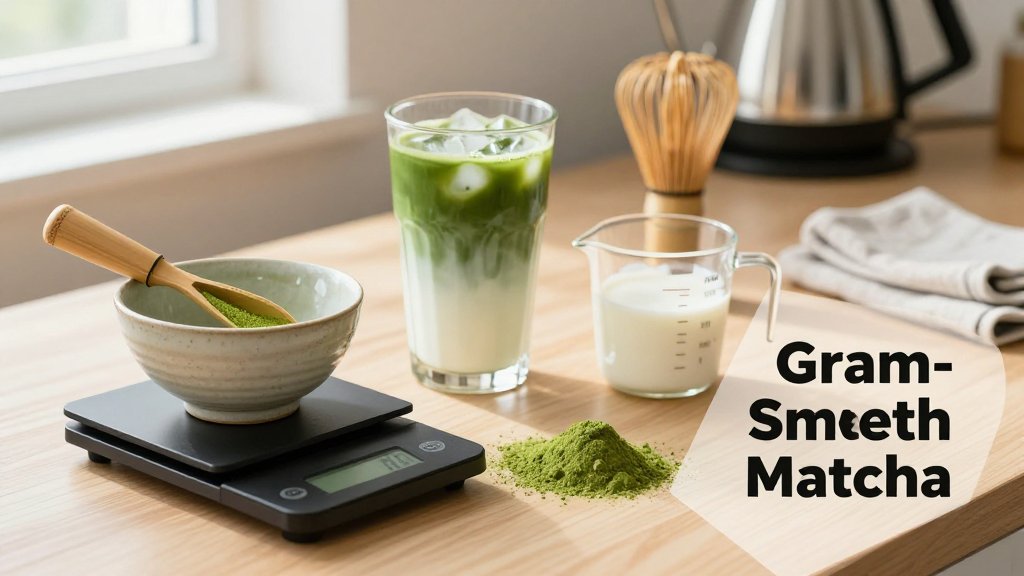
If your matcha latte sometimes tastes silky and sweet, then suddenly turns sharp and bitter, you are not imagining it. A tiny difference in how tightly you pack a spoon can change the dose more than the brand does, which makes repeatable results feel impossible. This guide switches you from spoon scoops to grams-first brewing, with simple ranges for usucha and koicha, plus tips for water ratios and whisking so you can dial in flavor on purpose. No guesswork, just consistency.
How many grams of matcha per serving
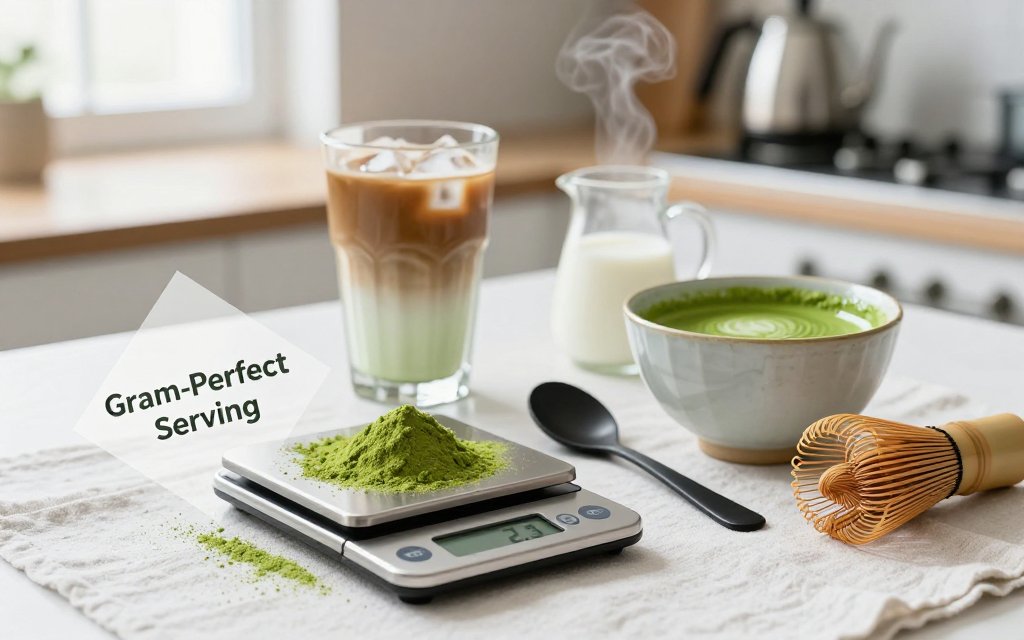
If you want one quotable baseline that keeps most homemade drinks smooth, start here: use 2.0 to 2.5 g of matcha per serving for a latte-style drink. That is enough to taste “matcha” (not just sweet milk) without crossing into sharp bitterness. Most bitter lattes are not doomed by “bad matcha.” They are usually a dosing problem (too much powder for the drink size) or a technique problem (clumps plus not enough whisking, so you taste gritty, concentrated pockets). If you measure by teaspoons, the same scoop can swing wildly based on how packed, humid, and clumpy your powder is, which is why grams are the easiest way to make your latte taste the same every time.
Usucha and koicha matcha grams range
Traditional matcha has two common strength styles, and the gram range matters. A practical usucha (thin matcha) range is about 1.5 to 2.5 g per serving, while koicha (thick matcha) often lands at about 3 to 4 g per serving. One clear reference point is the Ippodo matcha brewing ratios, which list 2 g for usucha, 4 g for koicha, and even call out 3 g as a latte serving size, alongside an 80°C (176°F) water target. Latte servings typically stay closer to usucha dosing because milk can amplify bitterness when you overshoot, especially if you also use hot water that is too close to boiling.
Use your cup size to choose the right gram target. For a 12 oz iced matcha latte, a good starting point is 2.5 to 3.0 g matcha whisked with about 60 mL (2 fl oz) warm water, then poured over ice and topped with milk. The extra volume and cold dilution can handle a slightly higher dose. For a 6 to 8 oz hot latte, start lower at 2.0 to 2.5 g, whisk into 60 mL water, then add steamed milk. If you are converting between ounces by weight (powder, sugar) and fluid ounces (water, milk), keep that distinction straight so your ratios do not drift, and use ounces vs fluid ounces conversions as a quick reference.
Start with 2 g matcha for most lattes. Sift, whisk 15 seconds with 60 mL of 80°C water, then add milk. If it is bitter, reduce by 0.5 g before blaming the matcha.
The most common reason matcha lattes turn bitter
The counterintuitive truth is that bitterness is often a measurement issue, not a quality issue. Matcha is ultra-fine, so it packs easily. A “1 teaspoon” can be 1.5 g when fluffed, or 3 g when packed down, and that single mistake can turn a balanced latte into a harsh one. Humidity makes it worse because damp powder clumps, and clumps behave like little flavor bombs that do not fully hydrate unless you whisk long enough. Even if your total grams are correct, skipping sifting can leave pockets of dry powder that hit your tongue as bitter grit. Treat matcha like cocoa powder in baking: weigh it, break up clumps, and fully disperse it before you judge the flavor.
If you do not have a physical scale handy, you can still be consistent by creating a repeatable “known scoop” and checking it occasionally. One practical routine is to weigh once at home (for example, confirm that your preferred scoop holds 2.3 g when leveled), then stick with that scoop for weekday lattes. If you need a quick estimate in a pinch, an app like Scale for Grams can help you sanity-check amounts from a photo so you are not accidentally doubling your dose. The goal is not laboratory precision, it is preventing the common leap from 2.3 g to 3.5 g that makes a small hot latte taste aggressively bitter.
Once you lock in grams, adjust like a recipe tester. Change only one variable at a time, and move in small steps. If your 8 oz hot latte tastes thin, go from 2.0 g to 2.5 g, not straight to 4 g. If it tastes bitter, first lower the dose by 0.5 g, then check technique: sift, use water around 80°C, and whisk until the mix looks glossy with fine foam, not grainy. This approach also saves money. At 2.5 g per drink, a 30 g tin gives about 12 servings, while a habit of 4 g per drink drops you to about 7 servings, plus the flavor is usually harsher in milk.
Matcha grams per teaspoon and scoop size
If you are searching “matcha grams per teaspoon” or “matcha scoop size in grams,” you are not alone, and you are not doing anything wrong by using kitchen spoons. The tricky part is that a teaspoon is a volume tool, not a weight tool. Matcha is fluffy, ultra-fine, and it clumps with humidity, so the same spoon can land you very different gram amounts depending on how you scoop, whether you sift, and how tightly the powder settles in the tin. That is why one recipe writer’s “1 teaspoon matcha” can taste smooth, and another’s turns bitter. Use the spoon estimates below as a practical starting point, then lock in your personal grams-per-spoon with one quick calibration the next time you are near any scale.
Teaspoon to grams estimates you can actually use
A level teaspoon of matcha is commonly about 1.5 to 2.5 g. If you are using a 1/2 teaspoon, a realistic range is about 0.8 to 1.3 g. That spread is normal across brands because matcha can be milled and sifted differently, and some tins are more prone to clumping than others. As a real-world serving guide with kitchen spoons, 1/2 teaspoon (about 1 g) is a lighter cup, good for a first try or for an afternoon drink. A full level teaspoon (about 2 g) is a solid everyday latte base for about 8 to 12 oz of milk, especially if you also add sweetener.
A heaping teaspoon typically jumps to about 2.5 to 4 g, and that is exactly where bitterness can sneak in if you were expecting “1 teaspoon” to mean the gentler 2 g range. The reason heaping varies so much is that “heap” is not a standard shape. A rounded mound can be twice as heavy as a modest bump, and your scoop method changes density too. Dip-and-pack (pushing the spoon into the powder) weighs more than spoon-and-level (sprinkling into the spoon, then leveling). If you are chasing consistency, stop switching between level and heaping. Pick one method, always do it the same way, and your taste will tighten up fast.
If you use a bamboo chashaku scoop, it is smaller than a teaspoon and it is usually used in multiples. Many matcha guides describe one scoop as roughly 1 g of matcha (often phrased as about one-third of a teaspoon), so a common “2 scoops” bowl lands near 2 g. For a stronger drink, people often go to 3 scoops (about 3 g), which can be great in a latte where milk and sugar soften the edges. If you want a quick visual benchmark, this chashaku scoop reference explains the typical scoop-to-teaspoon relationship and why the scoop is designed for small, repeatable portions.
One-time calibration trick for your favorite spoon
The fastest way to stop guessing is a one-time calibration for the exact spoon you actually use. Next time you have access to any physical scale (a friend’s kitchen scale, a shipping scale at work, even a small coffee scale), do this: (1) pick your method, for example level 1/2 teaspoon, (2) scoop 5 times into a small cup or bowl, (3) weigh the total grams, then (4) divide by 5 to get grams per scoop. Example: if 5 level teaspoons weigh 10.5 g, then your spoon is 2.1 g per level teaspoon. Write “1 tsp = 2.1 g” on painter’s tape and stick it to your matcha tin. Now your “teaspoon” is finally meaningful.
This same logic is exactly what small business owners do when they pre-tare packaging for shipping. You remove repeated guesswork so every parcel is consistent, and you do not keep re-checking the empty box weight. With matcha, you are essentially pre-taring your caffeine dosing and flavor intensity. It also helps you diagnose bitterness: if your favorite latte tastes harsh and you discover your “1 heaping teaspoon” is really 3.6 g, you can step back to 2.0 to 2.5 g and keep everything else the same. If you are away from a scale, a photo-based estimator like Scale for Grams can give you a quick ballpark, but the best consistency still comes from that one labeled spoon once you have calibrated it.
Weigh matcha without a scale using photos
No scale nearby still happens all the time: you are traveling with only a carry-on, you are making a latte in an office kitchen, you are working a pop-up booth, or you just do not want another gadget living on the counter. A photo-based estimate is not lab-perfect, but it can be repeatable enough to keep your matcha consistent from drink to drink. The trick is to stop thinking “I need the exact weight” and start thinking “I need the same setup every time.” If your daily goal is 2.0 g in a 10 to 12 oz latte, getting 1.9 g today and 2.1 g tomorrow is close enough to prevent that sudden jump to bitter, chalky, over-caffeinated.
Photo setup for estimating matcha powder weight
Consistency comes from the same cup, same lighting, and same reference object. Pick one small dish and stick to it, for example a sauce dish, a tiny ramekin, or the same matcha sifter catch cup every time. Use a plain background (white napkin, matte cutting board) and aim for bright, indirect light to cut shadows. Place your matcha in the center, then add a common reference object next to the dish. In the US, a nickel is 5.00 g and a quarter is 5.67 g, so either works well as a stable reference. Finally, shoot from directly overhead, not at an angle, and keep the phone the same distance each time (about 12 in or 30 cm is easy to repeat).
If your estimate swings a lot, do not change the recipe first. Fix the photo: brighter light, fewer shadows, same overhead angle, and the same reference coin in the same position. Repeatability beats perfection for daily lattes.
Powders are tricky because clumps change the shape, which changes what the camera sees. If your matcha has little “pebbles” from humidity, two scoops can look like a bigger pile than it really is. Before you snap the photo, break up clumps with the back of a spoon, or sift, then gently smooth the top so the surface is closer to flat than mountainous. That one habit improves repeatability a lot. Once you have the photo, a phone scale app like Scale for Grams can estimate grams from the image using computer vision, which helps you hit the same dose. That matters for caffeine consistency too, because 1 g versus 3 g is not a small change, it can be the difference between a calm latte and jitters.
Matcha caffeine per gram: how much caffeine am I getting
Matcha caffeine varies by harvest and grade, but a practical working range is about 19 to 44 mg of caffeine per gram, as summarized in matcha caffeine ranges. That means 2 g often lands around 40 to 90 mg, and 4 g can land around 75 to 175 mg. If you are caffeine-sensitive, start at 1.0 g in your latte for about 20 to 45 mg, then move up in 0.5 g steps. If you track intake for training, log matcha by grams the same way you log protein, because “one scoop” can quietly drift day to day.
How do I fix a bitter matcha latte without wasting it
Bitterness usually comes from too much powder, too-hot water, or under-whisking that leaves dry pockets. First, dilute: add 2 to 4 oz more milk (or water) and a small pinch of salt, which can soften bitterness without making it salty. Second, sweeten strategically: 1 to 2 teaspoons of simple syrup mixes faster than granulated sugar in cold drinks. Third, fix texture: whisk 1 to 2 tablespoons of warm water into the cup until smooth, then add the rest of your liquid. For next time, lower the dose by 0.5 g, and keep your whisking water warm, not boiling (think hot tap water range).
What is the best matcha dose for iced lattes versus hot lattes
Iced lattes usually want a slightly higher matcha dose because cold dulls aroma and sweetness. A solid starting point is 2.0 to 2.5 g matcha for an iced 12 to 16 oz latte, especially if you use a lot of ice. Hot lattes can taste stronger at the same grams, so 1.5 to 2.0 g is often enough for 10 to 12 oz. If you want a coffee-like “punch,” push to 3.0 g, but expect more bitterness and a bigger caffeine swing. The best workflow is to lock your grams first, then adjust sweetness and milk type, not the other way around.
Need to weigh something fast when your scale is not nearby? Download Scale for Grams and get an AI-powered weight estimate from a photo in seconds, so you can keep your matcha dose consistent anywhere. Try it now on iOS, then use the estimate to hit your preferred grams range for smoother, less bitter lattes.
Scale for Grams
Need to Weigh Something?
Download Scale for Grams and get an AI weight estimate from a photo in seconds.