Forgot to Tare? Estimate Container Weight Fast
No tare button, no problem. Learn what tare weight means, get quick empty-weight estimates for common kitchen and shipping containers, and use photo-based weight estimation plus a few sanity checks to reliably calculate net weight in grams.
Forgot to hit tare before you started weighing? That small slip can throw off recipes, supplements, shipping labels, and lab notes. The good news is you can still get a reliable net weight by estimating the container weight and subtracting it with a simple, repeatable workflow. In this guide, you will learn quick ways to approximate common container weights, how to use photo-based estimation when you are in a hurry, and how to document your method so your results stay consistent.
Kitchen scale tare meaning, and why it matters

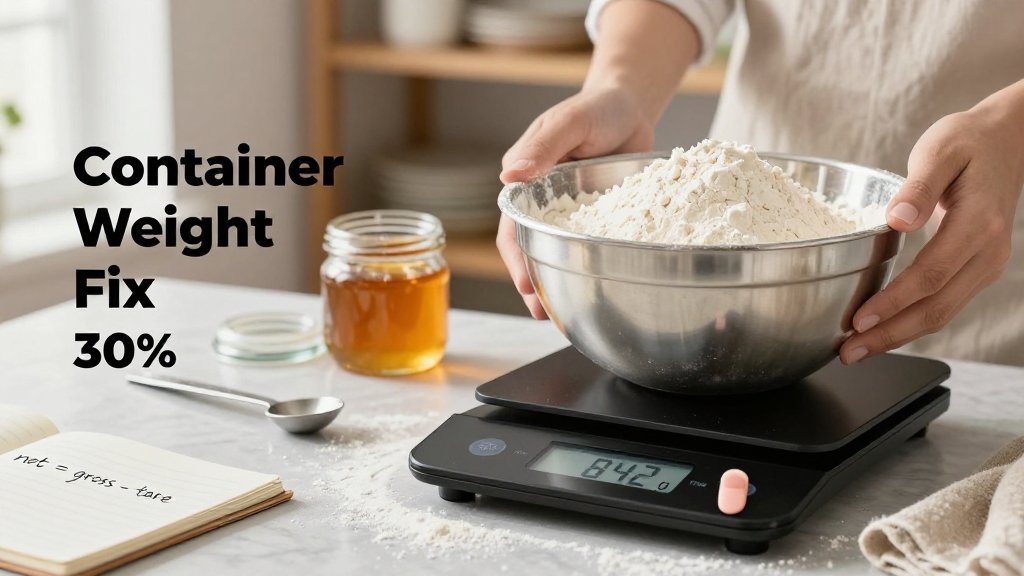
"Tare" means you ignore the container so you can measure only what you actually care about. If your bowl plus flour reads 842 g, the recipe does not want 842 g of flour, it wants flour only. Same idea with sticky ingredients: if you squeeze honey into a jar and the display shows a big number, part of that number is glass and lid, not honey. Taring is the shortcut that makes baking by weight fast and repeatable, because you can pour, check the number, and stop right on target without doing mental math mid-pour. It also keeps meal-prep portions consistent, and it prevents shipping labels from being based on guesswork instead of the actual packed weight.
The easiest way to think about it is this: every weigh-in has a "gross" weight (container plus contents) and a "net" weight (contents only). Tare is the missing piece that lets you get from gross to net in one tap. If you forgot to hit tare and you are already halfway through a recipe, you can still recover quickly by estimating the container weight, then subtracting it once, carefully. For non-kitchen jobs, the same logic helps with mailers, boxes, and padded envelopes. If you often need a quick backup estimate, photo-based tools can help you sanity-check your math, especially for travel and shipping, like estimate gear weight from photos.
Tare weight in one sentence, plus the only formula you need
"Tare weight is the empty container weight you subtract from the total to get the net contents." In other words, you are stripping away the bowl, jar, tray, or mailer so the number matches what you are measuring. The only formula you need is: net weight = gross weight - tare weight. This is also how the terms are used in commercial weighing standards, including NIST Handbook 44, which is one reason you see the same language in shipping and logistics. Once you have net weight, you can compare it to a recipe, a serving size, or a packing slip without accidentally counting the container twice.
Here is the mixing bowl example with real numbers. Your scale says the bowl plus flour is 842 g (gross). You remember that same stainless mixing bowl usually weighs about 420 g empty (tare). Flour net weight is 842 g minus 420 g, which is about 422 g of flour. That difference is not small: 422 g is close to 3 1/3 cups of flour depending on how it is scooped, so miscounting the bowl can quietly wreck hydration and texture. Grams are your best friend here. A 10 g error is only about 0.35 oz, but in baking that can mean a noticeably tighter dough, a drier cake, or cookies that spread differently.
The honey-in-a-jar situation is where tare saves your sanity. Say an empty jar with its lid is about 250 g. You add honey and the scale reads 690 g total. Net honey is 690 g minus 250 g, so about 440 g of honey. If you forget the lid, you might undercount by 20 g to 40 g (many metal lids live in that range), which is the difference between “one tablespoon” and “almost two” when you are portioning something sticky. A practical habit is to build a tiny “container cheat sheet” in your notes app: favorite bowl (420 g), glass meal-prep container with lid (610 g), small ramekin (95 g). Then you can subtract fast when you forget to tare.
Common tare mistakes that quietly ruin recipes and shipments
The sneakiest tare problems are the ones that feel “close enough” in the moment. A classic baking mistake is taring with one bowl, then switching to a different bowl because the first one got dirty, and continuing to pour as if nothing changed. Another is taring without the lid, then snapping the lid on and wondering why your portion looks heavy. Meal-prep containers can vary a lot: a thick glass container might be 500 g to 800 g empty, while a thin plastic deli tub might be 20 g to 40 g. Also watch your surface. If your scale sits on a soft cutting mat, a folded towel, or an uneven counter seam, the reading can drift or jump, which makes any tare estimate feel inconsistent.
Shipping adds two more gotchas: unit confusion and tiny weight cutoffs. If you accidentally read ounces but enter grams, you can be off by almost 28x. Even when units are correct, being off by 30 g (about 1.1 oz) can push a padded mailer into the next pricing bracket on many platforms, because postage tiers often step at whole-ounce boundaries. Example: a product plus a padded mailer might be 226 g, which is about 8.0 oz. Add a hangtag, extra tissue, or a sturdier mailer and you might hit 256 g, which is about 9.0 oz. If you forgot to tare the mailer and you guess wrong by 30 g, you can accidentally choose the wrong tier, which leads to adjustments, delays, or thinner margins.
If you forgot to tare, do not guess. Weigh the empty container after you pour it out, or look up your saved container weights. Subtract once, then label the result so you do not double subtract later.
Fast tare weight estimates for common containers
If you forgot to tare, you do not have to start over. A fast container-weight estimate (tare) gets you close enough to finish the job, then you sanity-check the result. This is especially handy when you already filled the bowl with cookie dough, packed a padded mailer, or poured a smoothie into a Mason jar and you cannot easily dump it back out. The trick is to think in ranges, pick a reasonable number fast, and then adjust for obvious factors like thick glass, double-wall insulation, or a heavy lid. You are aiming for “close fast,” not lab precision, so you can keep baking, shipping, or portion tracking moving.
Quick tare ranges in grams you can trust
Use these ranges like a quick reference card: pick the middle of the range when you are unsure, then nudge up or down based on thickness and lid. Example: if your total (food plus bowl) is 1,240 g and you think the bowl is a typical ceramic cereal bowl, subtract about 500 g first. That gives 740 g of food, then you do a quick “does that look right?” check. If it is a small portion that would never be 740 g, you probably grabbed the wrong end of the range, or you forgot the lid weight, which is one of the most common misses with deli containers, squeeze bottles, and Mason jars.
quick tare ranges:
A few quick cues that help you pick the right end of each range: handles and spouts add real mass on glass measuring cups, so a chunky handled 2 cup cup usually lands closer to 400 g than 300 g. For Mason jars, the base thickness matters a lot, and jars with thicker bottoms tend to jump 30 g to 80 g within the same size. Also, separate the jar from the hardware in your head. A pint jar at about 230 g plus a lid and ring at about 30 g puts you around 260 g total tare, which matches what many people see on a kitchen scale. Do not forget that disposable paper bowls are extremely light at roughly 10-20 g, so they barely change a bowl-of-soup number.
For shipping and small business packing, it helps to estimate the “container stack,” not just the box. A medium shipping box commonly lands in the 150-350 g range before you add tape, labels, and filler. Packing materials add up in sneaky ways: a single 30 x 30 cm sheet of bubble wrap is often only a few grams (about 3-8 g), but ten sheets becomes 30-80 g. If you are mailing jewelry, a padded mailer (say 25 g) plus a small jewelry box insert (another 15 g) can easily be 40 g before the item itself. Build your tare estimate the same way you packed the order, layer by layer.
How to adjust your estimate in 10 seconds
Do a quick feel test, then correct for the construction. As a general rule, glass is usually the heaviest for its size, then ceramic, then metal, then plastic, then paper. That order is basically a material-density shortcut, and you can see why it works by scanning typical material densities. Next, check for lids and double walls. A snap-on deli lid can add 5 g to 10 g, a Mason lid and ring can add 25 g to 40 g, and an insulated stainless bowl or tumbler can weigh far more than a thin single-wall one even if it looks similar in a photo.
Use two fast adjustment rules and you are usually within a few percent. Rule 1: add 10-15% if the container has a thick base, a heavy foot ring, or a double wall. Example: you picked 300 g for a medium stainless mixing bowl, but it is double-wall. Add 15% (45 g) and use 345 g. Rule 2: subtract 10-20% if it is thin disposable plastic. Example: you picked 30 g for a 16 oz deli container with lid, but it is the super thin takeout style. Subtract 20% (6 g) and use 24 g. These two tweaks fix most “oops, forgot tare” mistakes without overthinking it.
The counterintuitive tip that saves the most time is this: a smaller glass jar can weigh more than a larger plastic tub, because material density beats volume. A pint Mason jar at 230 g can easily outweigh a big plastic mixing tub that is only 80 g. So if your numbers look weird, do not assume the bigger container is heavier. Instead, sanity-check by imagining two swaps: “What if this was plastic instead of glass?” or “What if this was disposable instead of reusable?” If you want an even faster second opinion, snapping a photo and using an AI scale app like Scale for Grams can help you cross-check your estimate before you commit to a recipe ratio, a nutrition log, or a shipping label weight.
A repeatable workflow to get net weight
You can still get a reliable net weight even if you forgot to tare, as long as you combine three things: (1) a photo estimate for the total (gross) weight, (2) a reasonable tare estimate for the container, and (3) a sanity check using density or typical serving weights. This works surprisingly well for home baking, meal prep, and even quick shipping decisions because you are not guessing blindly, you are triangulating. The key is to treat the result like an estimate with a confidence level. If your estimate needs to be tight (for example, a shipping tier cutoff), you do one extra photo and one extra check.
If your gross estimate says 480 g and your jar tare guess is 260 g, your net is 220 g. The sanity check is what turns that math into confidence, or tells you to re-estimate.
The 3-step method: photo estimate, subtract tare, sanity-check
Concrete scenario: overnight oats in a pint Mason jar. Step 1 is to estimate the gross weight (jar plus food) from a photo using Scale for Grams. Put the jar on a plain surface, get the full jar in frame, and take the photo from slightly above, not from the side. Let’s say the app returns about 480 g total. That number is your starting point. Do not overthink it yet. Gross weight is the easiest part because the jar is a single object, the contents are contained, and you are not trying to separate ingredients at this stage.
Step 2 is to subtract tare (jar plus lid). If you do not know your exact jar, use a range. A typical pint jar is often about 200 to 260 g without the lid, and the lid plus ring often adds about 25 to 40 g, so a practical tare guess is 240 to 300 g for the full setup. If you guess 260 g, net contents are 480 minus 260, which is 220 g. Step 3 is the sanity check: 1/2 cup dry oats is commonly labeled as 40 g on nutrition panels like this Quaker oats serving size, and 3/4 cup milk is about 180 g, so you expect about 220 g before add-ins. In baking, aim to land within about 5 to 10 g. In shipping, be conservative and round up your final package weight.
When to re-photo, re-estimate, or start over
Some items are harder for any photo based estimate, and they are also the same items that make tare mistakes more painful. Foamy foods (whipped cream, cappuccino foam, sourdough starter mid-rise) change shape and hide volume cues, so take a second photo after bubbles settle. Irregular piles (trail mix heaped above the rim) can trick your eye and the camera, so level it or pour into a straighter container. Reflective jewelry is another edge case, since glare can erase edges; switch to a matte background (paper towel works) and diffused light. Crumpled mailers and wrinkled poly bags hide their real footprint, so smooth them flat before photographing. Very small quantities (like 2 g of yeast or a 1.5 g gemstone) are where you should start over with a more controlled setup or use a real scale if it is available.
Use a few triggers to decide if you need another pass. If the container could be more than half of the total weight, tare accuracy matters more than your photo estimate, so err toward a tighter tare, or switch to a lighter container next time. If you are within about 20 g of a shipping threshold (for example, right on the edge of a carrier tier), do another Scale for Grams estimate from a second angle and use the higher of the two totals. Also watch for “new container surprises”, like a thick ceramic bowl or a double wall tumbler, because the tare can be hundreds of grams. One practical habit that saves time is keeping a “favorite container notes” list on your phone: write down “my pint jar tare 275 g with lid” or “my bubble mailer 18 g” once, then reuse it for months.
Can I do tare weight without a scale?
Yes. You can estimate tare from typical ranges, then subtract it, especially when you combine it with a gross weight estimate from a photo based tool. It gets harder when containers are heavy (thick glass, ceramic, cast iron), when you use lids and rings, or when shipping weight is borderline. A good rule of thumb is this: if your tare guess could be off by more than about 15% of the net contents, re-check with a second photo from a different angle, or switch to a container with a more predictable weight. For example, guessing a jar is 250 g when it is really 300 g is a big deal if you only have 200 g of food inside.
What is a Mason jar empty weight in grams?
A practical range is more useful than one magic number. Pint jars often land around 200 to 260 g without the lid, and quart jars often land around 380 to 520 g without the lid. The flat lid plus metal ring commonly adds about 25 to 40 g. Charts vary because brand matters, and so does glass thickness, wide-mouth versus regular-mouth, and decorative embossing. The best practice is personal: once you have a jar you reuse, save its tare estimate in your notes as “my jar tare”, including whether that number includes the lid and ring. Then your net weight math becomes a fast, repeatable routine instead of a one time guess.
How do I handle package tare weight for shipping?
Treat shipping tare as everything that ships, not just the empty box. That includes the mailer or carton, tape, label, tissue, bubble wrap, inserts, and a packing slip. A conservative workflow is: estimate the packaging first, then estimate the packed box, then round up so you do not underpay postage. A common mistake is estimating only the product, then forgetting the packing slip and the extra tape on the seams. Quick reality check numbers help: a label plus a few strips of tape can easily add 5 to 20 g, and bubble wrap can add more than you think if you wrap an item twice. If your result is close to a carrier tier cutoff, do a second photo estimate from another angle and use the higher total.
Need to weigh something fast right now? Download Scale for Grams to get an AI-powered weight estimate from a photo in seconds. It is a practical backup when the tare step is missed, or when you do not have the right scale nearby. Grab the app for iOS, take a clear photo, and get a quick estimate you can use immediately.
Scale for Grams
Need to Weigh Something?
Download Scale for Grams and get an AI weight estimate from a photo in seconds.