How Heavy Is Sterling Sheet? Gauge to Grams
Need to quote a jewelry job or price a shipment without a scale? Use sterling silver density plus sheet thickness (gauge) and your cut dimensions to estimate weight in grams or ounces, fast and reliably.
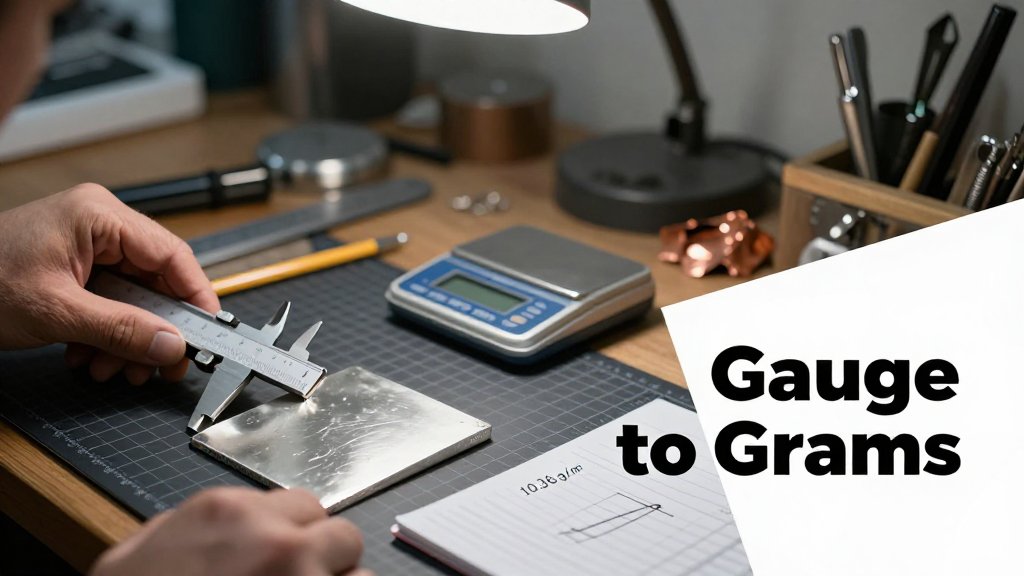
Sterling sheet can feel light in your hand, then surprise you once you stack blanks, build a bezel, or calculate shipping. Getting the weight right matters for pricing, quotes, and ordering enough material without waste. In this guide, you will learn a simple formula to estimate sterling silver sheet weight from gauge or thickness and your exact dimensions, then convert the result to grams or ounces. You will also see common mistakes that skew estimates and an easy sanity check using a photo-based scale app.
Sterling sheet weight basics, density and quick formula
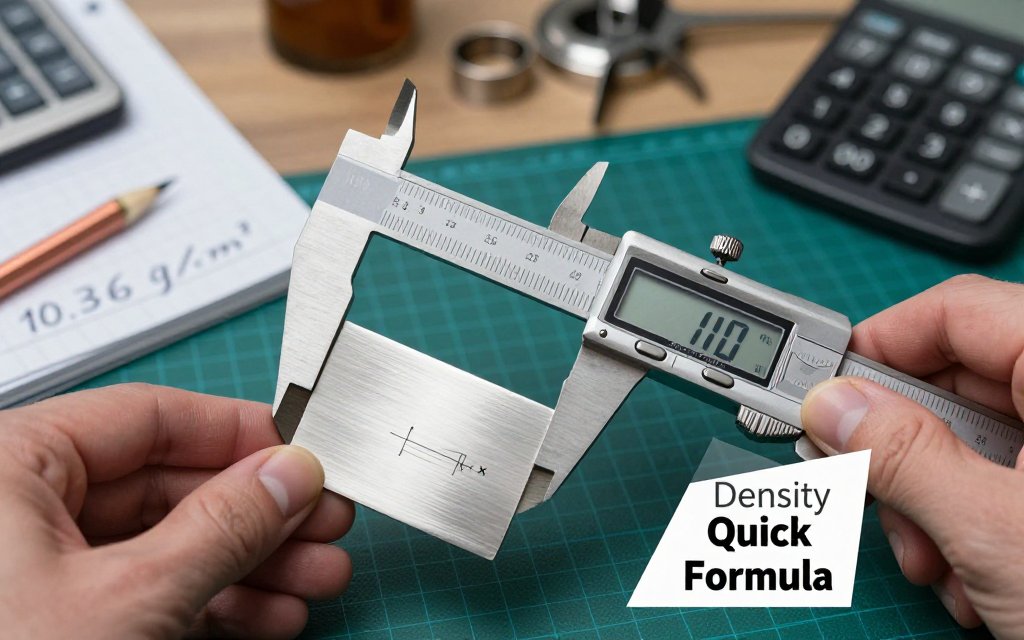
If you remember only one thing about sterling sheet, remember this: weight comes from volume, and volume comes from area times thickness. Sterling silver is usually 92.5% silver and 7.5% copper, and that alloy has a density of about 10.36 g/cm3. You do not need a lab to use that number, you just need consistent units. “Gauge” is where people get tripped up. Gauge is a numbering system that points to a thickness, but the exact thickness can change depending on which gauge standard your supplier is using. For weight estimates, treat gauge as a label and treat thickness (in mm or inches) as the real input.
A visual way to avoid mistakes is the “stack of paper” picture: imagine your sheet is a flat rectangle on the table, then you stack identical rectangles upward until you reach the sheet’s thickness. That stacked height is the thickness, and the tabletop footprint is the area. Multiply footprint by height, and you get volume. Multiply volume by density, and you get grams. If you have ever estimated fabric weight from surface area, the thinking is similar, which is why people who understand fabric GSM estimation without tools usually pick up metal sheet math quickly too. The key is to write down the units next to every number before you multiply anything.
The one formula that usually gets you within a few percent
Here is the fast plug-in method. Sterling silver density is about 10.36 g/cm3 (you will see small variations by exact alloy and temper, but this number is a solid shop default), and you can sanity check it against sterling alloy density data. Metric formula: grams = area(cm2) x thickness(cm) x 10.36. Inch-based formula: grams = area(in2) x thickness(in) x 16.387 x 10.36. That 16.387 is the conversion from cubic inches to cubic centimeters, because 1 in3 = 16.387 cm3. Pick one formula, keep units consistent, and your estimate will usually land within a few percent of a real scale.
Worked example (a realistic jewelry blank): a 1.0 in x 2.0 in rectangle, 0.8 mm thick. First compute area: 1.0 x 2.0 = 2.0 in2. Convert thickness: 0.8 mm = 0.08 cm (because 10 mm = 1 cm). Convert area to cm2: 2.0 in2 x 6.4516 = 12.9032 cm2. Now volume: 12.9032 cm2 x 0.08 cm = 1.0323 cm3. Now grams: 1.0323 x 10.36 = about 10.69 g. In practice you can call that 10.7 g for planning, then add a little if you expect extra material for tabs, bezels, or a thicker rolled edge.
Measure the top area, multiply by thickness, then multiply by 10.36. That gives grams for sterling sheet. Convert everything to centimeters first, and remember to subtract any pierced holes or big cutouts.
Once you have the grams for one piece, scaling up is straightforward. Making ten identical tags for a bracelet set? Multiply your single-piece estimate by 10, then decide how much cushion you want for filing and sanding. Shipping small business owners can do the same with packaging components: if you are adding a sterling logo plate to a box, you can estimate the added grams and see whether it bumps you into a higher postage tier. Jewelers should also remember that “sheet” is not perfectly uniform. Rolled stock can vary slightly across the width, and a hammer-textured finish effectively adds surface area without adding much volume, so the math stays valid. A practical cushion for real parts is often 2% to 5% above the calculated grams.
Common mistakes that make your estimate wildly wrong
The biggest “wildly wrong” estimates usually come from one of four issues. First is confusing gauge with thickness, because different gauge charts exist and the same gauge number can map to different actual thicknesses depending on the standard and metal category. Second is mixing millimeters and inches mid-calculation, like using area in in2 but thickness in mm, which silently ruins the volume. Third is forgetting cutouts on pierced designs. A pendant blank with a large center window might be missing 30% of its area, and your estimate should drop by roughly that same percentage. Fourth is using the density of fine silver (about 10.49 g/cm3) when you actually have sterling. That difference sounds small, but on larger sheets it adds up.
If you are unsure which unit you are holding, the safest move is to convert everything to centimeters first, because the density is in g/cm3. Keep these quick conversions on a sticky note: 1 mm = 0.1 cm, 1 in = 2.54 cm, and 1 in2 = 6.4516 cm2. For cutouts, a simple trick is to sketch a grid on paper, count the squares that are “missing,” and reduce your area before you multiply by thickness. You do not need perfect math for most home projects or shipping estimates, you just need to avoid the big unit mistakes. Once your inputs are clean, the density formula becomes a reliable quick check that you can do in a minute.
Gauge to thickness, then thickness to grams
Why silver sheet gauge charts disagree
Gauge is a convenient shopping label, but it is not one single universal thickness number. That is why two charts can both look official and still disagree. The biggest reason is that “20 gauge” depends on the gauge standard and the metal category being referenced (steel charts, aluminum charts, and non-ferrous jewelry charts do not always match). For jewelry makers, that mismatch turns into real money fast because weight is directly tied to thickness. If you accidentally grab a steel-based thickness for sterling, your grams estimate can be off by roughly 10 percent or more, and that error multiplies across a batch of blanks.
The fastest way to stay accurate is to treat gauge as a product locator, then switch to the actual thickness the supplier lists in inches or millimeters. Most reputable jewelry suppliers give a gauge and a measured thickness side by side, and that thickness is the number you should plug into your grams formula. For example, one supplier selling sterling sheet from 16 to 21 gauge publishes a gauge table that includes both mm and inches, along with piece weights for specific cut sizes, see their sterling sheet gauge table. That style of listing is gold for quoting because you can copy the thickness value without debating which chart is “right.”
In practice, you will see thickness written like 0.8 mm, 0.64 mm, 0.032 in, or 0.025 in. Pick one unit system and stick with it all the way through your math. If your density is in g per cm3 (sterling is commonly approximated around 10.36 g per cm3), convert thickness to centimeters and area to cm2 before you multiply. If you are ordering often, it is worth keeping a cheap digital caliper at the bench and measuring a corner of the sheet when it arrives. Even a small vendor variation of 0.05 mm can move your weight estimate enough to matter for pricing per gram, especially on wide tags and cuff blanks.
A quick quoting workflow for jewelers and small shippers
Picture a realistic job: you need to quote 12 round blanks for stamped logo discs, and you also want a shipping estimate before you cut metal. Start by opening the exact supplier listing for the sheet you plan to buy and writing down the thickness in mm or inches (not just the gauge). Next, calculate the area of one blank using the finished dimensions, for a 1 inch circle the area is about 0.785 in2. Multiply area by thickness to get volume, then multiply by sterling’s density to get grams for one piece. Multiply by quantity for total finished grams, then adjust for scrap based on what you are quoting: add a scrap allowance if you are quoting raw material needed, but ignore scrap if you are quoting finished goods weight for postage.
Here is the same job with actual numbers. Say the supplier lists “20 gauge” as 0.81 mm thick (0.081 cm). A 1 inch diameter blank has area 0.785 in2, which is about 5.06 cm2. Volume for one blank is 5.06 cm2 times 0.081 cm, about 0.410 cm3. Multiply by 10.36 g per cm3 and you get about 4.25 g per blank. For 12 blanks, that is about 51.0 g of finished silver. If you are sawing from a larger rectangle and you expect 15 percent waste from kerf and layout, estimate material needed as 51.0 g divided by 0.85, about 60 g. For shipping labels, convert finished weight: 51.0 g is about 1.80 oz, then add packaging weight (a small bubble mailer can easily add 0.6 to 1.2 oz).
A mini sanity check saves more quotes than any fancy spreadsheet: if the result feels too heavy or too light, re-check thickness units first. The most common mistake is copying “0.032” and forgetting whether it was inches (about 0.81 mm) or millimeters (paper thin). A second quick check is to compare your calculated grams to something physical you already know, like the weight of a finished pendant you have sold before. If you do not have a bench scale handy, an app like Scale for Grams can give you a quick photo-based estimate to see if you are in the right ballpark before you commit to buying sheet for a big run. Once your estimate passes those checks, you can confidently convert to grams for cost per gram pricing, and to ounces for postage decisions.
Estimate sterling sheet weight without a scale
If you can estimate the size of a sterling sheet blank, you can usually get close enough on weight to plan a project, quote a job, or decide whether an order is worth it. The practical shortcut is: estimate volume first, then turn volume into grams. For a flat sheet, volume is length x width x thickness. Example: a rectangle that is 50 mm x 100 mm, cut from 0.50 mm sheet. Convert to centimeters to keep units tidy: 50 mm = 5 cm, 100 mm = 10 cm, 0.50 mm = 0.05 cm. Volume = 5 x 10 x 0.05 = 2.5 cm3. Multiply by sterling’s working density (about 10.36 g/cm3) and you land near 25.9 g. That is a solid estimate for planning and quoting.
This kind of estimate is especially useful when you price jobs by gram or you are trying to stay inside a metal budget. Say you are making 12 small bar pendants. Each blank is 30 mm x 8 mm, and you plan to use 0.80 mm sheet. In centimeters, that is 3 cm x 0.8 cm x 0.08 cm = 0.192 cm3 per blank. At 10.36 g/cm3, each blank is about 2.0 g, and 12 blanks are about 24 g of sterling before sawing losses. If your cost for sterling (after supplier premiums and shipping) averages $1.20 per gram, that is roughly $28.80 in metal cost. Add a realistic scrap and finishing loss allowance (often 5% to 10%) so your quote does not get squeezed by saw kerf, filing, sanding, and polishing.
Estimating also helps outside the jewelry bench. Small business shipping is full of moments where you only have a photo, a rough size, and a deadline. If your shipping label wants ounces, you can convert to grams and back to sanity-check your estimate. The everyday ounce used for shipping and kitchen weights is the avoirdupois ounce: 1 oz = 28.349523125 g (exact). Metals are often discussed in troy ounces instead, and 1 troy ounce = 31.1034768 g, which you can confirm in the NIST conversion table. Tip: if you write quotes or invoices, label ounces clearly (oz av vs ozt) so nobody “helpfully” converts the wrong ounce later.
How accurate do you need to be for pricing and ordering -
For early-stage quoting and ordering, being within 5% to 10% is usually good enough if you build in a little buffer for scrap, cleanup, and finishing loss. You still weigh for final pricing, especially if you charge customers by exact grams or you need tight inventory numbers. The surprise for most makers is how much tiny thickness differences matter as the piece gets larger. Using the same 50 mm x 100 mm example, 0.50 mm sheet estimated about 25.9 g, but 0.40 mm sheet comes out near 20.7 g. That is a 5.2 g swing, roughly 20%, caused by only 0.10 mm of thickness. On bigger cuffs, backplates, and wide pendants, thickness usually drives the cost more than people expect.
What is the density of sterling silver in g/cm3?
A reliable working value for 925 sterling silver is about 10.36 g/cm3. Pure silver is commonly listed around 10.49 g/cm3, and sterling runs a bit lower because it is an alloy (typically 92.5% silver with copper making up most of the rest). For estimating sheet weight, that difference matters, but it is usually smaller than your uncertainty about thickness and cutout waste. Practical tip: if you are estimating from a photo and you are not 100% sure on thickness, run your math twice (thin guess and thick guess) and quote a range, not a single “perfect” number.
How do I convert silver sheet weight from ounces to grams?
Multiply ounces by the correct grams-per-ounce factor for the kind of ounce you are using. For shipping, baking, and most everyday weighing, use avoirdupois ounces: grams = ounces x 28.349523125. Example: 6.4 oz x 28.349523125 = about 181.4 g. For precious metals, many suppliers and spot prices use troy ounces: grams = troy ounces x 31.1034768. Practical tip: if your supplier lists sheet as “oz” without saying which one, assume nothing and check, because mixing oz av and ozt creates about a 9.7% error.
How can I estimate metal weight without a physical scale?
Use a photo plus approximate dimensions to estimate volume, then multiply by density to get grams. The easiest setup is photographing the sheet next to a known reference (a ruler, a business card, or a coin) so you can scale the image. From there, measure length and width, choose a thickness (from gauge or a caliper reading from a similar sheet), and compute: grams = length(cm) x width(cm) x thickness(cm) x 10.36. Apps like Scale for Grams can help by turning a photo into a quick size-based estimate when you are away from the bench. Practical tip: shoot straight down, keep the sheet flat, and avoid wide-angle distortion that makes edges look larger than they are.
Need to weigh something fast without pulling out a scale or doing the math? Download Scale for Grams and get an AI-powered weight estimate from a photo in seconds. It is a quick way to sanity check your sterling sheet calculations before you price a job, place a materials order, or pack a shipment. Install it now on iOS and try a photo estimate on your next sheet, scrap pile, or finished piece.
Scale for Grams
Need to Weigh Something?
Download Scale for Grams and get an AI weight estimate from a photo in seconds.