What Is Fabric GSM, Estimate It Without Tools
GSM tells you how heavy a fabric is per square meter, and it matters for sewing, shipping, and product listings. Learn what common GSM ranges feel like, how to estimate fabric weight at home using reference items and simple math, and how to convert GSM to ounces per square yard when a pattern or marketplace requires it.
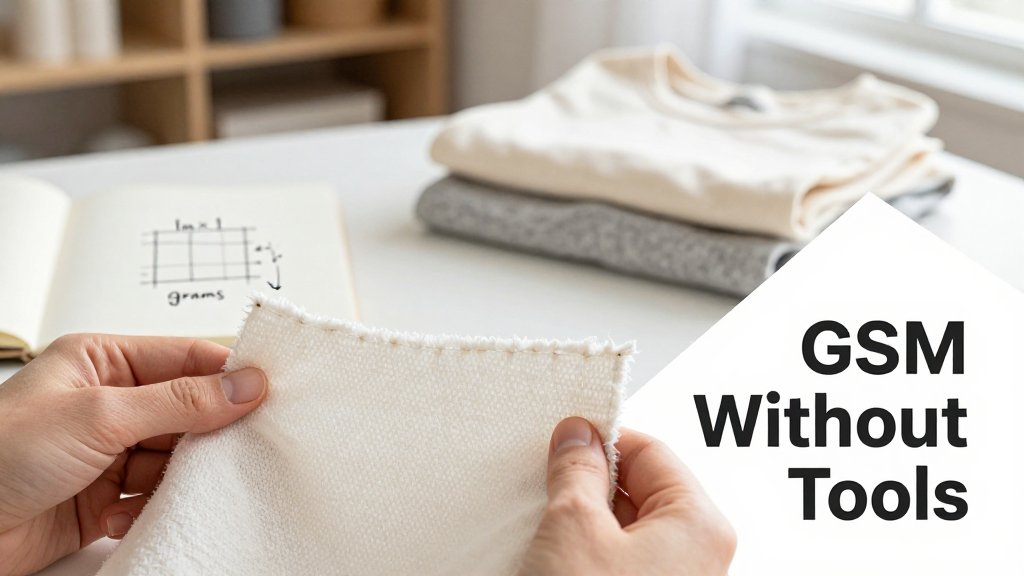
If you have ever bought fabric online and it arrived lighter, thinner, or less structured than you pictured, fabric weight is usually the reason. GSM, or grams per square meter, turns that surprise into a simple number you can compare across listings and swatches. In this guide, you will learn what fabric GSM means, what ranges look like for common textiles, and how to estimate GSM without a scale. You will also get quick conversions and a photo-based method for scraps.
Fabric GSM meaning and why it matters
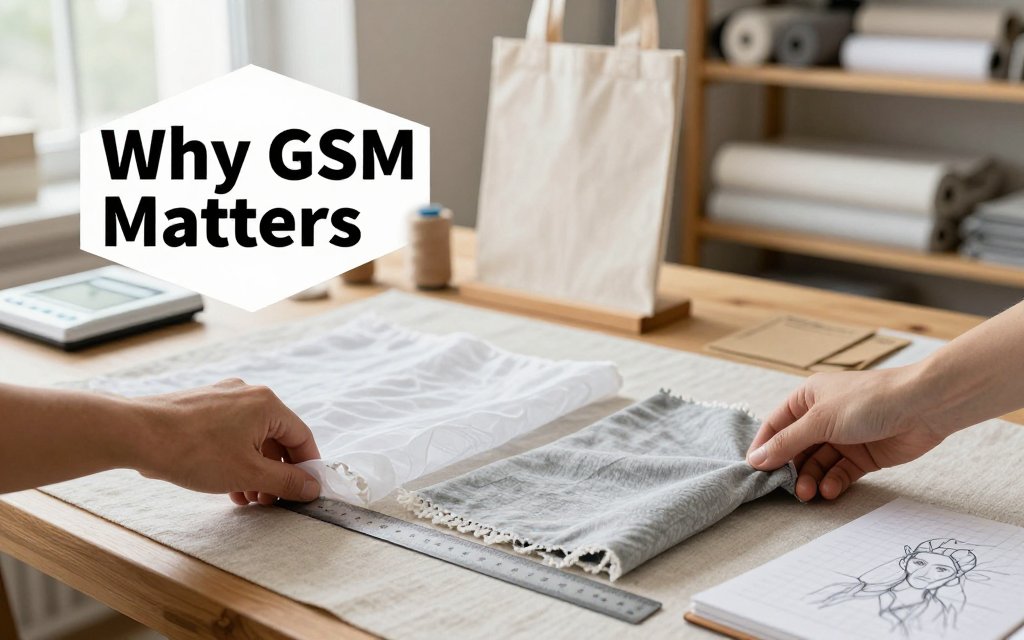
Fabric shopping gets confusing fast because two materials can both be labeled "cotton" and still behave nothing alike. One tee feels light and breezy, another tee feels hefty and holds its shape. One "cotton" tote bag slouches like a grocery sack, another stands up like a tool bag. GSM is the number that helps you predict those differences before you sew, buy, wash, or ship. It affects how a fabric drapes (flowy vs structured), how see-through it is, how durable it feels at stress points like elbows and knees, how warm it is for layering, and even how much it may shrink because heavier fabrics often hold more fiber and sometimes more finishing chemicals that relax in the first wash.
What GSM actually measures in textiles
GSM is grams per square meter, a measure of fabric mass per area. Think of it as, "If I had a piece of this fabric that was 1 meter by 1 meter, how many grams would it weigh?" That makes it a fair comparison even when you are holding a tiny swatch, because the number scales up to the same standard area. Sewing resources like the American Sewing Guild GSM overview describe GSM as a common way to talk about fabric weight or density across categories. A higher GSM usually means more coverage, more structure, and more shipping weight. If you sell products, that last part matters because a bulkier, heavier fabric can bump your package from, say, 8 oz to 12 oz once you add labels, mailers, and inserts. (asg.org)
GSM is not a direct thickness measurement, but it often correlates with thickness and warmth because more mass in the same area usually means more fiber and less airiness. The trick is that fiber type (cotton vs polyester vs rayon), yarn size, and weave or knit structure can change the feel a lot at the same GSM. Still, GSM gives you a reliable baseline: 120 GSM cotton voile is typically more translucent than a 180 GSM quilting cotton, and a 300 GSM sweatshirt fleece usually traps more heat than a 160 GSM tee knit. For a quick mental model, imagine stacking layers: two layers of 150 GSM fabric behave roughly like one layer of 300 GSM in weight, which can help when you plan linings or quilt backs. (en.wikipedia.org)
If you only remember one thing: GSM tells you how heavy a full square meter would be. Higher numbers usually mean more coverage, more body, and more shipping weight. Always compare GSM before buying fabric online.
Lightweight vs heavyweight fabric GSM ranges you can feel
Your hands can learn GSM ranges surprisingly quickly. Very light fabrics around 80 to 140 GSM tend to flutter, wrinkle easily, and show seam allowances through the front, which is why they often get used for linings, summer tops, and drapey dresses. Many t-shirt knits land around 140 to 200 GSM, giving you enough opacity for daily wear without feeling stiff. Quilting cottons commonly sit around 120 to 180 GSM, which is why they press crisply and hold a fold for piecing. Sweatshirt fleece often lives around 240 to 320 GSM, and you feel that extra body immediately in the hood, cuffs, and kangaroo pocket. Canvas and heavy denim can start around 350 GSM and go up from there, which is why they make sturdy aprons and tote bags but can feel bulky at seams.
A common beginner surprise is that knit vs woven changes the feel even at the same GSM. A 180 GSM jersey knit can feel softer and stretchier than a 180 GSM plain-weave cotton, even though the scale says the mass per area matches. Knits can also feel thicker because the loops create loft, while some tightly woven fabrics feel thin but firm because the threads are packed tightly. Use GSM as the starting point, then sanity-check it with the fabric description: words like "slub," "brushed," "loopback," "twill," and "duck" usually hint at how the weight will present in real life (soft, fuzzy, structured, or rugged). If you are sewing for function, like a gym towel, apron, or tote, that knit-or-woven note can matter as much as the number.
Quick conversion callout (because listings vary by country): ounces per square yard (oz/yd²) is another common fabric weight unit. The math is straightforward: 1 oz/yd² is about 33.906 GSM. That means a 160 GSM tee knit is roughly 4.7 oz/yd² (160 ÷ 33.906), and a 300 GSM hoodie fabric is about 8.9 oz/yd² (300 ÷ 33.906). Going the other direction, a 6 oz/yd² fabric is about 203 GSM (6 x 33.906). If you sell sewn goods, this conversion also helps you estimate finished item weight from supply specs, which can prevent undercharging shipping. (calculator.academy)
Two mistakes cause most "this fabric is not what I expected" moments. First, thread count is not fabric weight. Thread count tells you how many threads are in a set area, while GSM tells you the mass of that area. A high thread count fabric can still be light if the yarns are fine, and a lower thread count fabric can be heavy if the yarns are thick or the weave is dense. Second, "cotton" is not one uniform thing. Cotton voile at 90 GSM, quilting cotton at 150 GSM, and cotton canvas at 360 GSM are all cotton, but they drape, wrinkle, and wear completely differently. If you already use weight-based thinking in the kitchen, you will like this approach for textiles too. For another no-scale habit builder, see palm-to-grams macro tracking and apply the same idea of consistent, repeatable ranges to fabric choices.
How to estimate fabric weight at home
If you are staring at a mystery fabric from your stash and trying to write an accurate listing, plan yardage, or predict shipping weight, you can get surprisingly close without a physical scale. The two easiest no-tool approaches are (1) measure the area of a neat rectangle and estimate its grams, then convert to GSM, and (2) estimate grams by comparing the fabric bundle to reference objects you already know. Neither method is lab-grade, but for typical sewing and ecommerce use, it is realistic to land within about 10% to 25% if you take 3 minutes to measure carefully and avoid “fluffy fabric” traps like brushed knits and fleece.
The quick math method: measure a rectangle, estimate GSM
You can estimate GSM if you can estimate the fabric piece weight and measure its area. Start by making a neat rectangle you can measure cleanly. Cutting is fine, but folding is safer for stash fabric. Common “easy math” sizes are 10 cm by 10 cm (small sample) or 20 cm by 20 cm (usually more accurate because tiny errors matter less). Measure with a ruler, or use something you already have with straight edges, like US letter printer paper (about 21.6 cm by 27.9 cm) as a quick measuring guide. Keep the fabric flat, not stretched, and line up edges so your rectangle is truly square.
Now do the friendly formula in words: GSM equals grams divided by square meters. So you need two numbers: (1) area in square meters, and (2) grams for that rectangle. Converting area is the only part that looks “mathy,” but it is quick. A 20 cm by 20 cm square is 0.2 m by 0.2 m, which is 0.04 square meters (0.2 times 0.2). A 10 cm by 10 cm square is 0.1 m by 0.1 m, which is 0.01 square meters. If you remember those two areas, you can do most stash checks without re-deriving anything.
Worked example: you fold a 20 cm by 20 cm square and estimate it weighs about 8 g. GSM is 8 divided by 0.04, which is about 200 GSM. That is a “medium heavy” fabric range, like a sturdy tee knit, ponte, or a lighter sweatshirt knit depending on fiber and finish. If you are writing a listing, you can also convert that to practical totals. One square meter at 200 GSM weighs about 200 g. If you are selling a 0.5 m cut that is 150 cm wide, that is 0.75 square meters, so the fabric alone is roughly 0.75 times 200 g, about 150 g, before packaging.
Reference objects that make fabric weight easier to guess
The trick is to compare the folded fabric to items with known weights, then “stack” the comparisons. Coin weights are especially handy because they are consistent: a US nickel is 5.000 g and a US quarter is 5.670 g according to US Mint coin specs. If a small folded scrap feels like about 3 nickels, start with 15 g. Then refine: if it feels a little heavier than that, bump it to 16 g to 18 g. If it feels like 2 quarters, start near 11 g to 12 g. You are not trying to be perfect, you are trying to be consistent.
Add a few “household anchors” and you can cover most situations: a standard sheet of US letter printer paper is often around 4.5 g to 5 g (it depends on paper weight), a tea bag is commonly around 2 g (just the dry tea), and a typical AA battery is around 23 g. Here is how stacking works in real life: you fold a fabric bundle and it feels like “one AA battery plus one quarter.” That puts you near 23 g plus 5.7 g, roughly 29 g. Or you think “about six sheets of printer paper,” so you start around 6 times 5 g, about 30 g. Once you have that grams estimate, you can plug it into the rectangle method above and get a usable GSM.
A common mistake is guessing by thickness alone. A fluffy brushed knit can feel thick but weigh less than a tightly knit cotton jersey, and fleece can trap air that tricks your hands. For better accuracy, compress the folded bundle the same way every time (lightly, not squished flat), and avoid stretching knits while measuring the rectangle. For small business shipping, add “known extras” after you estimate fabric weight: a poly mailer might add roughly 10 g to 20 g, a small cardboard box can add 60 g to 200 g depending on size, and tape and labels can add another 5 g to 20 g. If your goal is postage, rounding up is smart, especially if your estimate is based on a tiny swatch.
Estimate GSM from a photo, then convert it
You do not need a lab scale to get a practical fabric weight for a listing or a pattern check. A phone photo can get you a gram estimate, then a tape measure (or a cutting mat grid) gives you the area. Divide grams by square meters, and you have GSM. This is especially handy when you are holding a fat quarter you want to list today, a mystery knit remnant from a thrift-store haul, or a small swatch your customer asked you to match. The goal is a usable range, like 160 to 190 GSM, so you can say “midweight jersey” with confidence, not a perfect single-number spec.
Phone camera weight estimation workflow for fabrics
Here is a workflow that works well for a fat quarter, a 12 x 60 inch knit strip, or a 6 x 6 inch swatch. Use a photo-based gram estimator (like Scale for Grams on iOS) to estimate the fabric’s weight in grams, then calculate GSM from area. You are basically building your own “areal density” test with tools you already have. If you only have printer paper, use it as your size reference (US letter is 8.5 x 11 inches), and measure the fabric edges with the same reference in the photo so the area math is consistent.
Small technique upgrades improve consistency fast. Shoot straight down so the photo does not stretch the shape, and keep the full outline in frame, including corners. Smooth wrinkles because folds can hide area and make the fabric seem heavier per square meter. Avoid harsh shadows from your hands or phone, since the edge detector can “see” the shadow instead of the cloth. I also like a two-photo sanity-check: one photo with the fabric fully flat, then a second photo with it neatly folded into a rectangle. If both weights point to the same range, you can list it confidently.
Aim for a helpful range, not a perfect lab number. If your math says 175 GSM and your second photo suggests 185 GSM, list it as about 180 GSM (midweight) and move on.
GSM to oz per square yard conversion that patterns use
Once you have GSM, converting to pattern-friendly units is quick. A quotable rule: 1 oz per square yard is about 33.9 GSM, and 1 GSM is about 0.0295 oz per square yard (see this fabric weight conversion chart). Real-world conversions you will actually use: 150 GSM is about 4.4 oz per square yard, 200 GSM is about 5.9 oz per square yard, and 300 GSM is about 8.9 oz per square yard. Common listing mistake: mixing oz per square yard with oz per linear yard. Linear yard depends on width. Example: 5 oz per square yard fabric weighs about 8.1 oz per linear yard at 58 inches wide, but only about 6.1 oz per linear yard at 44 inches wide.
What is a good GSM for t-shirts, leggings, and hoodies?
For t-shirts, many people like roughly 130 to 170 GSM for a lighter tee, and about 180 to 220 GSM for a more structured “premium” feel. Leggings usually feel best in heavier knits, often around 220 to 280 GSM so they are less see-through and recover well after stretching. Hoodies vary a lot by style: French terry can land around 250 to 320 GSM, while fleece-backed sweatshirt knits commonly sit closer to 280 to 350 GSM. If your estimate spans two categories, list both, like “about 240 to 260 GSM, heavy jersey.”
How do I list fabric weight for ecommerce without a scale?
Use a repeatable method and disclose that it is an estimate. Take a clear, top-down photo with a ruler or cutting mat grid visible, then use a photo-based gram estimate. Measure the fabric piece so you can calculate area and GSM. Example: a fat quarter is usually about 18 x 22 inches (0.255 square meters). If your estimated weight is 40 g, your GSM is 40 ÷ 0.255 = about 157 GSM, so you can list “about 150 to 160 GSM.” Add the width and fiber content if you know them, since buyers use those to compare fabrics.
Is fabric GSM the same as ounces per yard?
GSM is the same idea as ounces per square yard, because both describe weight per area. They are directly convertible with a fixed factor, so they mean the same thing in different units. “Ounces per yard” by itself is where confusion happens. If someone means ounces per linear yard (a 36 inch length cut off the bolt), that number changes with fabric width. A 60 inch wide fabric has 36 x 60 inches of area in a linear yard, while a 45 inch wide fabric has much less. If you want shoppers and pattern guides to understand you, use GSM or oz per square yard.
Need to weigh something fast while you shop, sew, or sort scraps? Download Scale for Grams and get an AI-powered weight estimate from a photo in seconds. It is a simple way to make better calls when you do not have a scale nearby. Grab it here: iOS. Try it on your next fabric find and compare weights with confidence.
Scale for Grams
Need to Weigh Something?
Download Scale for Grams and get an AI weight estimate from a photo in seconds.