Can You Weigh Pokemon Packs From Photos?
Pack weighing used to be a real trick in older Pokemon sets, but modern packs add countermeasures that make it unreliable. Here is what still matters, what weight ranges people talk about, and how photo-based weight estimates can help spot suspicious listings.
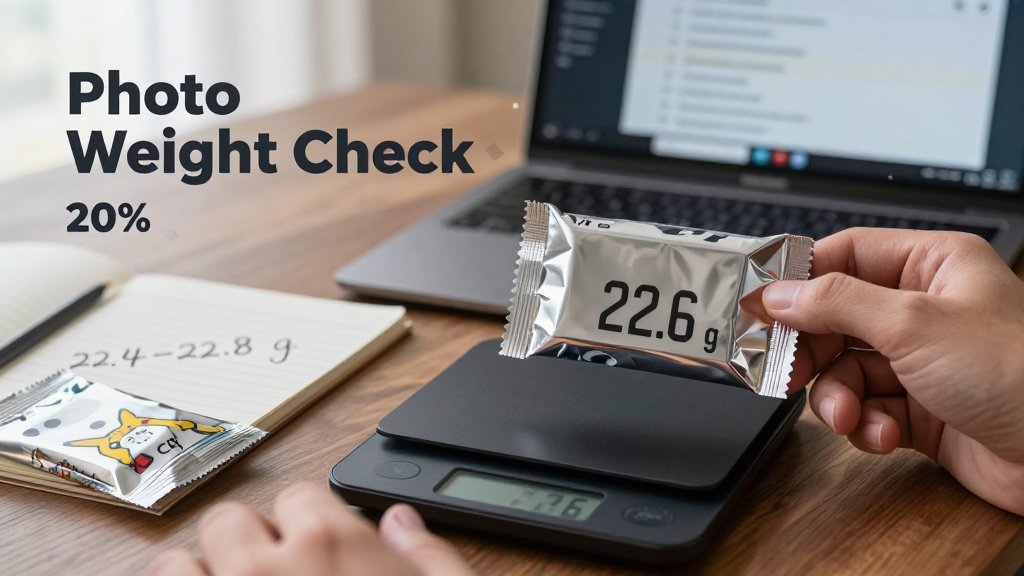
Buying sealed Pokemon packs online raises a big question: can you spot a heavy pack, and better pulls, from photos alone? It matters because weighing has been used for years to pick winners and sell the leftovers. In this guide, you will learn when pack weighing actually worked, why modern sets make it far less reliable, and what photos can and cannot reveal. You will also get practical tips for using images to spot red flags before you buy.
Can you weigh Pokemon packs from photos?
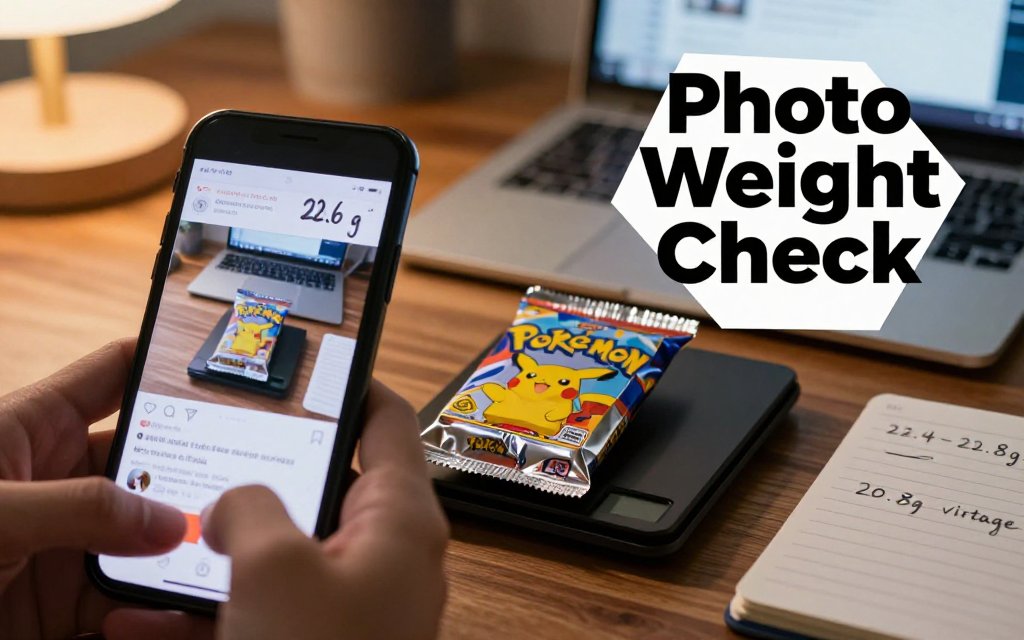
A photo cannot guarantee what you will pull from a Pokemon booster pack, and it should never be used as a “hit detector.” What a photo-based weight estimate can do is help you sanity-check a listing that looks suspicious. For a modern English booster pack, a realistic ballpark is about 22.4-22.8 g (roughly 0.79-0.80 oz), and tested packs from the same set can cluster tightly within about 0.1 g. A vintage WOTC era pack can be in a different range, for example a sealed 1999 Base Set pack listed at 20.8 g. If someone’s numbers are wildly outside those ranges, the safest move is to ask for clearer proof before you buy. booster pack weight tests offer a helpful reference point for what “normal” can look like. (wargamer.com)
What a photo can tell you, and what it cannot
Think of this as two separate goals. Goal 1 is predicting hits (not reliable from photos). Even with a real scale in hand, “heavy pack” logic is shaky for modern packs because pack contents include components like code cards that can be manufactured with varying weights. Goal 2 is sanity-checking a listing (sometimes helpful). If a seller claims a single loose modern pack is 28.5 g, that is not a tiny “maybe it’s heavy” difference, it is an “is something else included, or is the measurement wrong?” difference. A photo-based estimate is best used as a quick screen that helps you decide what to ask next, not as evidence that a pack is mapped, weighed, or guaranteed to contain anything valuable. (wargamer.com)
Even when you are trying to sanity-check, tiny gram differences matter, and photos add uncertainty that makes small differences basically meaningless. A 0.1 g swing can happen between two modern packs from the same set, so a photo estimate that is off by 0.3 g is not “proof” of anything. Real scale readings can also drift from humidity and storage conditions (foil and paper do not behave perfectly over time), plus you have normal manufacturing variation between print runs and pack art. Now add photo variables: camera angle, lens distortion, shadows, crimp folds, and whether the pack is sitting puffed up or pressed flat. The practical takeaway is simple: treat photo-based weights as a rough filter for big outliers, not a verdict on authenticity or pull rates. (wargamer.com)
Use photo-based pack weight like a smoke alarm: it cannot tell you what is inside, but it can warn you when the numbers are way off, before you spend money or open a return dispute.
A realistic weight sanity check in 30 seconds
Here is a fast, practical workflow. Scenario: a seller lists a “loose modern booster pack” at 28.5 g. You run a photo-based estimate (for example, using an AI scale app) and get about 22.7 g with a coin or standard card as the reference object. That does not prove the pack is good or bad, but it does tell you the listing’s number is probably not describing the same thing you are seeing in the photo. Your next step is to ask one clear question: “Is that 28.5 g including a cardboard sleeve, a team bag, or a protector?” If they cannot show the pack alone on a scale, that is a solid red flag. For modern English packs, a single-pack claim that is 5-6 g high should trigger extra caution. (wargamer.com)
Second scenario: a vintage WOTC pack is claimed to be 18 g. Your photo-based estimate comes out around 20-21 g, which lines up more closely with at least some documented sealed pack weights (for example, a 1999 Base Set pack listed at 20.8 g). Again, you are not “calling the pull,” you are checking basic reality. To get the best estimate from a photo, you want a clear top-down shot, the entire pack in frame, and a reference object that is flat and standard sized (a payment card, a ruler, or a known coin). This same habit is useful beyond cards: if you ship small orders, sanity-checking weight and size helps avoid postage surprises, and USPS cubic pricing explained is a handy follow-up read. (comics.ha.com)
One ethical note that matters: using weight (real or estimated) to try to “game” pulls is a bad goal, and it is also unreliable. Buyer safety is the better use case. You are looking for listings that fail a basic plausibility check, like a claimed “loose pack” weight that looks more like a pack plus a rigid protector, or a claimed “vintage pack” weight that seems missing packaging or measured incorrectly. A simple rule of thumb is to treat differences under 0.5 g as noise in photos, and to treat differences of 2 g or more as a prompt to ask for clarification photos (front, back, and on a scale). If the seller is honest, they can usually resolve the mismatch in one message. If they dodge, you just saved yourself time and money. (wargamer.com)
When pack weighing worked, and why it changed
Pack weighing became a thing for a simple reason: early Pokémon booster packs were often more uniform than people expect, so tiny changes in card stock, ink coverage, and holofoil could show up on a good scale. In the late 1990s and early 2000s (the Wizards of the Coast era), a holo rare usually meant a foil layer, plus different print coverage, and that could push a pack a few tenths of a gram heavier. That is not a lot, but if you have a precise scale (0.01 g resolution), those tenths start to look like a pattern. The problem is that the “pattern” was never universal, and modern packs were designed to blur it even more.
Vintage WOTC pack weights and the heavy pack idea
The heavy vs light concept took off because vintage packs often had fewer moving parts. You typically had a consistent wrapper style, a consistent card count, and fewer “surprise” inserts. If one version of the rare slot was a holofoil card and the other was a non-holo rare, the holo version could add measurable mass. People also point to small material differences like glue spots, crimp style (long crimp vs short crimp), and wrapper thickness, but the core idea was simple: foil and ink changes can matter when the rest of the pack stays similar from pack to pack.
Collectors commonly talk about Base Set (English) “light” packs landing roughly around 20.3 g to 20.8 g, with “heavy” packs often discussed around 21.0 g to 21.6 g. Jungle and Fossil often get similar treatment, with many people treating about 20.7 g to 21.0 g as the fuzzy middle where you cannot be confident either way. These are not promises, they are shorthand ranges that assume a specific wrapper type, language, and production run. Even within the same set, a pack at 21.1 g might be heavy in one box and ordinary in another box.
The biggest mistake buyers make is trusting a single number from a listing without knowing the exact context. “21.2 g heavy” means almost nothing if you do not know the set, whether it is 1st Edition or Unlimited, the language (Japanese and English packaging can differ), and what the light packs from that same booster box weighed. A seller can also weigh with the cardboard art insert still attached (like in some blisters), or include a protective sleeve, and suddenly the number looks “heavy” while the actual pack is not. If you ever see one magic cutoff being treated like a guarantee, treat that as a red flag.
Modern packs, code cards, and why weight signals get muddy
Modern packs are a different world because the pack composition is less predictable by design. The clearest example is the online code card, which became part of the booster pack experience in the Black and White era. Some early coverage of that shift is documented in this 2011 code card rollout. Once you add an extra card that can vary in thickness, ink, and finish, you can cancel out (or accidentally amplify) the tiny difference a holo layer might have created. That makes weight a noisy signal instead of a clean clue.
This is why the common Scarlet and Violet question comes up so often: “Do Scarlet and Violet packs have code cards, and can you weigh them?” Yes, code cards exist, but their presence and variability is part of why weighing as a hit predictor is unreliable. Modern sets can include different holo patterns, reverse holos, textured ultra rares, special illustration rares, and different insert mixes depending on product type. Two packs can weigh the same and have totally different “hit” outcomes. Even worse, a pack can weigh heavier because of a slightly heavier code card, not because it contains anything special.
Practical guidance people share for modern packs is usually about avoiding false confidence. You will see modern booster packs clustered around the low 20 g range (often roughly 22.0 g to 23.0 g depending on era and wrapper), but the spread inside a box can be tight, sometimes well under 1.0 g from lightest to heaviest. That means “heavy” might just be a normal pack from that print run. Even if a specific product batch shows a small weight trend for double hits, it is not consistent enough to be a buying strategy. If you are shopping sealed, assume “weighed modern packs” claims are marketing, not math.
How to spot weighed or tampered packs safely
A pack weight number, whether it comes from a precision scale or a photo-based estimate, is best treated like a weather forecast. It helps you decide what to pack, but it does not guarantee sunshine. For many modern English booster packs, the total pack weight tends to sit in a fairly tight band (often around 22 to 23 g), and tiny differences can come from normal printing variation, different foil layers, or inserts. The buyer mistake is trusting a single “heavy” or “light” claim more than the listing itself. Use weight as one signal, then zoom out: seller history, packaging condition, and whether the photos show the parts scammers try to hide.
Buyer checklist for safer sealed purchases
Loose packs are where people get burned, because they are easy to “cherry-pick” (opening a box, keeping the best pulls, then selling the leftovers) or to reseal. Start with the boring stuff that actually saves money: buy from sellers with long, consistent feedback and a return policy that specifically covers sealed condition. Prefer products that have traceable provenance (receipt, store source, case break, or at least a believable story that matches the photos). If a listing claims “fresh box” but shows a mix of pack arts from different print runs, or uses one stock photo for everything, treat it like a yellow flag and ask for proof before paying.
If you are using a photo-based weight estimate as a screening tool, ask for photos that make the estimate less “guessy.” A good seller can shoot five quick images: front, back, close-up of top crimp, close-up of bottom crimp, and a flat shot next to a reference object (coin, ruler, or even a sealed sleeve booster from the same set). Then you can compare multiple packs in the same lot. Example: if six loose packs from the same set estimate out as 21.9 g, 22.0 g, 22.1 g, 22.0 g, 23.6 g, and 23.7 g, the outliers are not automatic proof of hits, but they are a reason to pause and ask why two packs look so different from the rest.
Ask for straight-on photos of both crimps, the back seam, and the full pack front. If the seller refuses or only shows angled glamour shots, assume you are being steered away from the evidence.
FAQ: pack weighing myths, modern sets, and photo estimates
Modern pack collation changes are a big reason “just weigh it” advice keeps failing. For example, Scarlet and Violet era packs changed their card layout and foils, which adds normal weight noise even before you factor in different code cards, different ink, and print variation. If you want a quick refresher on what is actually inside each pack slot, the simplest explanation is in how SV packs changed. The practical takeaway is this: pack weight is not a reliable shortcut, but it can still help you spot suspicious listings when combined with clear photos and common-sense buying habits.
Are modern Pokemon packs weighable in 2026?
Not reliably, and that is the point. In 2026, most modern sets are designed so a “heavy pack” does not consistently mean a better pull. Extra foils, different code card stock, and normal factory variation can move weight by a few tenths of a gram without changing what you get. Some people still try to weigh for outliers, but that behavior mostly increases scam risk: sellers can offload “light” leftovers, or they can use weighing as a marketing hook. Treat weight as a sanity check, not a promise.
What is the Scarlet and Violet pack weighing code card issue?
The short version is that code cards stopped being a simple “tell.” Older English eras had code cards whose color and card stock were discussed as a way to balance weights, and some buyers tried to read pack contents from that. In Scarlet and Violet era products, the code card look changed (many are black-bordered), and every pack already includes multiple foils. That combination makes “code card color means hit or no hit” advice unreliable, and it also adds weight variation that has nothing to do with chase cards.
How can I use a photo-based weight estimate without getting scammed?
Use it to avoid bad listings, not to hunt “heavy” packs. Ask for clear flat photos with a reference object, and compare multiple packs from the same seller for consistency. If the estimated weights are wildly spread, or the seller only shows one pack and hides the crimps, walk away. Safer habits beat any number: buy sleeved boosters, blisters, booster bundles, ETBs, or sealed booster boxes from reputable sources, and record your unboxing if the order is expensive. For loose packs, assume the risk is higher and price accordingly.
Need to weigh something fast before you commit to a purchase? Download Scale for Grams and get an AI-powered weight estimate from a photo in seconds. It is a quick way to sanity-check what you are seeing and add one more layer of confidence when shopping for sealed items. Grab it here: iOS. Try it now and compare results across listings.
Scale for Grams
Need to Weigh Something?
Download Scale for Grams and get an AI weight estimate from a photo in seconds.