Candle Fragrance Load in Grams, Done Right
A practical, no-confusion way to calculate fragrance oil in grams from wax weight and fragrance percentage, plus realistic tips for estimating wax and oil weight when you do not have a physical scale.
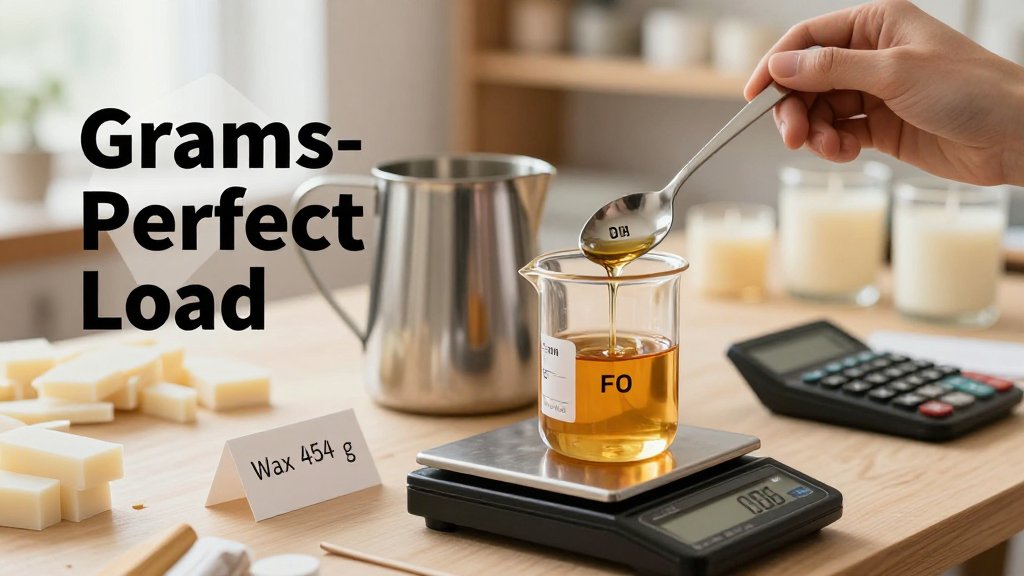
If your candles sweat, smell weak, or cure too soft, the problem is often not your wax, it is your fragrance load math. Getting the ratio right protects hot throw, burn quality, and even jar adhesion. In this guide, you will learn a simple formula to calculate fragrance load in grams, plus step-by-step examples using common batch sizes like 454 g of wax. You will also see the mistakes that cause separation, frosting, and oily tops, and how to fix them fast.
Fragrance load in grams, the simple formula
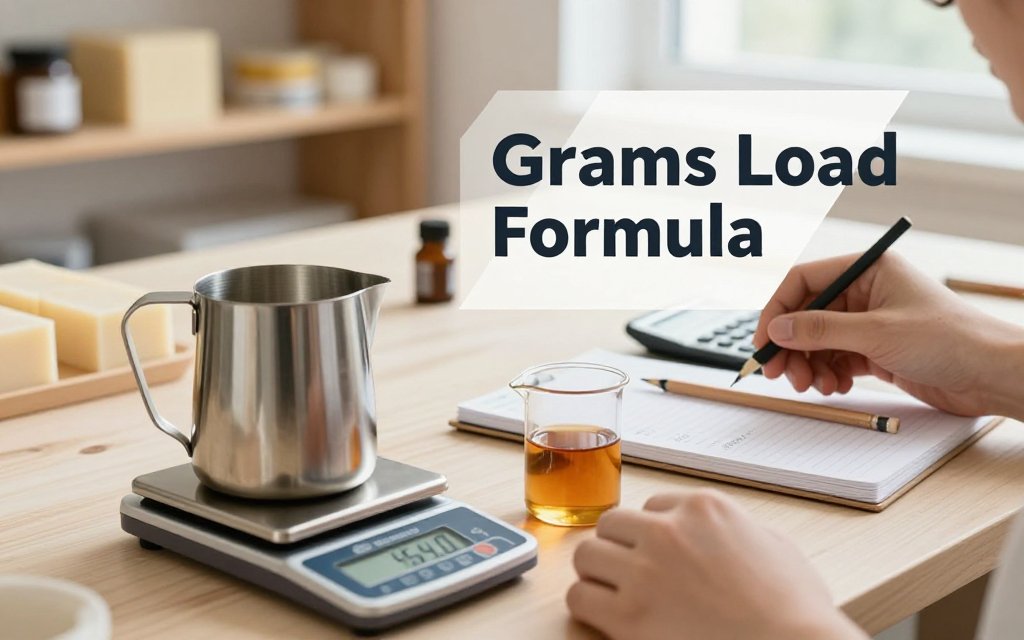
Fragrance load is simply how much fragrance oil (FO) you add compared to your wax weight. Think of it like baking by weight: the “percent” is a recipe ratio, not a vibe. If you melt 454 g of wax, a 6% fragrance load means your fragrance oil should weigh about 6% of that 454 g. This matters because FO affects hot throw, cold throw, cure behavior, and even how your candle burns. Too little and it smells weak, too much and you can get sweating, frosting, or wicks that struggle. The good news is that fragrance load math is fast, repeatable, and easy to sanity check in your head once you do it a few times.
The formula you actually need
Here is the quotable answer you can keep on a sticky note: Fragrance oil (g) = Wax (g) x Fragrance load (% as a decimal). “As a decimal” is the whole trick. 6% becomes 0.06, 8% becomes 0.08, and 10% becomes 0.10. Multiply your wax grams by that decimal and you get FO grams. That is the same core calculation you will see in most candle supply calculators and guidance, just written in a clean grams-first way. If you like a quick reference to confirm your approach matches common candle-making math, this standard fragrance load formula breaks it down the same way. (wicsupplies.com)
Two details prevent most beginner math errors. First, “wax weight” means just the wax, not the jar, not the lid, not the label, not the wick tab, and not the dye. Put your pouring pitcher on a scale, tare to zero, add wax until you hit your wax target (example: 454.0 g), then do the FO math from that number. Second, the fragrance load percentage refers to FO as a percent of the wax, not a percent of the total finished candle. A quick sanity check: if you add 10%, your FO grams should be about one tenth of your wax grams. If you calculated 10% and got a number that looks closer to half, you probably typed 0.10 wrong, or used the jar’s full weight by accident. (wicsupplies.com)
If your wax is 500 g and your load is 8%, your fragrance oil should be 40 g. If that number surprises you, recheck the decimal, because most mistakes come from mixing up percent of wax versus percent of total.
Real examples, from 1 lb to small test pours
Let’s run the classic “1 lb of wax” example in grams, because it makes the math obvious. One pound is 454 g. At 6% load: 454 x 0.06 = 27.2 g FO (rounded to one decimal). At 8% load: 454 x 0.08 = 36.3 g FO. At 10% load: 454 x 0.10 = 45.4 g FO. Those numbers are why many soy candle makers start testing in the neighborhood of 6% to 10%, especially for container candles, but you still need to follow the maximum fragrance load for your specific wax and any usage notes for your specific fragrance oil. Your best candle is the one that performs well after curing, not the one that “wins” by having the biggest percentage. (wicsupplies.com)
Small test pours are where this formula saves you time and materials. Example: 200 g of wax at 7% load is 200 x 0.07 = 14 g FO, exactly. That is a clean test size for comparing wicks or comparing two fragrances in the same wax. For a soy blend (like soy-coconut or soy-paraffin), the math is identical even if your practical load limits change. If you test 300 g of a blend at 9%, that is 300 x 0.09 = 27.0 g FO. If your scale reads to 0.1 g, pour 27.0 g. If it reads to whole grams, pour 27 g and write down what you did, so you can repeat it later. Consistency beats perfection in early testing.
The most common percentage mistakes are predictable, and you can catch them before you waste a batch. Mistake one is forgetting the decimal and multiplying by 8 instead of 0.08, which turns an 8% recipe into an oil soup. Mistake two is calculating FO as a percent of the total candle weight (wax plus FO), which shifts your ratio and quietly changes wick performance. Mistake three is mixing units, like measuring wax in grams and fragrance in ounces. Pick one unit system per batch and stick with it. Mistake four shows up when you have a target fill weight, like a jar that holds 300 g total, and you compute FO from 300 g instead of from the wax portion. If you want 300 g finished at 10% load, wax is 300 / 1.10 = 272.7 g, and FO is 27.3 g.
Fast workflow tip you can reuse every pour day: decide your wax grams first, multiply once to get FO grams, then tare and weigh FO directly into a small cup before it ever touches the wax. That single habit prevents most “oops” moments because you can look at the cup and see if 45 g of oil makes sense next to 454 g of wax. If you are away from your bench and just need a quick estimate, an AI photo-based tool like Scale for Grams can help you sanity check ingredient amounts and portions in everyday life, similar to how you might estimate food weights for macros in palm-to-grams macro tracking. Then, when you are back at your candle setup, you can lock it in with a real gram measurement for repeatable results.
Percentage mistakes that ruin scent throw
A candle can look perfect and still smell wrong because the fragrance math was off by just a few grams. Too little fragrance oil (FO) often shows up as a candle that smells faint in the jar and even fainter when burning. Too much FO can be sneakier: it may smell intensely strong cold, but burn poorly, soot, or throw almost nothing hot because the wick cannot keep up. That is why experienced makers treat fragrance load like baking, not like seasoning. Weighing FO in grams keeps your batches repeatable and helps you troubleshoot fast, and suppliers routinely recommend measuring by weight (not spoons) when you weigh fragrance oil for a set percentage.
The two most common math mix-ups
Mix-up #1 is using FO% of the total batch instead of FO% of wax. In candle making, “10% fragrance load” almost always means 10% of the wax weight. Example: 454 g wax at 10% should be 45.4 g FO. If someone decides the FO should be 10% of the finished candle (wax plus FO), the math changes: FO = wax x (0.10 ÷ 0.90) = 50.4 g FO, and the total batch becomes 504.4 g. That extra 5.0 g can push a stable candle into oily tops, wick drowning, or a jar that runs too hot. If you ever feel like you have to keep “fixing” the wick for one fragrance but not others, check which percentage definition you used first.
Mix-up #2 is a labeling mistake that causes silent overflow: adding 10% FO and still calling the wax amount a “1 lb batch.” If you start with 1 lb (454 g) of wax and add a correct 10% FO (45.4 g), you now have about 499.4 g of liquid to pour. That is not a one-pound total pour, it is one pound of wax plus fragrance. The practical problem shows up at the pitcher and at the container: you suddenly have extra wax to deal with, you overfill jars, or your “8 oz jar recipe” creeps upward over multiple batches because you keep topping off. On the next batch, decide what you are standardizing: wax weight per jar, or total fill weight per jar, then write it down in grams so you do not drift.
Signs your candle is over-fragranced
Over-fragrancing has a “feel” as much as a smell. The most common clues are oily or sticky tops after curing, a slick ring around the wick, wet spots that look unusually shiny, and wax that seems softer than normal for that wax type. During a burn test, watch for a wick that mushrooms quickly, struggles to form a full melt pool, or creates a deep melt pool that snuffs itself (a drowning wick). You may also see frosting that looks worse than usual on soy, especially if the fragrance separated slightly and disturbed the crystal structure. If the cold throw is huge but the hot throw is disappointing, that can be an overload signal too, not a “needs more oil” signal.
More FO does not automatically mean stronger hot throw because burning is a balance between fuel, airflow, and wick size. If there is excess oil, the wick can struggle to vaporize the fragrance cleanly and consistently, so you get soot, a lazy flame, or a candle that smells muted once it is hot. A practical fix path is boring, but it works: drop the FO by 1% to 2% and re-test with the same container and pour temp. Then revisit wick size or wick series instead of pushing FO higher. For a 454 g wax batch, stepping down from 10% to 8% is the difference between 45.4 g FO and 36.3 g FO, which is a big change you can feel and measure.
What to do on the next batch
Treat your next pour like a controlled test, not a rescue mission. Pick one variable to change: fragrance load or wick, not both at the same time. If hot throw was weak and the candle burned cleanly, try a small increase, like 1% higher, and keep the wick identical. If the candle was sooty, had mushrooming, or seemed oily, reduce FO by 1% to 2% first and keep your wax, jar, and wick the same. Keep a simple batch note that records wax in grams, FO in grams, wick type, pour temp, and cure time. Example for a larger run: 2,000 g wax at 9% is 180 g FO; at 10% it is 200 g FO. Those are decisions you can repeat exactly.
Counting drops and using spoons is where repeatability goes to die. A “drop” changes with viscosity, temperature, and the orifice on the bottle, so two people can add “100 drops” and be grams apart. Teaspoons are just as slippery because FO density varies by fragrance, and spoons are volume tools, not weight tools. Grams let you spot small errors fast, like realizing you poured 52 g FO when your target was 45.4 g. If you do not have a physical scale handy, a photo-based estimate from an app can still help you sanity-check amounts and catch obvious overpours before you commit to a full production run. The goal is consistency: same wax weight, same FO weight, same results, and fewer mystery candles.
How to estimate wax and oil without a scale
A missing scale does not have to stop a pour day. You can get close enough to test a new scent, finish a repour, or fill a few emergency orders by estimating wax from volume and fragrance oil from what the bottle label already tells you. The key is to keep expectations realistic. These methods will not beat a real gram scale for accuracy, especially if you are pushing max fragrance load or you need repeatable results for wholesale. Use estimates for small test batches, write down what you did, and plan to re-check your numbers with a scale as soon as you can.
To estimate wax in grams from a container, work from volume and density. A simple shortcut for soy container wax is to treat melted soy wax as roughly 0.9 g per mL (about 90 percent the density of water), which is a commonly cited rule of thumb for soy wax density, including in references that note soy wax density around 0.9 g/mL. Example: if your jar holds 250 mL to your intended fill line, 250 mL × 0.9 g/mL ≈ 225 g of wax. If you normally leave 10 mL headspace, estimate on 240 mL instead, so about 216 g wax.
You can apply the same idea to other waxes with a little caution. Many paraffin blends land close to 0.9 g/mL as well, and beeswax is often a bit heavier (closer to about 0.95 to 0.97 g/mL), so a beeswax candle poured by “soy math” can come out slightly underfilled. If you do not know your wax type density, estimate with 0.9 g/mL for a test and then adjust by eye on the next pour. Practical trick: measure one “known good” jar once when you have a scale, record the grams that filled it perfectly, and that jar becomes your reliable reference forever.
For fragrance oil, your best no-scale reference is the bottle’s labeled net weight. If a bottle says 100 g net, and your usual recipe is 8 percent fragrance load, then every 100 g of wax “wants” 8 g fragrance oil. Without a scale, flip that around and use the bottle as your measuring stick. Example: you need about 24 g fragrance oil for a 300 g wax test batch at 8 percent. That is about 24 percent of a 100 g bottle. Over a few batches, you can learn what that pour looks like in your specific pitcher and pour speed, then repeat it consistently for test runs.
Quick estimating methods that are good enough to test
If you already know your target wax grams from past batches, portion wax by “repeatable chunks.” One easy method is to pre-cut a slab into equal pieces when you do have a scale, for example ten chunks at 50 g each, then store them in a labeled bag. No scale later, you can grab four chunks for about 200 g. Another method is to use packaging net weight: if your soy wax comes as a 1 lb (454 g) bag, eyeball it into halves (about 227 g) or quarters (about 113 g) for small testers. Limitation: these are estimates, so use them for test batches and re-check with a real scale when consistency matters.
A fast backup for both wax pieces and small pours is the Scale for Grams iOS app. It estimates object weight from photos, which can be surprisingly handy when you are working with pre-weighed blocks, leftover wax chunks for repours, or a “mystery amount” of wax shavings you want to use up. Example: you break a 1 lb wax block into rough pieces for storage and later need about 150 g for two tealight testers. Photograph the pieces, get an estimate, and combine pieces until you are close. It is also useful outside candle-making, like quick food portion estimates or package weights when you are packing shipments.
> If you are estimating instead of weighing, keep the batch small, label everything, and change only one variable at a time. Once you have access to a real scale again, re-run the same recipe by grams and compare results.
How many grams of fragrance oil per pound of wax?
One pound of wax is 453.592 g (most makers round to 454 g). Multiply that by your fragrance load percentage. At 6 percent, use about 27.2 g FO per lb (0.06 × 453.6). At 8 percent, use about 36.3 g FO per lb. At 10 percent, use about 45.4 g FO per lb. If your wax is in a 1 lb bag, you can memorize this: 6 percent is about 27 g, 8 percent is about 36 g, 10 percent is about 45 g.
What is a good soy candle fragrance load in grams?
A practical starting point for soy container candles is 6 to 8 percent by weight, then test upward only if your wax and fragrance can handle it. In grams, that looks like this: for 300 g wax, try 18 g FO (6 percent) up to 24 g FO (8 percent). For 500 g wax, that is 30 g to 40 g FO. If you want to test a stronger option, 10 percent on 500 g wax would be 50 g FO, but watch for sweating, soft tops, and poor burn. Keep wicks and cure time consistent so you can judge scent throw fairly.
How can I weigh fragrance oil without a scale?
Use the bottle’s net weight as your reference and measure by “fractions of the bottle” for test batches. Example: a 50 g bottle, and you need 10 g FO, that is one-fifth of the bottle. Pour slowly into the same pitcher each time and mark the oil level with tape so you can repeat it. If you have pre-weighed fragrance samples, treat them like single-use packets and build batches around their grams. For a quick check, the Scale for Grams app can estimate weight from a photo, which is helpful for small bottles or pre-portioned cups. Then confirm on a real scale later.
Need to weigh something fast when your scale is not nearby? Download Scale for Grams and get an AI-powered weight estimate from a photo in seconds. It is a quick way to estimate wax or fragrance oil on the go, then plug the numbers into the grams formula you learned. Grab it here: iOS. Try it on your next pour and save your batch from guesswork.
Scale for Grams
Need to Weigh Something?
Download Scale for Grams and get an AI weight estimate from a photo in seconds.