Cast Iron Skillet Weight Chart for Every Size
A practical, size-by-size cast iron skillet weight reference, plus real-world ways to estimate weight from photos for shipping, buying vintage pans, and portioning food when you cook by weight.
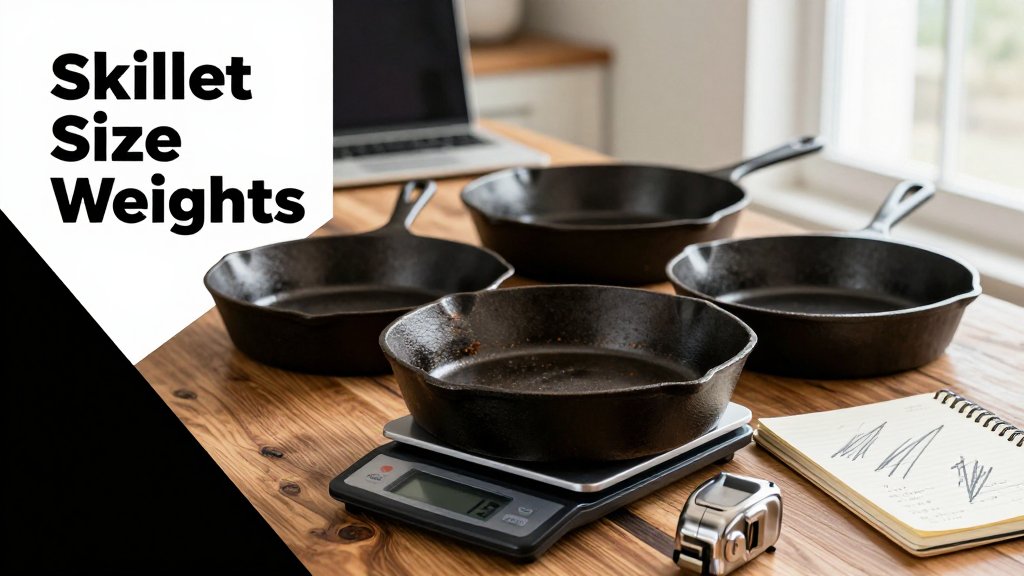
Cast iron skillets feel simple until you need to know what they actually weigh. That number matters when you are comparing a 10-inch vs 12-inch pan, budgeting for shipping, or deciding what your wrist can handle every day. In this guide, you will get a quick cast iron skillet weight chart for common sizes, plus practical tips to sanity-check online listings using photos and small details. By the end, you can estimate weight fast and avoid surprise postage or an uncomfortably heavy pan.
Cast iron skillet weight chart by inch size
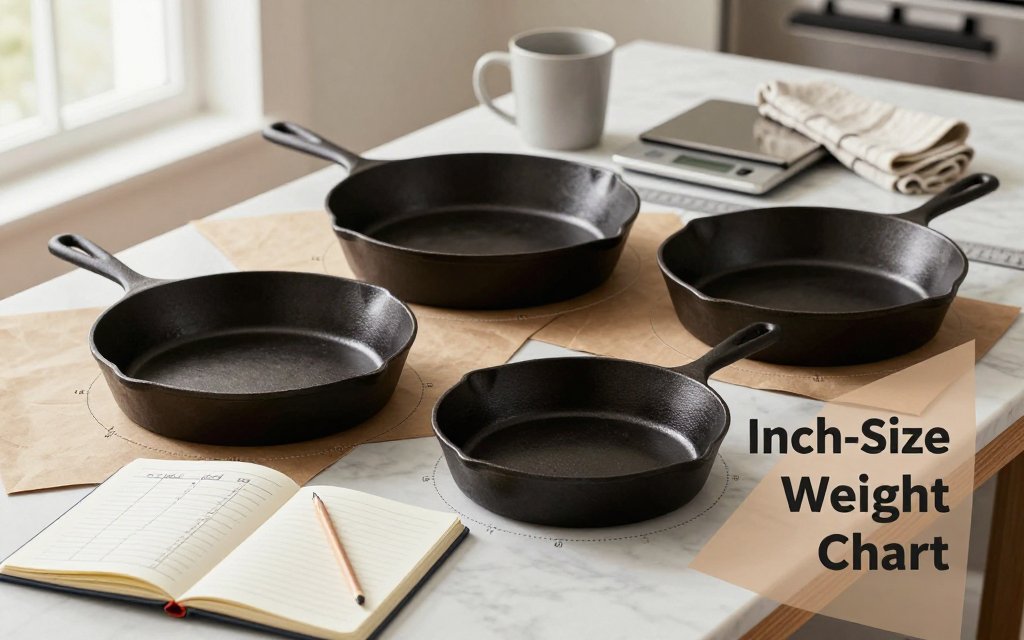
Need a quick, quotable estimate? A typical bare cast iron skillet weighs about 3 to 4 lb at 8 inches, 5 to 6.5 lb at 10 inches, 7 to 9 lb at 12 inches, 10 to 13 lb at 14 inches, and about 12 to 16 lb for big 15 to 16 inch pans. Those ranges are wide on purpose because a “12-inch skillet” is not a universal standard across brands. One 12-inch might measure 12 inches across the pour spouts, while another measures 12 inches at the rim but has a smaller cooking floor. For home cooks, that affects how much food you can sear without crowding. For shippers, it changes whether your box stays under a carrier tier once you add a lid, padding, and a carton.
Typical weights for 8-inch to 16-inch skillets
Use the chart below as a fast starting point for a bare skillet (no lid, no silicone handle cover, no food). If you are baking by weight, remember that pan weight matters most when you are preheating, moving it in and out of the oven, or flipping items like Dutch babies. If you are selling or shipping, treat these as “metal-only” weights. Packaging can add 8 to 20 oz fast, and a cast iron lid can add pounds, which is why many shipments jump from one pricing tier to the next without you noticing until checkout.
Two sizes get searched constantly: 10-inch cast iron skillet weight and 12-inch cast iron skillet weight. A 10-inch is often the everyday workhorse, heavy enough for steady heat but still manageable one-handed, and a real-world example is the Lodge 10.25-inch skillet, which lists a 5 lb 5 oz weight on REI. A 12-inch skillet is where many people feel the jump in heft, commonly landing around 7.5 to 9 lb. Add a lid and things change quickly: a cast iron lid often adds roughly 3 to 6 lb depending on diameter, knob style, and whether it is thick and self-basting.
If you ship cookware, the “surprise weight” is usually not the skillet, it is the extras. A helper handle, a thicker rim, or an included lid can move your shipment into a higher bracket, especially once you add a box, bubble wrap, and void fill. A practical habit is to estimate the complete shipped weight as skillet plus lid plus 1 to 2 lb for packing materials. If you do not have a physical scale handy, a photo-based estimate can still help you sanity check a listing before you print a label, similar to how makers estimate materials in craft workflows like estimate remaining yarn grams.
If your goal is a safe estimate, assume the heavier end of the range, then add 3 to 6 lb for a cast iron lid and another 1 to 2 lb for packing. That one habit prevents most shipping price surprises.
Why your 12-inch skillet might weigh more than mine
Skillet weight varies because “12-inch” can describe different measurements: outer rim, pour-spout to pour-spout, or cooking surface. Beyond size naming, the big drivers are wall thickness, how wide the cooking floor is, and how much extra iron is in features like pour spouts and a helper handle. Vintage pieces that were factory-machined smoother can feel lighter in the hand because they are often thinner, while many modern castings are intentionally thicker for durability and heat retention. Enameled cast iron usually weighs more than bare cast iron in the same nominal size because you are starting with a hefty casting and adding a glassy enamel layer plus larger sidewalls on many designs.
Here is a quick in-hand heuristic that works surprisingly well. If a 12-inch skillet feels “comfortable but serious” to lift with one hand and you can tilt it to baste without straining, it is probably closer to 7 to 8.5 lb. If you need your second hand on the helper handle every time you move it, and it feels front-heavy at the long handle, expect more like 8.5 to 10 lb. For shipping estimates, treat any 12-inch with a helper handle as the heavier case, and treat enameled 12-inch skillets as heavier again. If you want a fast number without digging through product specs, Scale for Grams can help you get a photo-based estimate in grams or ounces, which is often enough to decide on a box size and label tier.
How to estimate cast iron weight without a scale
You can get a surprisingly usable cast iron weight estimate from photos, accurate enough for buying decisions and for most shipping labels. I have done this for marketplace pickups and for shipping heavy cookware, and the goal is not perfection, it is avoiding expensive surprises. If you can identify the skillet’s real size and whether it is a lighter vintage style or a thick modern workhorse, you can usually land within about 1 lb. That is plenty to decide if a “great deal” is still a deal after shipping, or if your box needs extra padding because you are closer to 10 lb than 7 lb.
Photo-based estimation that actually works
Start by confirming diameter from the cooking surface, not the outer rim. This is the most common listing-photo mistake: someone measures straight across the top lip and calls it “12-inch,” but the flat cooking area might be closer to 10.5 to 11 inches. That difference matters because a true 12-inch class skillet is noticeably heavier than an 11-inch class skillet. If you have a reference object in the photo, use it. A US letter sheet of paper (8.5 x 11 in) is great for scale, and a standard half-sheet pan (about 18 x 13 in) is even better because it frames the pan clearly.
Next, look for thickness cues, because thickness is where the pounds hide. A thicker base and taller sidewalls almost always mean a heavier pan. Modern lodge-style skillets tend to have chunkier walls and a thicker cooking deck than many older, smoother pans. If the photo shows a pronounced heat ring, deep pour spouts, or a noticeably tall side profile, treat it as the heavier end of the weight range for that diameter. If the rim looks thin and the pan sits low and sleek, it is more likely to be a lighter build (often vintage), even if the diameter is similar.
Handle style is your next “tell.” A long main handle with a thick neck adds weight, and a helper handle is a big hint that you are dealing with a heavier pan meant for two hands. If the listing includes a lid, assume you are adding serious weight. A cast iron lid can add several pounds by itself, which can change your shipment from “single digit pounds” to “double digits.” For photo scale, I like objects that have predictable sizes: a 10 to 11 inch dinner plate, US letter paper, a sheet pan, or even an iPhone. Most iPhones are roughly 5.8 to 6.3 inches tall, so if the phone is lying next to the pan, you can sanity-check the diameter quickly.
If the photo shows a helper handle, tall sidewalls, and a thick base, assume it is the heavy version. For shipping, being safely high by a pound is cheaper than a relabel.
Quick checklist for shipping estimates
For shipping, your best “close enough” estimate is the pan weight plus packaging, then rounded up to a billable number. Many carriers price by whole-pound steps, and they commonly bill the next pound up when you have any fraction. For example, FedEx retail guidance states that fractional pounds round up, which is exactly why a 9.2 lb box should be treated like a 10 lb box when you buy a label. The other sneaky part is protection: cast iron is dense, so you usually need more padding than you think to prevent the skillet from punching through the box.
Here is a practical example you can copy. Say you are shipping a 12-inch skillet that looks like a modern, thick-walled pan with a helper handle. A reasonable estimate for the bare skillet is about 8 lb. Add a single-wall cardboard box plus paper padding, and you can easily add 1.0 to 2.0 lb, so call it 9 to 10 lb packed. If you guess 9 lb and the real packed weight is 10 lb, you can jump a pricing tier, and that often means several extra dollars, sometimes more, depending on zone and service. The annoying part is that the buyer rarely cares that it was “only” 1 lb off, because the label still has to match the billed weight.
One more buying tip that saves time: decide your “walk-away weight” before you message a seller. If you see a photo that clearly shows a helper handle plus a thick base, assume it is the heavier build for that size and plan accordingly. If the deal only works if the skillet is magically light, it probably will not work. If you need more confidence, ask for one extra photo that helps scale: the skillet sitting on a half-sheet pan, next to US letter paper, or beside a dinner plate. Those reference objects are common in kitchens, and they help you confirm that you are comparing the right diameter and not accidentally shopping for a smaller cooking surface than you wanted.
Vintage cast iron identification using size and weight
A listing that says “vintage cast iron, 10 inch” sounds specific, but it can still hide big differences in feel, shipping cost, and day-to-day usability. Weight is one of the fastest reality checks because vintage skillets were often cast and finished differently than many modern pans. A smoother, thinner-walled skillet can be noticeably lighter at the same rim diameter, which matters if you are trying to avoid a pan that feels like a gym weight, or you are trying to keep a shipped order under a pricey carrier bracket. Use weight like you would use a photo of the bottom. It narrows the field, it does not “prove” a brand by itself.
When weight is a clue and when it is not
Weight can hint at vintage because many older skillets (think common collector names like Griswold and Wagner, plus plenty of unmarked pieces) were machined smoother and sometimes cast a bit thinner. That often makes an older “No. 8” style skillet feel lighter than a modern 10 to 10.25 inch skillet with chunky walls. Practically, if a seller claims “lightweight vintage 12 inch” but the scale shows 9.5 pounds for the bare pan, it might still be great cookware, but it is less likely to be one of the notably lighter patterns. On the flip side, restored seasoning thickness, added pour spout metal, or a heavier handle design can push weights up across eras.
The catch is overlap. A heavy vintage deep skillet can weigh like a modern one, and some newer “heritage style” brands deliberately copy vintage proportions. That is why weight works best as a confidence ladder, not a single yes or no test. If you collect, the reference photos and attribute breakdowns in this unmarked cast iron guide are a good reminder of how many look-alikes exist.
Message a seller like this: “Can you share the pan’s weight (no lid), rim diameter, and a straight-on photo of the entire bottom, including the heat ring area and any numbers near the handle?”
How much does a 10-inch cast iron skillet weigh?
A typical 10-inch cast iron skillet weighs about 5 to 6.5 lb (about 2,270 to 2,950 g). A lot of “10 inch” skillets sold today are actually 10.25 inches, and those often land around the mid to upper part of that range. Vintage skillets of a similar cooking capacity can be about a pound lighter, but not always, especially if it is a deeper chicken fryer style. If you are buying for daily cooking comfort, pay attention to whether the listing weight includes a lid. A lid can add another 2 to 4 lb.
How much does a 12-inch cast iron skillet weigh?
A typical 12-inch cast iron skillet weighs about 7 to 9 lb (about 3,175 to 4,080 g) for the pan alone. Many common modern skillets cluster around 7.2 to 8.5 lb, but it is normal to see heavier examples depending on wall thickness and handle design. That spread is why sellers should list the exact weight, not just “heavy.” If you are weight-lifting the pan one-handed to drain grease or move it to the oven, the difference between a 7.2 lb skillet and an 8.8 lb skillet is very noticeable once food is inside.
How can I estimate cast iron cookware weight for shipping from photos?
Start by estimating diameter from the photo using a known reference (a standard dinner plate is often about 10.5 to 11.5 inches, and a US quarter is about 1 inch wide). Next, judge depth and style: a deep chicken fryer, a skillet with a helper handle, or a lid will add weight fast. Use your size-based weight range as the “pan-only” estimate, then add packing materials. A sturdy box plus padding is often 1 to 2 lb. Example: a 12-inch skillet estimated at 8.0 lb, plus 1.5 lb packaging, ships at about 9.5 lb, which you should round up to a 10 lb label. Photo-based weight estimators (like Scale for Grams) can help you sanity-check the listing, but for paid shipping, ask the seller to confirm on a real scale.
Need to weigh something fast, especially when you only have a photo? Download Scale for Grams and get an AI-powered weight estimate in seconds. It is a simple way to double-check listings, plan shipping costs, or compare cookware before you buy. Grab the app here: iOS. Try it now and make your next cast iron decision with more confidence.
Scale for Grams
Need to Weigh Something?
Download Scale for Grams and get an AI weight estimate from a photo in seconds.