Yarn Chicken Panic? Estimate Remaining Yarn in Grams
If you are playing yarn chicken, you do not need to guess. Learn a practical way to estimate how many grams are left in a partial skein using your phone, then convert grams to approximate yardage with a few sanity checks that avoid the most common mistakes.

Halfway through a project, nothing feels worse than the nagging suspicion that your last skein will not make it to the final bind off. In this guide, you will learn a realistic, phone-first method to estimate your remaining yarn in grams using photos, then convert that number into an approximate yardage you can plan around. We will also cover why labels list 50 g or 100 g, how humidity and moisture can change weights, and quick sanity checks for partial skeins before you frog anything.
How to estimate yarn grams without a scale
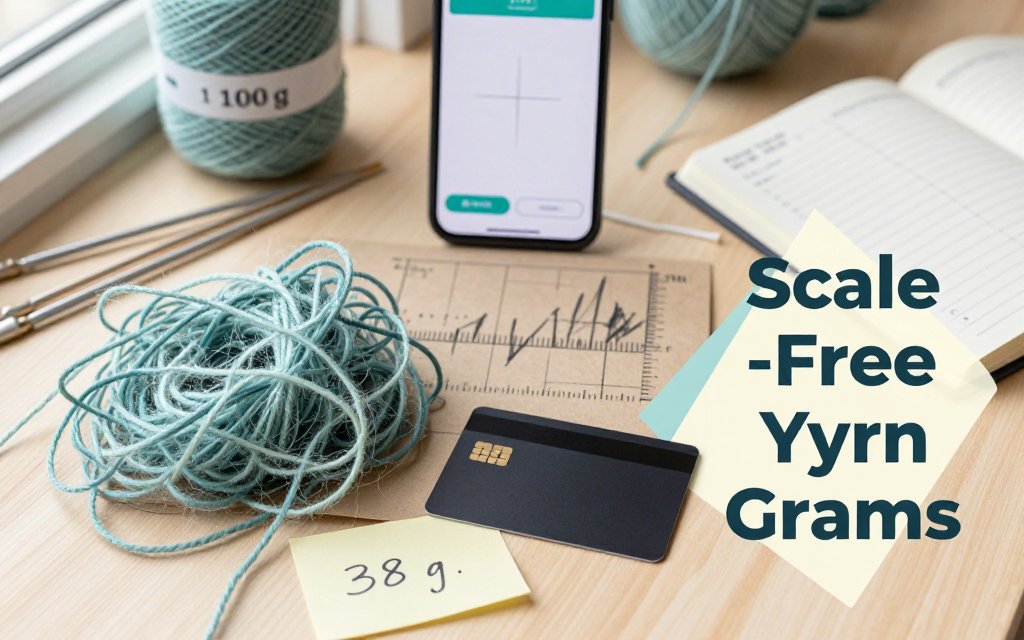
Here is a fast, practical method you can repeat any time you are playing yarn chicken: put your remaining yarn in one loose pile, place a familiar reference object next to it (a credit card works well), take a straight-down photo, then run it through a photo weight estimation app like Scale for Grams to get an estimated weight in grams. Write that number on a sticky note and treat it as your planning number, not a promise. If your estimate says you have 38 g left, you plan your next steps like you have 38 g, not “about half a skein.” This keeps you from getting trapped halfway through a sleeve or a long ribbed hem.
Before you even take the photo, grab one baseline fact if you have it: the original skein weight from the ball band. Most yarn labels include both the physical weight (ounces or grams) and the length (yards or meters), which is exactly what you need for realistic planning. The Craft Yarn Council’s yarn label basics walks through where to find that weight. Example: your worsted skein started at 100 g. If your photo estimate says the remaining pile is 38 g, you are sitting at roughly 38 percent of the skein. That is not “plenty,” it is a countdown clock.
Once you have a grams estimate, you can make a quick go or no-go decision. Patterns often list total yarn required, but sleeves, collars, and hoods are where yarn chicken happens because they come late and feel deceptively small. If your notes from a previous sweater say “one sleeve used about 45 g,” and your current estimate says “38 g left,” you have a clear warning. Also remember that little “invisible” choices add up: longer cuffs, a deeper rib, extra length before the underarm, or a few more repeats of lace can easily turn a close call into a guaranteed yarn shortage.
The biggest reason photo-based estimates go wildly wrong is inconsistency. If you take one photo under a warm lamp on a patterned quilt and the next photo in window light on a white table, the app is not seeing the same “object” twice. The yarn itself can look larger or smaller depending on shadows, contrast, and how much you fluffed it up for the picture. The goal is a repeatable estimate that is good enough to prevent bad project decisions, not laboratory precision down to the last gram.
Take two quick photos and average them. If your estimate says 40 g left and your pattern needs 45 g, assume you will lose the yarn chicken and plan a design change before you start the next section.
Fast setup that improves photo-based estimates
Set yourself up like you are taking a simple product photo. Pick one spot in your house and reuse it, a kitchen table near a window, or a desk with an overhead light. Put down a plain background (printer paper, a paper bag, or a solid cutting board) so the app can separate yarn from “everything else.” Keep the yarn in a single pile with the tail tucked in so it reads like one object, and do not stretch it into a long strand. A stretched strand looks thinner and can trick any visual estimate into undercounting what you actually have. If your yarn is in a cake, do not compress it with your hand to make it look neat.
Use a consistent reference object whenever you can. A credit card, a business card, or a standard ruler helps the app “understand” scale from photo to photo. This same habit is useful outside knitting and crochet too. If you ever estimate portions for meal prep or macros, the concept is identical: consistent lighting plus a consistent reference gets you closer to reality. If that is a goal of yours, keep the workflow similar to macro tracking without a food scale, where you repeat the same setup to get numbers you can compare week to week.
A quick yarn chicken example you can copy
Say you are knitting a top-down sweater in a basic worsted wool blend. You have already finished the body and one sleeve, and now you are staring at the last sleeve. Your remaining yarn is a partial skein with no label attached, so you do a quick photo estimate. Scale for Grams gives you about 38 g left. Your pattern notes from sleeve one say you used about 45 g to get the length you liked, including a 2 inch cuff and a standard decrease rate. That gap, 7 g, is exactly where yarn chicken turns into panic. You choose a plan that makes 38 g workable.
Two easy saves: switch to a contrast cuff, or shorten the sleeve before you get invested. For example, you keep the same main color until you hit your preferred length minus 3 inches, then finish the last 3 inches in a coordinating color you know you have plenty of. Or you decide on a slightly cropped sleeve and put the “missing” length into a deeper ribbed cuff in contrast yarn, which also looks intentional. After you make that decision, take a second photo of the remaining yarn and confirm the estimate did not swing by 10 g because the pile shape changed. If it did, reshoot with the same setup and average the two numbers.
Convert yarn grams to yards with label math
If you already have an estimate of how many grams are left in your ball or cake, you are one tiny step away from “Do I have enough yardage?” The trick is to let the yarn label do the hard work for you. Most ball bands list two numbers that matter here: total yardage (like 220 yd) and label weight (like 100 g). Once you turn that into yards per gram, you can multiply by the grams you have left and get a quick, practical yardage estimate for bind-offs, sleeves, toe-up socks, or one last granny square. The Craft Yarn Council’s yarn label basics page is a helpful refresher on what information manufacturers usually print on the band.
What yarn label net weight 50 g and 100 g means - Define net weight as the yarn only, not the ball band. Explain why two yarns can both be 100 g but have very different yardage. Include a practical takeaway: always pair grams with yards-per-gram from the label.
On a yarn label, “net weight 50 g” or “net weight 100 g” means the weight of the yarn itself. It is not counting the paper ball band, the plastic sleeve, or the little twist tie that sometimes comes on hanks. Net weight is the number you want for math, because it is the closest thing to a standard input across brands. Practically, this means you can ignore the label when you are estimating leftovers, as long as your “grams left” number is for yarn only. If you are weighing a full skein and it still has a thick label or a retail tag attached, subtract a couple grams for paper before you calculate yardage.
Two yarns can both be 100 g and still behave like totally different amounts of “string.” Fiber, construction, and thickness change how much length fits into a given weight. For a clear mental picture, compare something like a bulky wool to a lace weight mohair blend. A bulky yarn might be around 100 g for 110 yd, while a lace yarn might be 100 g for 800 yd or more. Same grams, wildly different yardage. The takeaway you can actually use in the middle of a project is simple: never think in grams alone. Always pair grams with the label’s yards-per-gram number (or meters per gram) so your estimate is tied to that exact yarn, not a generic “worsted guess.”
The only formula most knitters need - Give the conversion: estimated yards left = grams left x (total yards on label / label grams). Include an example like 100 g, 220 yd yarn, with 38 g left. Also include a quick grams-to-ounces conversion for patterns that list ounces.
Here is the one formula worth saving in your notes app: estimated yards left = grams left x (total yards on label / label grams). You can treat (total yards on label / label grams) as your “yards per gram” shortcut. Example: your ball band says 100 g and 220 yd. Divide 220 by 100 and you get 2.2 yd per gram. If you estimate you have 38 g left, multiply 38 x 2.2 = 83.6 yd left. Round in a way that matches the risk. If you need 75 yd for a sleeve cuff, 84 yd is probably fine. If you need 90 yd for the second sock, that same estimate says you are likely short.
Many U.S. patterns list yarn amounts in ounces instead of grams, especially older patterns and some cone yarn listings. Converting is straightforward as long as you are using the regular ounce used for food and shipping (avoirdupois). Use: ounces = grams ÷ 28.3495, and grams = ounces x 28.3495. With the same example above, 38 g ÷ 28.3495 = about 1.34 oz of yarn left. If a pattern says you need 3.5 oz total, that is about 99.2 g. One more practical tip: yarn labels sometimes print both systems (like 3.5 oz / 100 g). If yours does, you can copy the label numbers directly and avoid a separate conversion step.
No label, no problem, you just need one reliable ratio. First choice is to look up the exact yarn online by brand name and colorway, because manufacturers usually publish yards and grams for each skein size. If that fails, you can still estimate your own yards-per-gram by sampling. Wrap off a measurable length, like 10 yd, keeping it relaxed like it would be in knitting (not stretched tight). Then estimate the grams of that sample, and compute grams per yard or yards per gram. For example, if 10 yd comes out to about 5 g, that yarn is about 2 yd per gram. If your remaining ball is 38 g, you would estimate about 76 yd left.
Once you start thinking in “label ratio plus leftovers,” you can make quick calls without turning the craft table into a full spreadsheet session. Write the ratio on a sticky note and tuck it into your project bag, for example “2.2 yd per g” or “0.45 g per yd,” and you can do the math in seconds. This is also where photo-based estimators like Scale for Grams can save a project: if you can get a reasonable grams-left estimate and you still have the label yardage, you can translate that into yards left before you commit to the last repeat. Add a safety buffer for lacy bind-offs, cables, and heavy texture, since they eat yardage faster than plain stockinette.
Avoid bad estimates: moisture, partial skeins, and tracking
The fastest way to lose yarn chicken is to trust one single number without checking the real-world mess around it. Yarn changes weight with humidity (and a lot more with wet blocking), leftovers stay attached to your project, center-pull skeins hide surprise tangles, and mixing dye lots can trick you into thinking you have “enough” when you really have “almost.” If you are using a phone-based estimator like Scale for Grams, treat the result like a good kitchen measurement: helpful, repeatable, and safest when you confirm it with a couple of quick controls. A 100 g skein that is off by just 5 g can be the difference between finishing a hat brim or running out halfway through.
Sanity checks before you trust the number
Moisture is the sneaky one because it can look like “extra yarn.” Under standard textile conditions, cotton is often referenced around 8.5% moisture regain, meaning it can naturally carry water equal to about 8.5% of its dry weight in normal air, and wool can vary even more depending on humidity and fiber type, so your grams can drift by a few percent. For a 50 g mini skein, a 3% shift is 1.5 g, which can matter if your pattern only needs 6 g to finish the last cuff. If you just wet-blocked a swatch, that yarn can be dramatically heavier until it fully dries. For a quick refresher on the numbers, this moisture regain basics handout shows cotton’s commonly used regain value in textile calculations.
Quick rule of thumb: If your yarn was soaked, steamed, or dried in a humid room, treat the first estimate as a wet weight. Re-check after 12 to 24 hours of air-drying before you cast on.
Do two fast “reality passes” before you commit. First, estimate twice from different angles (top-down, then a slight side angle) so shadows, loops, and the hollow center do not fool the camera. Second, compare against something you know. If you have an unopened full skein of the same yarn that is labeled 100 g, estimate that too in the same lighting. If your full skein estimates at 92 g and your leftover estimates at 23 g, you can correct your expectation without overthinking it. Also subtract yarn that is physically on the needles or already knitted into a WIP. A sock in progress can easily “hide” 8 g to 15 g in the fabric plus another 2 g to 5 g on the needles and tail, which is enough to change your last-repeat math.
Simple yarn stash inventory by weight workflow
A simple inventory system prevents “mystery grams” from becoming wasted money. Put each partial skein into a clear zip bag (quart size works for most leftovers), then label it with: yarn name or brand, fiber content (like 75% wool, 25% nylon), dye lot (if known), estimated grams, and estimated yards. Example: “Knit Picks Stroll, 75/25, Lot A123, 38 g, about 150 yd.” The yards part can come from your label math: if the ball band says 100 g = 400 yd, then 38 g is about 152 yd. Add a note if the skein is center-pull and tangled, since tangles add time cost even when the yardage is fine.
This workflow is surprisingly useful outside knitting, especially if you sell or ship products. Small business owners can use the same phone-based weight estimate approach to sanity-check a poly mailer before printing postage, or to sort small items like stitch markers, enamel pins, or jewelry components into “about 20 g per bag” bundles. Makers who sell destashes benefit too: listing “three partial skeins, 62 g total, same dye lot” is more honest than “about half.” Planning matching sets gets easier when your bags tell you the real constraints, like “I have 90 g of the main color and only 18 g of contrast,” which is the difference between a full-size beanie and a headband.
How accurate is it to estimate yarn weight with your phone?
Phone estimates are best for quick decisions and consistent tracking, not lab-grade precision. A reasonable expectation is that a tidy yarn bundle photographed in good light, on a plain background, can land close enough to answer “Do I have 25 g left or 45 g left?” Accuracy drops with dark yarn on dark tables, fuzzy mohair halos, and messy center-pull tangles that hide depth. Improve repeatability by taking two photos from different angles, keeping the yarn in the same shape each time (coiled, not stretched), and re-checking after drying if you recently blocked something.
How do I figure out how much yarn is left in a skein with no label?
Start by estimating grams, then translate that into a yardage range. If you can identify the yarn weight category, your estimate gets much tighter. A quick method is wraps per inch (WPI): wrap the yarn around a ruler without stretching it, count how many wraps fit in 1 inch, then match that to a weight family. Then use typical yardage ranges per 100 g as a guide (for example, many worsted yarns land around 180 to 220 yd per 100 g, while many fingering yarns land around 380 to 440 yd per 100 g). If your unlabeled leftover is 30 g and feels like fingering, you might have roughly 115 to 130 yd.
How do I convert grams to ounces for yarn and patterns?
Use this conversion: ounces = grams ÷ 28.3495. If your phone estimate says 57 g, that is about 2.01 oz (57 ÷ 28.3495). Handy checkpoints: 25 g is about 0.88 oz, 50 g is about 1.76 oz, and 100 g is about 3.53 oz. This matters when a pattern lists yarn in ounces, or when you are packing an order and want a quick “is this roughly 4 oz total?” sanity check before you seal the box. If you also track yards, keep grams as your master number and convert only when needed.
Need to weigh something fast, even when your scale is not nearby? Download Scale for Grams to get an AI-powered weight estimate from a photo in seconds, then use that number to make smarter yarn decisions on the spot. Grab it here for iOS, and start turning yarn chicken panic into a clear plan before you cast on the next sleeve.
Scale for Grams
Need to Weigh Something?
Download Scale for Grams and get an AI weight estimate from a photo in seconds.