DIY Bath Bomb Ratios: Convert Cups to Grams
Stop guessing with cups. This guide gives practical bath bomb ratios in grams, common cup to gram conversions for baking soda and citric acid, and a simple way to standardize batches, even if you do not own a kitchen scale.
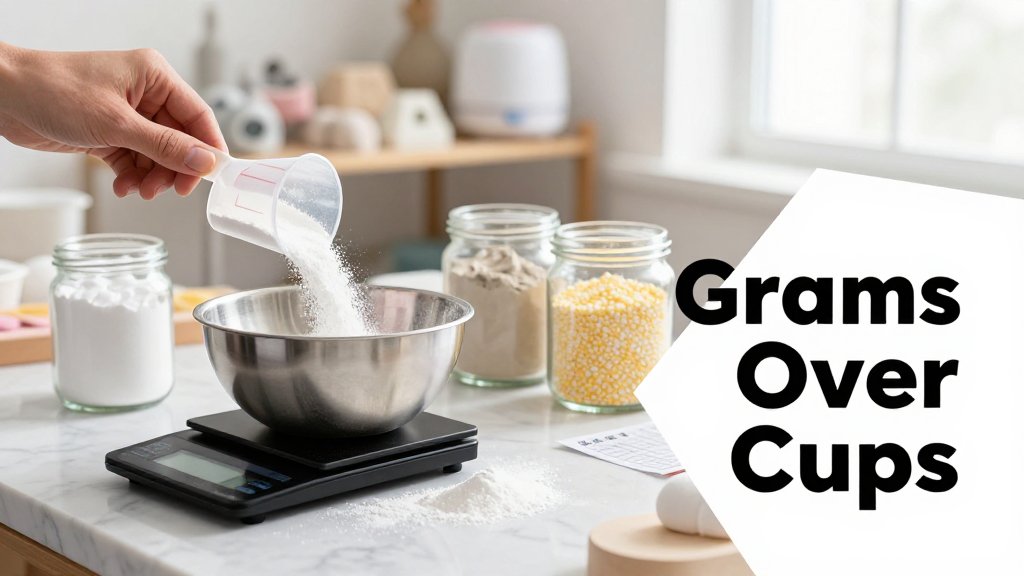
Ever make bath bombs with the same recipe twice, yet one batch fizzes perfectly and the next cracks or crumbles? The culprit is often volume measuring. A “cup” of citric acid can weigh very differently depending on how tightly it is packed, plus humidity and storage can quietly change your powders. In this guide, you will learn reliable DIY bath bomb ratios using a grams-first approach, plus quick cups-to-grams conversions when a recipe is written in cups. You will also get troubleshooting tips for consistent results.
Why grams beat cups for bath bombs
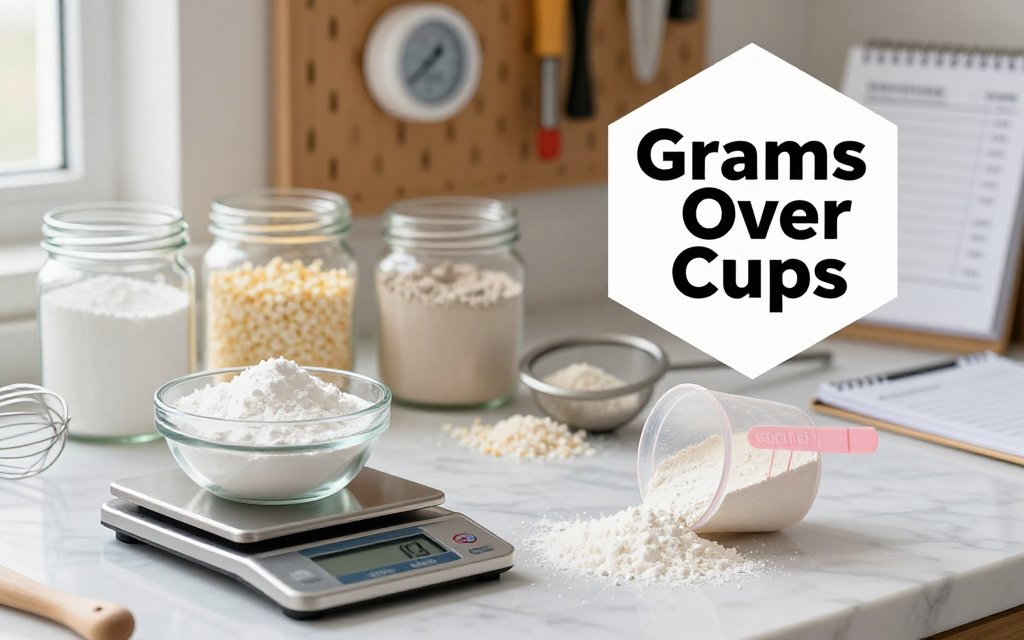
Cups feel quick, but they are a guessing game for bath bomb powders. Baking soda, citric acid, clays, starches, and powdered colorants all behave differently in a measuring cup because they trap air. A “level” cup can still mean very different amounts depending on how you filled it, how dry the room is, and whether the powder has clumped. Grams solve that in one move: you stop measuring the space the ingredient takes up, and instead measure the amount of ingredient you actually have. Once you switch to a grams-first formula, your batches get repeatable, your bombs press more predictably, and troubleshooting becomes much easier because you can change one number and know what really changed.
The sneaky reasons cups change your ratios
The biggest “cup problem” is packing. If you scoop baking soda straight from the box with a measuring cup, you compress it just by dragging the cup through the powder. If you spoon it into the cup and level it, you leave more air in the cup. Tapping the cup on the counter to “settle it” compresses it even more. Those tiny technique differences add up fast in bath bombs, where your dry mix might only be 300 g to 600 g total. For a concrete reference point, the KitchenAid sifter-and-scale conversion chart lists baking soda cup weight at about 221 g per cup. If your “cup” ends up even slightly heavier or lighter than that, your acid-base balance shifts, which changes how the bomb hardens and how it fizzes.
Grain size and clumps create a second layer of inconsistency. Citric acid can come as fine crystals or chunkier granules, and it loves to form hard clumps in a humid room or if the bag sits open. A cup of clumpy citric acid can contain big air gaps between chunks, so the cup looks “full” but weighs less than you think. The opposite happens with very fine powders like kaolin clay or titanium dioxide, which can pack densely and silently add extra grams. That matters because the same “1 cup baking soda” could push your mix toward too dry and crumbly (too much base and filler for the moisture you spritz), or toward premature fizzing if your acid ends up high and the mix gets lightly moisture-activated while you are pressing.
Humidity is the third culprit, and it is the one people underestimate. Powders pull in moisture from the air, especially citric acid, salt-based colorants, and some fragrance blends. Even if the cup-to-cup volume looks consistent, moisture changes how powders settle and how quickly the mixture starts reacting once you add witch hazel or water. On a rainy day, a batch that usually needs 6 to 8 quick spritzes might start binding after 3 spritzes, or it might begin to expand and “grow” in the bowl because fizzing started early. Weighing in grams will not remove humidity, but it removes the hidden variable of “how much powder did I really use,” which is what makes humid-day troubleshooting feel impossible with cups.
If you want bath bombs that press the same every time, stop chasing cups. Weigh your powders in grams, write the numbers on the container, and change only one variable at a time. Troubleshooting becomes fast and repeatable.
A simple baseline ratio you can trust
Use this as your baseline rule of thumb: start with a 2:1 baking soda to citric acid ratio by weight. That means 200 g baking soda to 100 g citric acid, or 400 g to 200 g if you are scaling up. This ratio works because it gives you a strong fizz without making the mix so acid-heavy that it wants to react the moment a little moisture hits it. It also gives you room to add “extras” (starch for silkiness, clay for slip, butters for conditioning) without accidentally turning your bath bomb into a soft, fragile puck. Once you write your formula in grams, doubling the batch is truly doubling, and a small tweak like “minus 10 g citric acid” is precise and easy to repeat.
From that 2:1 base, tweak in small percentages so you can tell what helped. A practical starter batch for testing is 300 g total main powders: 200 g baking soda and 100 g citric acid. Then add your additives as a measured fraction of that base, for example 15 g cornstarch (5%), 6 g kaolin clay (2%), or 9 g cocoa butter (3%). If you add heavy butters or lots of oils, your mixture can feel like wet sand sooner, so you often need less spritzing liquid to bind. If you add very dry “thirsty” powders like extra clay or lots of powdered botanicals, the mix can turn crumbly, and you may need a touch more binder or a slightly higher butter percentage. Grams let you record these adjustments like a recipe, not a hunch.
Grams also make your notes useful later. If a batch cracks, you can write, “next time add 2% more binder” and actually do it. If a batch fizzes too early, you can reduce your citric acid by 5 g to 10 g, or tighten your process (dehumidifier, faster pressing, airtight storage) while keeping the exact same powder weights. This is the same logic bakers use to keep bread and cookies consistent, even when weather and flour vary, and it is why ratio thinking transfers well across hobbies. If you like practical ratio shortcuts in other projects too, bookmark sourdough starter gram ratios for another example of how weight-based formulas make results easier to repeat.
Cup to gram conversions for bath bomb powders
Cups are handy for quick batches, but bath bomb powders are picky about moisture and packing. A “cup” of the same ingredient can swing up or down depending on brand grind, how hard you scoop, and even whether the powder sat open on a humid counter overnight. Use the gram estimates below as a starting point, not a lab-grade truth. If you are selling bath bombs, shipping packages, portioning food, or working with small molds, dialing in grams is what makes repeats actually repeat. If you do not have a physical scale, a photo-based estimator like the Scale for Grams iOS app can help you sanity-check amounts, but for reaction-heavy mixes, a real gram weigh-in is still the gold standard.
Quick conversions for baking soda and citric acid
Baking soda (base) plus citric acid (acid) is the fizz engine. Most recipes start with a 2:1 relationship by volume, like 2 cups baking soda to 1 cup citric acid, because it is easy to remember. The common mistake is stopping there and assuming “2 cups vs 1 cup” automatically means the same balance by weight. It does not. Citric acid crystals can pack differently than baking soda, and that density mismatch can shift your acid-base balance enough to change how fast the bomb reacts, how brittle it cures, and whether it feels too chalky or too “bitey” on sensitive skin.
For snippet-ready numbers people actually search, here are practical conversions for level measures (not heaping). These are based on common weight charts and real-world spoon-and-level measuring. For baking soda specifically, you will see values like 4.6 g per teaspoon, 13.8 g per tablespoon, and 221 g per cup in a KitchenAid gram chart. Round to the nearest gram and write your final numbers on your recipe card, so your second batch matches your first batch, not just your measuring style that day.
If your bombs crack, fizz too fast, or feel gummy, do not guess. Reweigh your last batch by grams, note your room humidity, then change one thing at a time, only 2% to 5% per test.
Common add-ins and how they shift the mix
Add-ins are where bath bombs get customized, and also where they get finicky. Cornstarch is a classic “softener” that can make the bomb feel silkier and a bit less aggressively fizzy, but it also drinks up binder, so too much can make the mix crumble in the mold. Epsom salt is heavier and crystalline, it can add a spa feel and a firmer pack, but large amounts can make a bomb feel gritty if it does not dissolve fast enough in the tub. Kaolin clay is very fine, it can help anchor fragrance and add slip, but it is absorbent, so it can push your mix toward dryness and premature cracking.
A simple way to stay out of trouble is to cap your “extras” at a small percentage of your total dry weight for the first few test batches. Try 3% to 5% cornstarch, 0.5% to 2% kaolin clay, and 5% to 15% Epsom salt, then adjust based on your climate and mold style. Example: if your core powders (baking soda plus citric acid) total 750 g, you might start with 30 g cornstarch (4%), 10 g kaolin (1.3%), and 60 g Epsom salt (8%). Once that batch presses cleanly and survives a 24-hour cure without cracking, you can step changes up gradually.
Humidity changes everything because these powders start absorbing water before you ever spritz witch hazel or add oil. In a dry room, a mix can look powdery but still press like perfect sand once you add 10 g to 20 g of liquid binder per 500 g of dry mix. In a humid room, that same “dry-looking” mix might already be partially activated, which is when you get early expansion in the mold, surface craters, or a bomb that puffs up and then collapses. Practical tip: keep powders sealed, weigh fast, and if you must measure by cups, do it the same way every time (spoon in, level off, no tapping).
If you are converting a cup-based recipe to grams for production, do one calibration batch: measure your usual “1 cup” of each powder, then weigh it once. Write those brand-specific grams next to the ingredient name, like “Brand X baking soda, 1 cup = 214 g in my kitchen,” and use your own number from then on. That one step saves money for small business makers and saves time for anyone portioning batches around shipping boxes or inventory. It also helps jewelry makers and fitness trackers who want consistency, because the habit is the same: pick a method, confirm it in grams once, then repeat with confidence.
Standardize batches and fix humidity problems
If your bath bombs feel like a different recipe every time, the problem is usually not your mold or your mixing. It is that cups measure space, and powders change how they fill that space from day to day. A humid afternoon packs “1 cup” heavier than a dry morning, and the same scoop can swing your fizz, hardness, and dry time. The fix is to lock your formula to weight percentages, then use those percentages like a small business would use a production spec. Once you have a grams-based baseline, you can adjust for weather in tiny, controlled changes instead of randomly adding more liquid binder and hoping.
Turn a cup recipe into a grams recipe in one batch
Make your cup recipe one time exactly as written, but pause after you measure each dry ingredient. For each powder, record an estimated weight in grams (or weigh it if you have a physical scale). Use the same measuring cup you normally use and level it the same way, because you are building a repeatable system. Once you have grams for every dry ingredient, add them up to get your total dry weight. From that moment on, you stop thinking in cups and start thinking in percentages of the total dry mix. That way, you can scale up, scale down, and swap molds without changing performance.
Here is a copyable, round-number example. Batch 1 dry mix: baking soda 400 g, citric acid 200 g, cornstarch 100 g, kaolin clay 100 g. Total dry weight = 800 g. Convert to percentages: baking soda 50%, citric acid 25%, cornstarch 12.5%, clay 12.5%. Now you can make any size batch by multiplying those percentages by your target total. Want 1,200 g of dry mix for a production run? Baking soda 600 g, citric acid 300 g, cornstarch 150 g, clay 150 g. Same recipe, same behavior, just scaled.
Next, standardize the “wet side” by weight too. Pick a starting point and write it down as grams per 100 g of dry mix. Example: 2 g of oil per 100 g dry (that is 16 g oil for an 800 g batch), then add binder spray in tiny weighed bursts. A practical method is to prefill your spray bottle, weigh it, mist 6 to 10 sprays, then weigh again. If you used 8 g of binder to reach that packable wet-sand texture for an 800 g batch, your binder rate is 1 g per 100 g dry. On humid days you might need only 0.5 g per 100 g; on dry days you might need 1.5 g per 100 g. Controlled tweaks beat guessing.
No physical scale? You can still stay consistent by using a phone photo weight estimate workflow, especially for powders. With Scale for Grams, use the same bowl or cup every time, place it on a plain counter, and include a common reference object in the frame (a coin or a standard card works well). Pour in one ingredient at a time, level it, take a photo, and log the estimated grams in your recipe notes. Repeat for each dry ingredient, then keep your future batches locked to those same percentages. The absolute number might be off by a little, but consistency is what makes batches match. Keep lighting similar, shoot from the same angle, and do not change container size mid-season.
How do I measure bath bomb ingredients without a scale?
Use one container setup and turn it into your “reference kit.” Measure each dry ingredient by cup like you normally would, then take a phone photo estimate in grams for that exact cup measure and write it down. Build your formula as percentages of total dry weight, then stick to those percentages every time. If you must adjust, adjust by percentages, not by spoonfuls. Practical trick: keep a small jar labeled “+10 g dry” with premixed baking soda and citric acid (same ratio as your base). If a batch feels too wet, you can rescue it by adding that mix in measured pinches.
How does humidity affect bath bomb weight ratios?
Humidity sneaks extra water into your powders, and that can start the fizz reaction early or make the mix feel wetter than it really is. The best defense is to keep your dry ratio stable (especially the classic 2:1 baking soda to citric acid relationship) and change only the binder rate. If bombs expand or stick on humid days, reduce binder by about 0.5 to 1 g per 100 g of dry mix, and increase a “drying helper” powder (kaolin clay or starch) by 2% of total dry weight. Bramble Berry specifically calls out the 2:1 baking soda ratio and warns that moisture and humidity are the common culprits behind texture problems.
My bath bombs are crumbly or expanding, what weight tweaks fix it?
Crumbly usually means the mix is too dry or under-bound. Keep your dry percentages the same, then add binder in tiny, tracked amounts: start with +0.5 g binder per 100 g of dry mix, mix for 30 seconds, then do the squeeze test. If it still will not hold, add another +0.5 g per 100 g. Expanding means the opposite, your mix is too wet or reacting in the mold. Fix it by lowering binder by 0.5 to 1 g per 100 g dry next batch, and optionally add +2 g clay or starch per 100 g dry to slow moisture pickup. Practical trick: if it expands in the mold, unmold immediately, break it back into crumbs, blend in +10 to 20 g of your premixed dry base, and remold firmly.
Need to weigh something fast, especially when you do not have a kitchen scale handy? Download Scale for Grams and get an AI-powered weight estimate from a photo in seconds. It is a quick way to sanity-check cup-based recipes, portion ingredients, or estimate totals while you shop. Grab it here: iOS. Try it on your next bath bomb batch and dial in repeatable ratios.
Scale for Grams
Need to Weigh Something?
Download Scale for Grams and get an AI weight estimate from a photo in seconds.