Handmade Soap Bar Weights: Labeling, Pricing, Shipping
Typical handmade soap bar weights in grams and ounces, how to label net weight without getting burned by water loss, and how to estimate packaged shipping weight so you do not underpay postage.
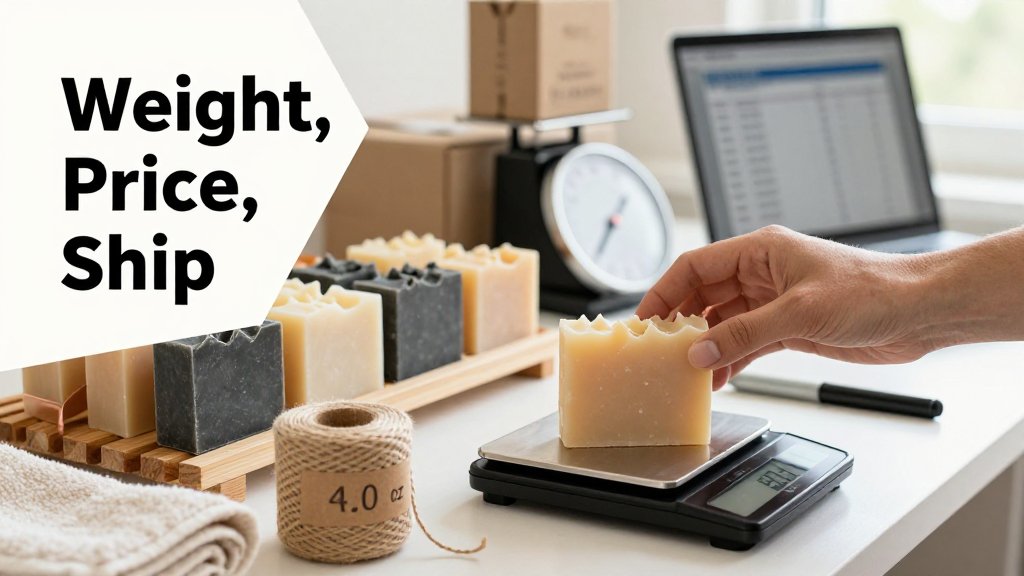
Getting soap bar weights right is not just a detail, it affects labeling accuracy, customer trust, and your bottom line on shipping. If you have ever wondered what net weight to put on a label, how to convert ounces to grams without second-guessing, or how much a wrapped bar really weighs for postage, this guide is for you. You will learn realistic target weights, easy conversion tips, and quick methods to estimate packaged shipping weight, even without a scale.
What does a handmade soap bar usually weigh
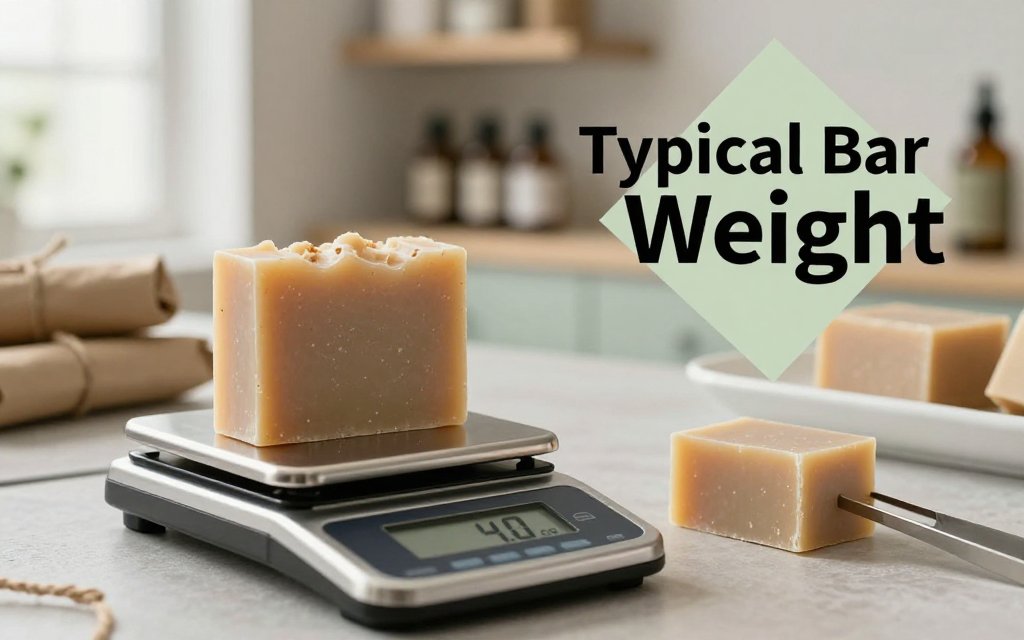
If you pick up a handmade bar at a market and it feels “about right,” it is usually somewhere around 3.5 to 5.0 oz (roughly 100 to 140 g) once it is cured and ready to sell. That range covers most everyday bath bars, plus it matches what many shoppers casually mean when they say “a 4 oz bar.” The surprise for first-time sellers is that two bars that look the same size can land on different weights, and a bar that was exactly 4.5 oz on cut day might be closer to 4.0 oz after curing. If you label based on the pour or cut weight, you can accidentally under-deliver later.
Fresh cut versus cured is the biggest reason the numbers move. Cold process soap is made with water (or milk, beer, etc.), and the bar slowly loses that liquid during cure. It can also lose a little more over time in dry climates, which is why a “4 oz” bar is best treated as a net weight promise at the time the customer receives it, not a goal at the moment you slice the loaf. One practical example comes from a commercial maker that explains how their bars weigh more right after making, then average less when shipped because water evaporates and the bar shrinks a bit. See how soap weight drops as it cures for a real-world reference point.
Average soap bar weight ranges you will actually see
Quotable answer: most cured handmade soap bars land in the practical 3.5 to 5.0 oz range (about 100 to 140 g), with common outliers on both ends for samples and oversized “spa” cuts. The tricky part is that weight is not only about size. A “water discount” recipe (less water in the lye solution) can produce a bar that reaches a sellable hardness sooner and may end up slightly heavier at the same calendar day because it started with less water to lose. Additives also swing weight: clays, salt, coffee grounds, and oat flour add solids; whipped soap or high-aeration textures can make the bar feel bigger without adding as much mass. Even “superfat” (extra oils left unsaponified) can change the feel and density.
Here are the ranges you will actually run into when you start weighing finished bars. Think of these as cured weights after a typical 4 to 6 week cure, not the loaf weight the day you unmold. In many home recipes, a reasonable expectation is that a bar may lose roughly 5% to 12% of its weight during curing, depending on how much water you used and how dry your room is. That is why two bars cut to the same thickness can end up with different “final” weights if they were poured on different days, or if one batch used a heavier fragrance load or a salt-heavy formula. For shipping, these differences matter: six bars labeled 4.0 oz can add up to a 1 to 3 oz swing in your package total once you include paper wrap and a box.
Cut at 4.5 oz if you want to sell a 4.0 oz bar. Most recipes lose weight during cure, so weigh again at week 4 and label the lowest consistent number you can always meet.
Quick conversions: ounces to grams for labels
The most searched conversion is simple: a 4 oz soap bar is about 113.4 g (because 1 oz is about 28.35 g). Makers commonly work near that number, so here are a few label-friendly neighbors you will see in the wild: 3.5 oz is about 99.2 g, 4.0 oz is about 113.4 g, 4.5 oz is about 127.6 g, and 5.0 oz is about 141.7 g. If you sell to jewelry makers or anyone used to precious metals, call out that you mean the everyday ounce (avoirdupois), not a troy ounce. For packaging, dual labeling like “Net Wt 4.0 oz (113 g)” helps shoppers compare bars quickly.
Pick a net weight you can hit consistently after cure, not your “goal” weight on cut day. A practical workflow for a new recipe is: (1) cut a few bars at a known fresh weight, like 4.6 oz each, (2) cure them on the same rack you will use for real inventory, and (3) re-weigh at week 4 and week 6. If the lowest bar lands at 4.05 oz, labeling at 4.0 oz is comfortable. If one drops to 3.85 oz, you either cut thicker next batch or label at 3.8 oz. This is also where additives matter: a heavy salt bar might stay closer to its cut weight, while a high-water goat milk bar can drift lower. Your label should match what ships, not what you hoped for on soap day.
A simple visual size check to avoid surprises
A quick visual guide can prevent the classic customer message: “This doesn’t look like 4 oz.” Create a repeatable photo reference for your shop: place a cured bar next to a ruler and one common object (a credit card, a standard lip balm tube, or a 1 inch binder clip). Then store that image with your product listing photos, so buyers see both the net weight and the real size at a glance. This also helps you stay consistent when you change molds, because a tall skinny bar can weigh the same as a short wide bar, but it feels different in the hand. If you need a fast estimate while you are packing orders or planning postage without grabbing a scale, the same idea applies to gear and boxes too. Start with estimate gear weight from photos, then adapt the “reference object” trick to your soap setup.
How to label net weight in ounces and grams
Your net weight is the number customers remember, and it is the number an inspector will check if your booth ever gets a spot audit. For bar soap, think “net weight” as the cured soap only, not the paper band, box, or shrink wrap. The tricky part is that soap keeps losing water as it cures, so a bar that weighs 5.0 oz on cut day might be 4.3 oz after a four to six week cure. If you label too early, you end up accidentally promising more than you deliver. The goal is simple: pick a net weight that stays true, even after cure, even after a couple humid days, and even after you wrap and transport it to a market.
Pick a net weight you can meet after cure
Choose the lowest weight you reliably hit at the end of cure, then label slightly below that. That is the easiest way to stay compliant without reprinting labels every batch. A practical workflow is to pull a handful of fully cured bars from the batch you consider “normal,” weigh at least 10 bars, and write down the minimum. Example: your cured bars range from 118 g to 110 g. Instead of labeling “Net Wt 113 g” because that feels like the average, label 108 g or 110 g so the lightest bar still clears the promise. Customers rarely complain that a bar is heavier than the label, but they do notice when it is lighter.
Weigh at the same point in your process every time, because timing changes the number. Many small makers get the most consistent results by weighing twice: once at “cured and trimmed,” and once again after packaging, just to confirm nothing odd happened in storage. Humidity swings can move bar weight by a few grams, especially if you cure in a basement, then store finished soap in a tighter plastic tote, then take it out into summer air at an outdoor market. Even your wrap can matter. A paper cigar band might be 2 g to 4 g, and shrink film can be similar, but those materials do not belong in your net weight. Net means product only.
Decide whether you are labeling each bar or labeling to a batch minimum. For the most “sleep well at night” approach, label every bar with its actual net weight, like 4.2 oz (119 g) on a small sticker. That is especially helpful if you hand cut uneven loaves or you sell “end pieces” at a discount. If you want one printed label for the whole batch, set that label to the minimum you can meet, not the average. If your lightest cured bar is 3.9 oz, printing “Net Wt 4.0 oz” is asking for trouble. Instead, print “Net Wt 3.8 oz (108 g)” and let your typical bars come in a bit over.
Label format basics: ounces, grams, and placement
Use a clear “Net Wt” line, put it where shoppers can see it on the front, and show both ounces and grams to reduce confusion. A clean example that works well at market booths is: “Net Wt 4.0 oz (113 g)”. That one line helps the customer who thinks in ounces, and it also helps the customer who compares everything in grams for shipping, recipes, or portion tracking. For placement, most U.S. packaging rules expect the net quantity statement on the principal display panel, typically in the bottom portion of the front label. If you want a solid reference for formatting and placement expectations, skim the NIST labeling guide and mirror the examples in plain language.
Rounding is where labels quietly go wrong, so keep it conservative and consistent. Ounces on a bar soap label are ounces by weight, and it is common to print one decimal place, like 4.0 oz or 3.5 oz. Grams are usually easiest as a whole number. For quick reference, 4.0 oz is about 113.4 g, so “(113 g)” is a reasonable rounded metric equivalent. If you label 3.8 oz, that is about 107.7 g, so “(108 g)” fits. The key rule in everyday terms is: do not round in a direction that could make the label claim higher than what you can actually deliver. If some bars hit 107 g, do not print 108 g.
Avoid the two biggest mistakes: labeling a pre-cure weight and mixing up fluid ounces with ounces by weight. Soap is sold by weight, so “oz” here means a weight ounce, not “fl oz,” which is volume used for liquids like body wash. Another common slip is adding “approx” as a safety blanket. Customers read “approx 4 oz” as “4 oz,” and you still risk complaints if a bar feels small. If you need a quick spot check at a booth without a physical scale, a photo-based estimator like Scale for Grams can help you sanity-check whether your “4.0 oz (113 g)” bars are in the right neighborhood before you put them on the table. Treat it as a backstop, then keep your printed net weight tied to your lowest fully cured bar.
How to estimate shipping weight for handmade soap
Postage surprises usually happen for one reason: you priced shipping based on the soap bar alone, but you mailed a soap bar plus packaging. For most sellers, the “real” mailing weight is the cured bar weight plus wrap, plus a box or mailer, plus padding, plus the label and tape. If you underpay, the package can arrive with postage due, get delayed, or come back to you. The goal is not perfect lab accuracy, it is a repeatable packed-weight estimate you can confidently round up. That estimate also makes it easier to set flat-rate shipping for 1 bar, 2 bars, and gift sets without constantly guessing.
A simple packed-weight estimate that prevents postage surprises
Rule of thumb you can quote in your shop notes: shipping weight is the cured bar weight plus packaging, and packaging is often 20 to 60 g per bar depending on how you pack. A bare cigar band and a thin paper sleeve might only add 3 to 8 g. A bubble mailer, label, and tape can add 15 to 30 g. A small cardboard box with crinkle paper can add 40 to 80 g. If you ship premium bars with thick tissue, a sticker, and extra padding to protect corners, assume you are on the high end. The safest habit is to round up to the next ounce (or next 10 g).
Packed shipping weight equals cured soap weight plus packaging. For most single-bar orders, add 20 to 60 g per bar, then round up. Your future self will thank you when postage adjustments disappear.
To make this predictable, build one complete “standard pack” and treat it like a template. Pick one bar size you sell often (for example, a 120 g to 135 g cured bar). Pack it exactly how you would for a customer: band or label, inner wrap (tissue or glassine), then either a 6 in x 9 in bubble mailer or a small tuck-top box. Add your typical filler amount (crinkle paper or kraft paper), then seal it with the same tape length you always use. Once you know that packed weight, reuse that number for dozens of orders. If you change any component, like switching to a thicker box, update the template.
Here is a real-world example you can copy: you sell a “4.5 oz” bar that cures out around 128 g. You wrap in a thin paper sleeve (4 g) and add a small ingredients label (1 g). Your go-to 6 in x 9 in bubble mailer is 18 g, and you use about 2 g of tape. Packed estimate: 128 + 4 + 1 + 18 + 2 = 153 g. If you ship in a 4 in x 4 in x 2 in box instead, the box plus crinkle paper can easily be 55 g to 75 g, so that same bar becomes roughly 185 g to 205 g. Writing down both “mailer pack” and “box pack” numbers prevents underpayment when customers choose gift packaging.
FAQ: soap weight, labeling, and shipping estimates
These are the three edge cases that cause the most confusion when you are labeling and shipping soap: converting ounces to grams accurately, deciding whether to label right after cutting or after cure, and estimating shipping weight when you do not have a physical scale. Use the answers below as a quick troubleshooting checklist. The big idea is consistency: pick one point in your process to set “net weight” (usually after cure and trimming), then pick one packing template to set “shipping weight” (soap plus packaging), and stick with those numbers until something changes.
How much does a 4 oz soap bar weigh in grams
A 4 oz soap bar (by weight, not fluid ounces) is about 113.4 g, because 1 oz equals 28.349523125 g. You will usually see it rounded to 113 g on labels. If your bars cure out a little heavier or lighter, that is normal, but the conversion itself is fixed. For a quick check: 3.5 oz is about 99 g, 4.0 oz is about 113 g, and 4.5 oz is about 128 g. If you want the exact factor for your records, NIST publishes an ounce to gram factor.
Can I label my soap at the weight right after cutting
Labeling right after cutting is risky because the bar is still losing water as it cures, and it often gets a little lighter after trimming and planing. If you label a fresh-cut bar at 5.0 oz (142 g), it might cure down several grams, and your labeled net weight could end up higher than what the customer actually receives. A practical approach is to pick a “label point” that matches your process, like “after 4 to 6 weeks cure, after beveling, and after final wipe-down,” then only label based on that stage. For online listings, describe your bars as “minimum net weight” so normal cure variation does not create a compliance headache.
How do I estimate shipping weight if I do not have a scale
If you do not have a scale, aim for a safe estimate with two numbers: (1) the bar weight estimate, and (2) a packaging allowance you always add. For the bar weight, you can use a photo-based estimator like Scale for Grams on iOS to get a quick grams estimate from a picture, then round up. For packaging, use a conservative add-on like 40 g for a bubble mailer pack or 70 g for a small box with filler, then round up again to the next ounce. For multi-bar shipments, add bar weights together, then add packaging once, not per bar. This method is intentionally cautious, but it prevents postage due on real orders.
Need to weigh something fast when you do not have a scale nearby? Download Scale for Grams and get an AI-powered weight estimate from a photo in seconds. It is a handy way to sanity-check soap bar sizes, packaging weight, or small shipping items before you print labels or list products. Grab it here for iOS and try a quick estimate today.
Scale for Grams
Need to Weigh Something?
Download Scale for Grams and get an AI weight estimate from a photo in seconds.