How Heavy Are Gemstone Beads? Size to Grams
Need to estimate bracelet or necklace weight fast? This guide shows how gemstone bead size translates to grams, why quartz and glass can weigh differently at the same mm size, and how to estimate jewelry weight from photos when you do not have a scale.
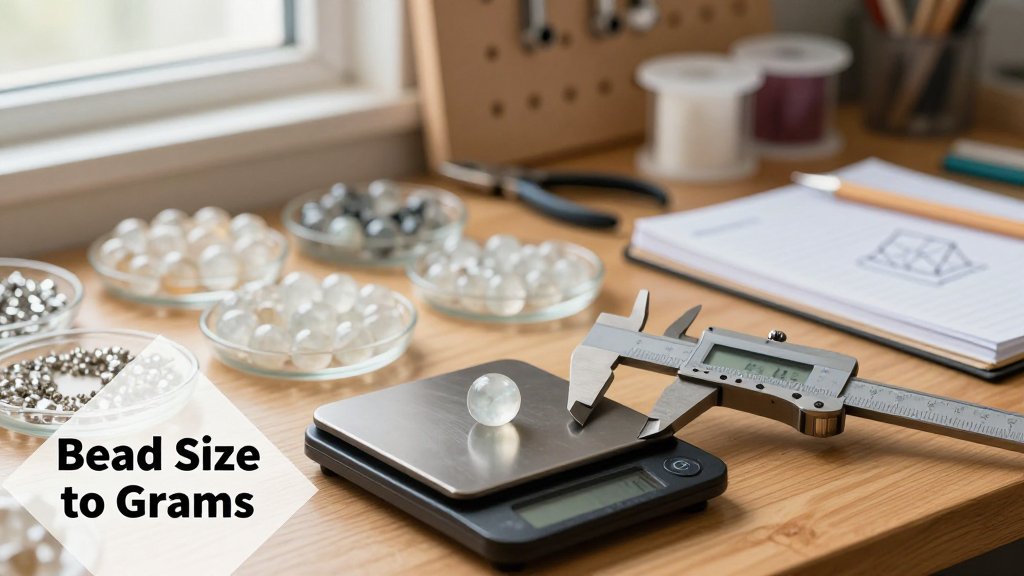
Gemstone bead weight can make or break a project, whether you are mapping out a bracelet, calculating postage, or pricing a finished strand. The catch is that bead size is not bead weight, and an 8mm bead in one material can weigh far more than an 8mm bead in another. In this guide, you will learn a practical size-to-grams mindset, the key factors that change weight, and a simple workflow for estimating grams from a photo when you do not have a scale.
Gemstone bead weight by size, the quick math
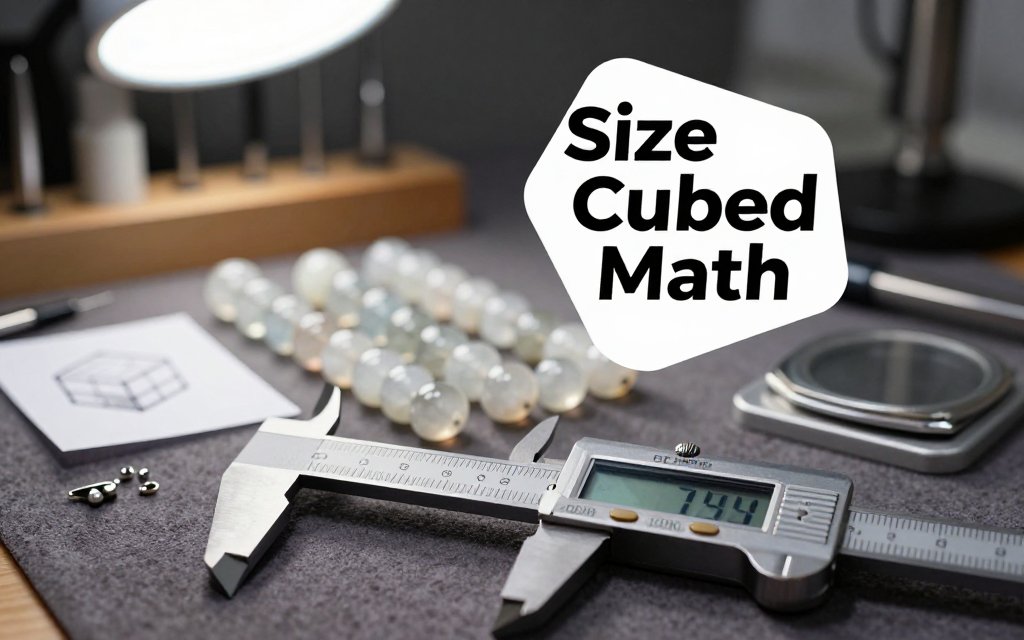
Bead weight is mostly about volume, and volume grows fast as millimeters increase. A round bead is basically a tiny sphere, and a sphere’s volume depends on the radius cubed (not the diameter plus a little). That is why an 8mm bead is not “a little bigger” than a 6mm bead in weight, it can be more than twice as heavy in the same material. If you like formulas, the key idea is the sphere volume formula; if you do not, just remember “bigger by mm” quickly becomes “much heavier by grams.” (en.wikipedia.org)
Treat bead diameter like a volume problem, not a ruler problem. Jumping from 6mm to 8mm usually means about 2.4x the bead grams. Estimate grams per bead first, then multiply by bead count and add a small findings allowance.
A simple rule, weight scales with size cubed
Here is the plain-language shortcut: if you scale the bead size up, the weight goes up roughly by (new mm ÷ old mm)3. So 6mm to 8mm is not 33% heavier, it is about (83 ÷ 63) = 512 ÷ 216 = 2.37x heavier for the bead itself. In practical numbers, a “medium” stone-like bead (think quartz-like density) might be about 0.30 g per 6mm bead, but about 0.71 g per 8mm bead. Go to 10mm and you are near 1.4 g per bead. Those numbers vary by material, but the size-cubed jump is the part people underestimate.
This cube rule is gold for jewelry planning because it lets you sanity-check a design without a scale. Example: say your 6mm bracelet with 28 beads came out around 9 g of beads (0.32 g each as a rough average), plus 2 g of clasp and jump rings, so about 11 g total. If you rebuild the same bracelet in 8mm beads and keep the bead count similar, expect the beads alone to land closer to 21 g (9 g x 2.37), then add the same findings, so around 23 g. The common mistake is budgeting stringing wire, elastic, and clasps correctly, but under-estimating bead weight because your brain thinks “only 2mm bigger,” instead of “much more volume.”
The fastest estimate, per-bead grams then multiply
The workflow is simple, and you can do it on a sticky note. First, pick the bead diameter (6mm, 8mm, 10mm). Second, choose a material category so you are not guessing in the dark: light (plastics, wood, very porous stones), medium (most common stone and glass beads), heavy (dense stones and metal beads). Third, estimate grams per bead once, then multiply by bead count. For a fast start, a medium 8mm round bead is often around 0.6 g to 0.8 g; a medium 6mm is often around 0.25 g to 0.35 g. Finally, add a small fixed “findings allowance” for clasp, jump rings, crimp beads, and spacer bars, often 1 g to 3 g total for most everyday designs.
Now turn that into totals you can actually use. Bracelet example: 8mm beads, 23 beads, medium weight assumption at 0.70 g each. Beads total about 16.1 g. Add 2 g for findings and you are near 18 g finished. Necklace example: 8mm beads, 45 beads (a common count for a shorter strand depending on spacing). 45 x 0.70 g is 31.5 g of beads, plus 2 g to 4 g of findings, so roughly 34 g total. This quick math is perfect for pricing (your materials cost and shipping tier), checking “will it feel chunky,” and even travel planning if you carry heavy jewelry, which pairs nicely with our estimate luggage weight tips.
Two tiny adjustments keep your estimates realistic. First, most round beads are drilled, so the bead is not a perfect solid sphere. If you want to be conservative, take 5% to 10% off your per-bead estimate, especially for larger hole sizes or big faceted beads. Second, spacing changes weight less than people expect, but bead count changes everything, so measure the planned length and do a quick “beads per inch” check before you commit. If you need a fast double-check and do not have a physical scale, a photo-based tool like Scale for Grams can help you estimate the weight from a picture so you can confirm your per-bead assumption before you list a product or print postage.
Why quartz, glass, and agate weigh differently
If you have ever bought two “8 mm gemstone” strands and one feels noticeably heavier, you are not imagining it. Bead weight is mostly about density, which is simply how much mass is packed into the same space. Quartz and agate (a type of microcrystalline quartz) are both stone, so they sit in a similar weight range. Glass can land surprisingly close to stone, which is why “glass agate” lookalikes can fool your hands and your shipping label. Resin, wood, and hollow composites are the big curveballs, they can look identical in photos but weigh dramatically less. Metal beads are the opposite, a small size can still feel heavy and “clunky” on a bracelet.
Density cheat sheet, what feels heavier at the same size
For quick estimating, it helps to think in “density buckets.” Most stone-like beads you see on Etsy, Amazon, and bead shops cluster in a middle zone, so your estimate will be close as long as you pick the right bucket. Quartz is a great reference point because it is common and well documented. For example, a typical quartz density value is about 2.65 g/cm3. Soda-lime glass often sits around 2.4-2.5 g/cm3, close enough that size variation can matter more than material. Resin is usually around 1.1-1.4 g/cm3, which means a resin bead can be close to half the weight of the same size stone bead.
That “feel test” matters when you are buying online. If two 8 mm strands look identical in photos, the heavier one is often truly stone or glass, while the very light one is often resin, acrylic, or a hollow imitation. A practical shipping example: imagine a 25 bead bracelet. If each bead is about 0.65-0.75 g (typical stone or glass), the bracelet can land around 16-19 g before you add a clasp or cord. If it is resin at roughly half that, the same bracelet might be closer to 8-11 g. Those differences are big enough to bump you into a different postage tier once you add a padded mailer and a box.
Hidden details that change weight, hole size and faceting
Even if you guess the material correctly, beads are not solid marbles. The drill hole removes real volume, and a bigger hole removes a lot more than you think because the removed volume grows with the square of the hole radius. With an 8 mm round bead, a 1.0 mm hole (common for elastic bracelets) removes a small “core.” A 1.8 mm hole (common for thicker cord, some mala strands, or inconsistent mass-produced beads) removes roughly three times as much material. Across a 25 bead bracelet, that can easily be about 1 g difference in finished weight, just from hole size. If you are estimating grams for shipping labels, that 1 g can be the difference between rounding up or staying under your target weight.
“8 mm” is also a marketing label, not a guarantee. Real bead-to-bead tolerances are normal, and it is common to see 8 mm beads that measure closer to 7.6 mm on one batch and 8.4 mm on another. That sounds tiny, but volume scales with size cubed, so small diameter changes can create surprisingly large gram changes. In practical terms, two bracelets with the same bead count can differ by several grams just because one batch runs big. Faceting changes weight too, faceted rounds and rondelles have less volume than smooth rounds at the same widest measurement. If you are matching a previous order’s “feel,” faceted beads often come out lighter than you expect.
Plated and “composite” beads are another common gotcha. A bead listed as “gold” might be a thin plating over brass, steel, or even plastic, and the base material drives most of the weight. Similarly, dyed stone is still stone (the dye rarely changes grams in a meaningful way), but reconstituted stone (stone dust plus resin binder) can land somewhere between stone and resin depending on the mix. If you do not know what you have, choose your assumption using multiple clues: how cold it feels at first touch (stone and glass tend to feel cooler), whether it makes a sharp clink (glass) versus a dull knock (resin), and whether a small magnet reacts (many metal spacers and some hematite beads will).
A simple way to stay accurate without turning this into a lab project is to pick a “default density” based on what the listing claims, then nudge it if the strand feels off. If the beads feel stone-like, start with a stone assumption (quartz or agate range). If they feel suspiciously light for their size, switch your assumption to resin or wood. If they feel heavy enough that a short strand seems to “drop” into your palm, treat them like metal or a heavy stone. For quick sanity checks, compare to common reference weights you may already know: a US nickel is 5.0 g and a US quarter is 5.67 g, so a bracelet that feels like “about two quarters” is roughly 11-12 g. When you use a photo-based estimator like Scale for Grams, this is the step that matters most, pick the closest material bucket first, then refine after your first real-world shipment or finished piece feels right.
Estimate bracelet and necklace weight without a scale
You can estimate a finished bracelet or necklace closely enough for pricing, comfort checks, and shipping tiers by combining three things: bead size, bead count, and a reasonable material assumption (for example, “most quartz-like gemstones”). The goal is not lab-grade precision. The goal is to land in the right ballpark, like 18 g versus 28 g, so you can pick the right mailer, stay under a postage tier, or write a listing that feels trustworthy. A photo is enough to do this repeatably, especially if you include one known item for scale and you remember to add a few grams for clasps and findings.
Photo-based workflow: measure, count, estimate, convert
Start by taking a straight-down photo on a flat surface, then include a reference object in the same plane as the beads. Easy options: a ruler, a cutting mat with a 1 cm grid, or a US coin. Coins work well because they are consistent and easy to spot in a photo. Try to avoid angled shots because perspective makes beads closer to the camera look larger. Good lighting matters too, since bead edges are what you will “measure” from the image. If you are using an AI photo scale app like Scale for Grams, the reference object plus a clear top-down photo makes it much easier to estimate bead diameter reliably.
Next, estimate bead diameter in millimeters from the photo, then count beads. For a bracelet, count every bead you can see, then check if any are hidden by the wrist curve or the clasp area. A simple trick is to count the visible half, then double it, then adjust by 1 to 3 beads if the photo shows overlap. For a necklace, estimate beads per inch (or per centimeter) by zooming in on a straight segment and counting how many beads span exactly 1 inch on your reference. Example: if 4 beads span 1 inch, an 18 inch strand is about 72 beads before you account for spacing, knots, or larger accent beads near the pendant.
Now apply a per-bead gram estimate based on size and “typical gemstone” density. A very usable rule of thumb for quartz, agate, jade-like stones, and many common gemstone beads is: 6 mm bead about 0.25 to 0.35 g, 8 mm bead about 0.6 to 0.8 g, 10 mm bead about 1.2 to 1.6 g. Multiply by bead count, then add findings. > Your estimate gets much better if you add the non-bead parts. A lobster clasp, jump rings, and a short extender usually add 2 to 5 g, even on small pieces. Finally convert grams to ounces for shipping labels: divide grams by 28.35. NIST’s NIST conversion factors list 1 oz as about 28.35 g, which is accurate enough for postage and buyer-facing estimates.
FAQ: How heavy are gemstone beads? Size to grams
How much does an 8mm bead weigh in grams?
A typical 8 mm round gemstone bead often weighs about 0.6 to 0.8 g per bead, assuming a quartz-like stone (many agates and jaspers land close). If the bead is a heavier material like hematite, it can be closer to 1.1 to 1.4 g per bead. If it is porous and lightweight (for example, lava stone), it may be more like 0.4 to 0.6 g. Drilled holes and faceting shave a little weight, so treat these as practical ranges, not absolutes.
How do I estimate the weight of a bracelet or necklace from bead count?
Multiply bead count by a per-bead estimate, then add a findings allowance. Example bracelet: 23 beads at 8 mm, using 0.7 g each, gives 23 x 0.7 = 16.1 g. Add 3 g for a clasp and jump rings, total about 19 g. Example necklace: 75 beads at 6 mm, using 0.30 g each, gives 22.5 g, then add 4 g for clasp and extender, total about 26.5 g. If you have metal spacers, add about 0.1 to 0.3 g each (more if they are chunky).
How do I convert grams to ounces for jewelry and shipping labels?
For shipping labels, use avoirdupois ounces: ounces = grams ÷ 28.35 (and grams = ounces x 28.35). Quick checkpoints: 10 g is about 0.35 oz, 20 g is about 0.71 oz, 30 g is about 1.06 oz. For postage tiers, round up a bit to stay safe, especially once you add a jewelry box, bubble mailer, and invoice. If your jewelry niche uses “troy ounces” for precious metals, do not mix them up with shipping ounces, since troy ounces are a different size.
Need to weigh something fast, even when your scale is not nearby? Download Scale for Grams to get an AI-powered weight estimate from a photo in seconds. It is perfect for quick bead checks, shipping prep, and last-minute pricing decisions. Try it now on iOS, snap a clear photo, and let the app do the math so you can get back to making.
Scale for Grams
Need to Weigh Something?
Download Scale for Grams and get an AI weight estimate from a photo in seconds.