How Many Grams Is a Cup of Kibble?
A practical guide to converting cups to grams for dog and cat kibble, why grams-per-cup varies by brand, and how to portion consistent meals even when you do not have a kitchen scale.
If you have ever wondered, "How many grams is a cup of kibble?" the most useful truth is this: there is no single grams-per-cup number. Kibble size, shape, density, and even how you scoop can change the weight, which can quietly nudge your pet’s portions up or down over time. In this guide, you will learn how to find your brand’s grams-per-cup on the bag, how to calculate it if it is missing, and a simple photo-based way to stay consistent when you are away from your kitchen scale.
How many grams are in one cup of kibble
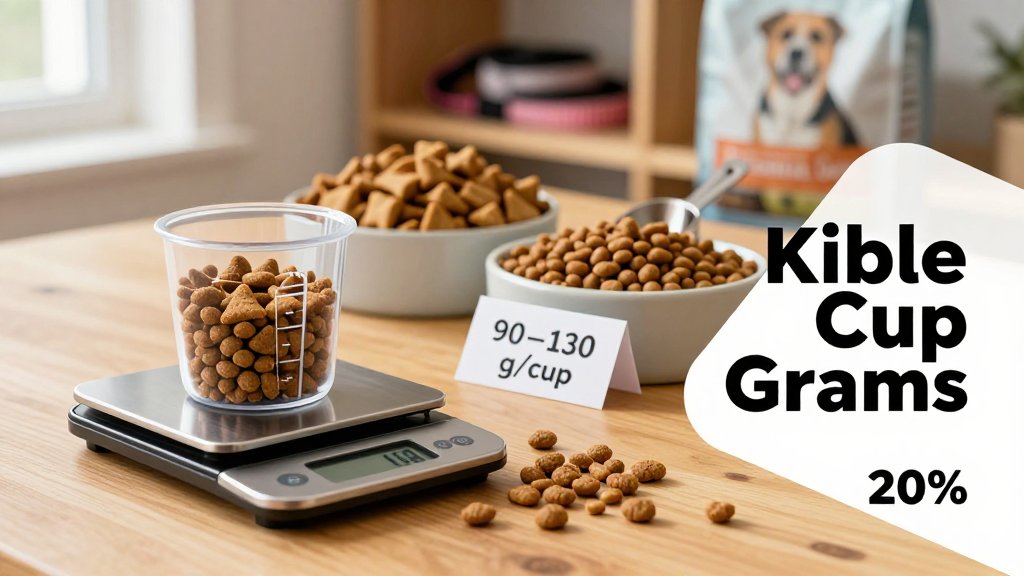
One cup of kibble is not a fixed weight, but for most dry pet foods, a level US cup usually lands somewhere around 90 to 130 grams (about 3.2 to 4.6 oz). That range is wide on purpose, because “1 cup” measures volume, and kibble is mostly air gaps plus little nuggets of varying density. If you want a quotable rule of thumb, use this: cups are a handy starting point, grams are the repeatable answer. Once you know the grams per cup for your specific bag, you can feed the same amount every day, even if your scoop, cup, or pouring style changes a little.
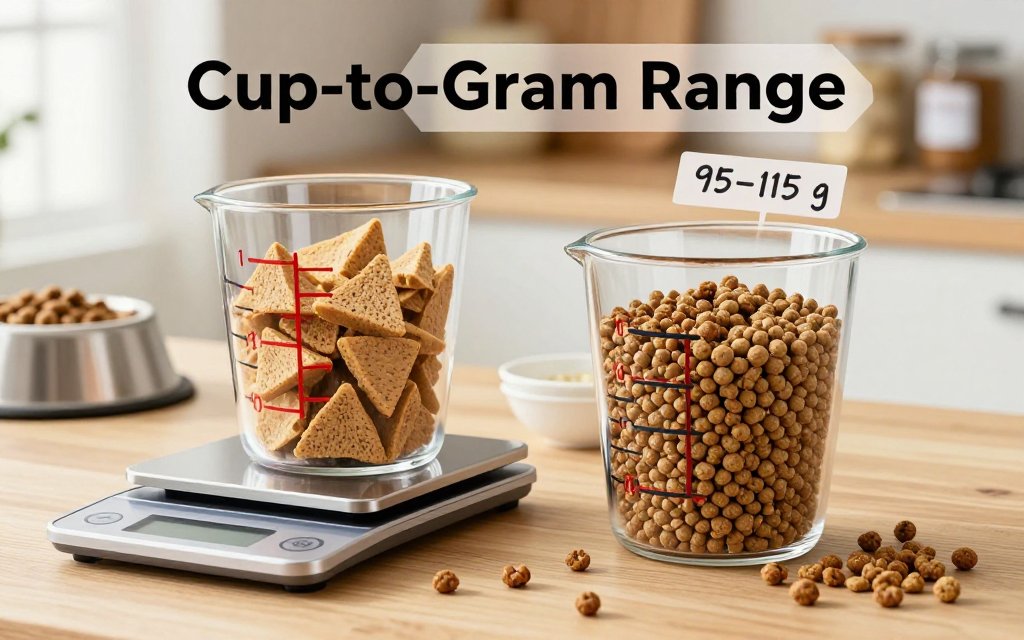
Two kibbles can both fill a “1 cup” measuring cup and still weigh very differently. Picture one food with big puffy triangles and lots of space between pieces, and another with small compact pellets that settle into every gap. The cup is full in both cases, but the dense pellets pack more actual food into the same volume. This is where real-life feeding mistakes show up: grabbing a tall skinny cup from the drawer, scooping loosely and leaving it mounded, or switching brands without re-checking grams. A small difference per cup adds up quickly when you feed multiple cups per day.
Quick answer range for most dry pet food
If you need a practical range right now, many dry dog foods cluster around roughly 95 to 115 g per level US cup, with plenty of formulas drifting lighter or heavier. Inukshuk notes that common dog food brands typically range from 95 g to 115 g per cup and also provides cup and gram feeding guides you can compare against your bag. For dry cat food, a useful day-to-day range is often about 80 to 120 g per cup, again depending on shape and density. As a pattern, high-fat, airier, larger-kibble blends often weigh less per cup, while dense, small pellets often weigh more per cup.
Here is how the “same cup, different results” problem shows up in a home: you feed your 45 lb dog 2 cups a day of Food A, and life is stable. Then you switch to Food B because it is on sale, and you keep feeding 2 cups. If Food A was 100 g per cup and Food B is 125 g per cup, your dog just went from 200 g per day to 250 g per day. That extra 50 g daily can push weight gain over a few weeks, even if the bowl looks identical. The opposite happens too: switching from a dense kibble to an airy kibble can accidentally cut grams, and a dog can slowly lose weight while you swear the scoop has not changed.
The easy fix is to anchor your routine in grams, then use cups only as a scooping tool. Check your bag for a grams-per-cup statement (some brands print it near the feeding chart), or weigh one level cup once and write it on the container. After that, conversions are simple: if your target is 160 g a day and your food is 105 g per cup, that is about 1.5 cups, but the goal stays 160 g. This same habit helps if you track your own portions, because “volume guesses” drift; the idea behind palm-based macro tracking in grams is the same, you want a repeatable unit that survives real life.
If you want the same meal every day, measure kibble in grams, not cups. Keep one scoop, level it once, and log the grams for that food, then adjust only by grams when brands change.
Why cups vary by brand, shape, and scoop style
Three things drive the gap between “1 cup” and the grams you actually feed. First is kibble density, which changes with ingredients, fat level, and how the kibble is processed. Second is kibble size and shape, because that controls how much air space gets trapped when the pieces pile up. Big odd shapes tend to bridge and leave gaps, so the cup looks full at a lower weight. Small uniform pellets settle like gravel, so the same volume holds more grams. Third is user technique: packed versus leveled versus heaping is not a small difference, it can be the difference between consistent feeding and slow drift over time.
To tighten up your measurements, use the same scoop every time, fill it once, and level it with a straight edge like the back of a butter knife. Skip the “shake to settle” habit, because shaking often compacts small pieces and bumps the grams up without changing what you see at the rim. Also watch out for non-standard cups. A true US measuring cup is 236.6 ml, but a random kitchen mug or a tall skinny cup can be hard to level consistently, so your “cup” becomes more like a moving target. The takeaway is simple: cups are convenient for scooping, grams are how you make it repeatable.
Find grams per cup on your pet food label
Grab the bag (or the storage bin lid) and do a 2 minute scan before you guess. The best-case answer is usually already printed on the packaging or on the brand’s product page, because many feeding guides use grams for accuracy and cups for convenience. Your goal is to find one clean conversion you can reuse: grams per 1 US cup of that exact formula. Do not rely on “a cup of kibble is about…” rules from other brands because kibble size, density, and oil coating can change the weight a lot from one recipe to the next.
Where to look for the grams-per-cup conversion
Start on the feeding chart area, usually a side panel on dog food bags and the back panel on many cat food bags. Zoom in with your phone camera and look for exact wording like “1 cup = X g,” “grams per cup,” “g/cup,” or “grams per measuring cup.” Some brands also spell out the measuring tool as “standard 8 oz measuring cup,” which is a volume cup (8 fluid ounces) and should match a US measuring cup. As a real example of the kind of line you are hunting for, this Royal Canin cup-to-gram chart includes a clear conversion such as 1 cup (8 fluid ounces) equaling 108 grams for one dry formula.
If you only see cups (like “1 to 1 1/4 cups per day”), do not assume the bag is hiding grams somewhere else. Instead, switch tactics: look up the exact product name plus “grams per cup” on the brand website, then check the product’s feeding guide, FAQ, or portion calculator. If you still cannot find it, contact customer support and ask one specific question: “How many grams are in 1 US measuring cup (8 fl oz) of this formula?” That wording matters because some brands include their own scoop sizes in promotions, and a branded scoop can be larger or smaller than 1 cup.
Once you find grams per cup, protect it from common measurement drift. Always use the same dry measuring cup (or the same labeled scoop) and fill it the same way every time. Pour kibble in, then level it with a straight edge like a butter knife. Do not shake the cup to “settle” pieces unless you always do it, because settling can add noticeable extra food. A heaping cup can easily run 10% to 20% heavier than a leveled cup, depending on kibble shape. Example: if your label says 120 g per leveled cup, a casual heaping fill might land closer to 132 g to 144 g, which adds up fast over a week.
Two simple at-home estimation tests without a scale
Method 1: Use calories as a bridge. Many bags list calorie density as “kcal per cup” (sometimes also “kcal/kg”). If your vet or feeding plan gives a daily calorie target, you can estimate cups per day without weighing anything. Example: your dog needs 400 kcal/day and the bag says 500 kcal/cup. That is 400 ÷ 500 = 0.8 cups per day. Once you locate grams per cup online for that exact food (say it is 120 g/cup), you can convert to grams: 0.8 cups/day × 120 g/cup = 96 g/day. Keeping one decimal place (0.8, not “about 1 cup”) helps keep the error small.
Method 2: Use a known-weight reference object plus a photo-based estimator. Pick a reference that is consistent and easy to repeat, like US coins. A modern US nickel is 5.000 g and a US quarter is 5.670 g. Place 4 quarters together (22.68 g total) next to a leveled cup of kibble on a flat surface, then take a clear overhead photo with good lighting. In the Scale for Grams app, estimate the kibble weight from the photo, and use the coin weight as a quick sanity check for your setup. Repeat the photo three times with three separate leveled fills of the same cup, then average the three gram results to get an approximate grams-per-cup for your exact kibble and your exact cup.
Two easy mistakes can wreck your consistency even if your math is perfect: mixing scoop sizes and changing cups mid-week. If one person uses a 1 cup scoop and another person uses a 2 cup scoop “filled halfway,” the portions rarely match. Same problem if you switch between a metal measuring cup and a plastic one with a thicker rim that changes how you level it. Pick one cup, label it, and stick with it. For small pets, tiny differences matter. If a cat eats 1/4 cup twice a day, being off by just 10 g per day can change calories noticeably over time. Make one note, then re-verify whenever you change recipe, kibble size, or bag lot.
Portion kibble accurately in grams without a scale
If you can repeat the same gram portion every day, you will get more consistent results than chasing “one cup.” Cups measure volume, but kibble pieces vary in size, shape, and how much air space sits between them. One day you scoop loosely, the next day you tap the cup on the counter and accidentally pack in more food. Grams sidestep all of that. A repeatable 80 g dinner stays 80 g dinner, whether the kibble is tiny cat nuggets or big, airy dog triangles. For busy households and anyone tracking nutrition, “same grams every time” is the calm, reliable target.
A practical way to do this is to pick a grams-per-meal goal, confirm it once, then stick to grams as your daily routine. Pet owners can pull the gram target from the bag (for example, a feeding guide might translate to 240 g per day for an active 50 lb dog, which becomes two meals of 120 g). Fitness trackers who log food portions can do the same for meal prep, like packing 60 g of kibble into a training treat container and logging it once, rather than guessing with a scoop. Even for shipping small packages, “grams first” helps you stay consistent when you do not have a scale handy.
A repeatable routine for grams-based feeding
Start by choosing your grams target from the label or your vet’s guidance, then lock in your tools: same bowl, same cup, same habit. Confirm the grams one time at home (or borrow a kitchen scale once) by weighing a “normal” scoop from your cup, then write down your personal grams-per-cup for that exact food. Leveling matters, so use a flat edge to level the scoop the same way each time, like the dry cat food measuring steps describe. Re-check grams-per-cup any time you switch brands, flavors, kibble size, or life-stage formula. Even within one brand, a chicken recipe and a salmon recipe can pour differently.
A photo-based weight estimator can be a helpful backup when you are traveling, at the office, or packing meals where a physical scale is not available. For example, if your dog’s target is 120 g per meal, you can portion kibble into the same bowl or container, snap a photo, and get a grams estimate to keep your feeding routine close to normal. To reduce error, keep your setup consistent: use the same container every time, photograph from the same angle and distance, and aim for bright, even lighting (window light beats a yellow lamp). Avoid harsh shadows, shiny bowls, and cluttered backgrounds. If you change containers or lighting, do a quick “reality check” once when you get home so your next estimate stays on track.
Is 1 cup of dry dog food always the same grams?
No. “1 cup” is a fixed volume, but grams depend on density, and kibble density changes with size, shape, ingredients, and even how much you shake or pack the cup. Two foods can both fill a 1 cup measure and still differ by 15 to 30 g or more. Even within the same brand, a small-breed formula can weigh differently than a large-breed formula because it fits together differently. Treat any cup-to-grams number as food-specific, then re-check whenever the recipe changes.
How do I measure cat food in grams if the chart is in cups?
Convert the chart into a grams target for your exact kibble, then stop thinking in cups. If the feeding chart says 1/2 cup per day and your bag lists grams per cup (many do), multiply and split into meals (example: 1 cup = 100 g, so 1/2 cup per day becomes 50 g per day, served as two 25 g meals). If your bag does not list grams per cup, measure 1 level cup once (with any scale you can access), record the grams, and reuse that number until you switch foods.
How accurate is a phone scale app for portioning kibble?
A phone-based, photo-estimated weight can be accurate enough for day-to-day consistency, but you should treat it as an estimate, not a lab measurement. The biggest wins come from repeatability: using the same bowl, same lighting, and the same photo angle can keep your portions close to your target, like 80 g staying near 80 g instead of drifting up and down with “heaping scoops.” If your pet needs a tight medical diet, confirm the portion with a physical scale as often as you can, and use the app as a travel and convenience tool.
Need to weigh something fast when you do not have your scale handy? Download Scale for Grams and get an AI-powered weight estimate from a photo in seconds. It is a quick backup for portion checks, travel, and everyday "just to be sure" moments. Grab it here: iOS. Take a photo, get an estimate, and keep feeding amounts more consistent.
Scale for Grams
Need to Weigh Something?
Download Scale for Grams and get an AI weight estimate from a photo in seconds.