Is Your Protein Scoop Really 30 Grams?
A “30 g scoop” sounds simple, but protein powder density, scoop size, and how you fill it can swing your serving by 5 to 15 grams. Here is how to verify your real scoop weight and estimate servings accurately when you do not have a physical scale.
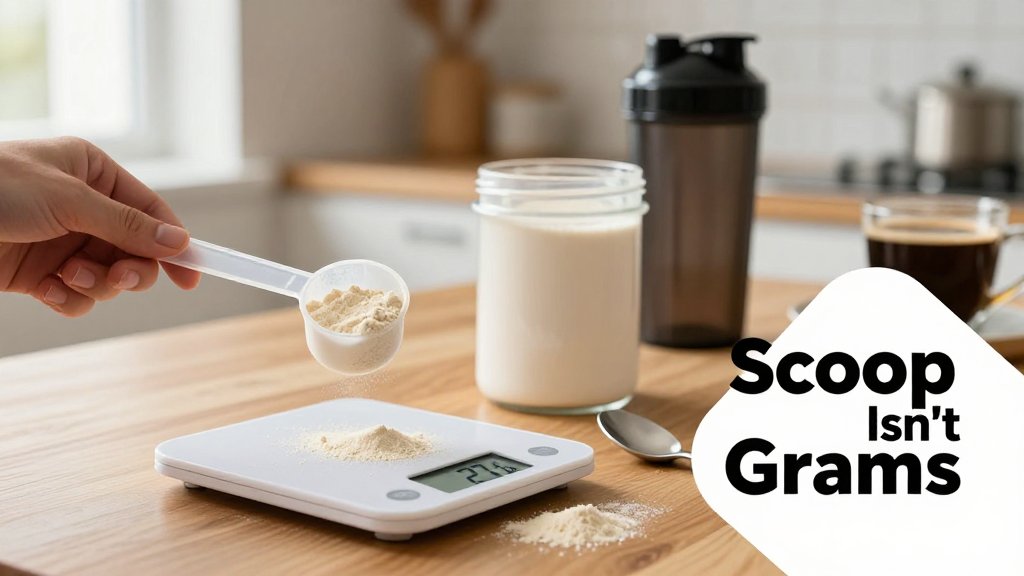
You trust the label: one scoop equals 30 grams, easy. But if your scoop is bigger, smaller, or packed differently, your “30 grams” can quietly turn into 24, 35, or more. That matters for hitting macros, managing calories, and getting consistent results from day to day. In this guide, you will learn what 30 grams actually refers to, why scoops vary between brands and techniques, and simple ways to verify your serving size without turning your kitchen into a lab.
How many grams is a protein powder scoop
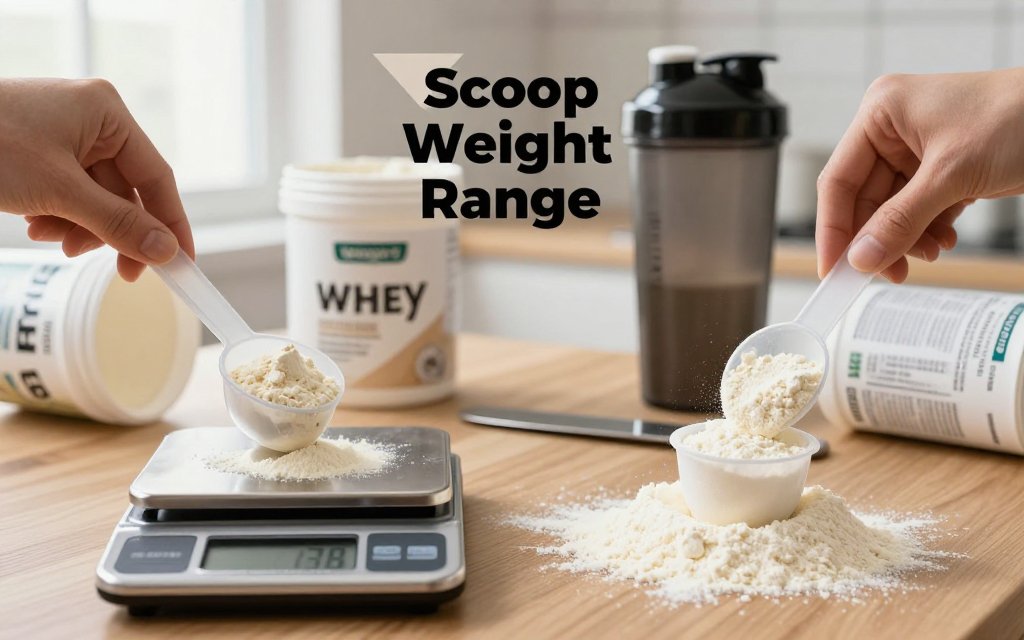
A protein powder scoop is not automatically 30 grams. A “1 scoop” serving often lands around 25 to 35 g, but it can swing outside that range with fluffier blends, heavier add-ins, or a different scooping technique. The reason people get it wrong is simple: the scoop measures volume (how much space the powder takes up), while the nutrition label lists weight (grams). “30 g” on the label is a weight target for that specific product, not a universal promise that every plastic scoop in your pantry equals 30 g. Two powders can fill the same scoop and still weigh very different amounts because their densities are different. That difference can quietly change calories, protein, and baking results, even if your shaker bottle looks the same every day.
The citation hook: a scoop is volume, grams are weight
Think of your scoop like a tiny measuring cup, not a tiny scale. The same scoop can weigh differently across powders because “how heavy per spoonful” depends on density. Density changes with particle size (fine powders pack tighter), air pockets (instantized or “fluffy” powders trap more air), fat content (creamier blends can be heavier per volume), and moisture (humidity can make powder clump and settle). Even brands that include a scoop are usually trying to match a serving by volume only approximately, which is why some packages warn that scoops measure volume, not weight. Practical takeaway: “1 scoop” is a convenient habit, but grams are the only consistent way to repeat a serving across products and across time.
The most common mistake is assuming every brand’s scoop equals 30 g because your last tub did. One whey isolate might be close to 30 g for a level scoop, while a mass gainer, a plant blend with added fats, or a highly aerated flavor mix might be noticeably different in the same scoop size. That “close enough” assumption is how small errors become routine, especially if you are cutting, tracking macros, or baking by weight. If you do not have a physical scale handy, you can still build consistency by checking portions once and then sticking to a repeatable method, including visual checks. For a quick way to sanity-check portions without a scale, palm-to-grams macro tracking can help you stay consistent when you are away from your kitchen.
Why your technique changes the grams more than you think
Technique can change the grams more than the label makes you expect. A level scoop (scoop, then scrape flat) is usually the most repeatable. A rounded scoop adds powder above the rim, and a packed scoop can add even more because you are squeezing out air pockets. Real life makes it messier: scooping from a fresh tub can be lighter because the powder is fluffy and aerated, while scooping from the bottom can be heavier because the powder has settled and compacted during shipping and daily handling. Tapping the scoop on the rim, shaking the tub, or storing it in a humid kitchen can all nudge density upward. If you want your “30 g” to actually be 30 g, the goal is not perfection, it is doing the same thing every time.
Treat the scoop like a cup measure, not a scale. If you need repeatable macros or recipes, weigh one typical scoop once, write the grams on the tub, then stick to that technique.
Here is how the “silent extra” shows up. Say your label serving is 30 g, but your casual heaping scoop comes out closer to 38 g. That is only 8 g extra powder, which looks like nothing in a shaker. Depending on the formula, 8 g extra can add roughly 30 to 40 calories (many powders land around 4 to 5 calories per gram when you include protein plus carbs and fats). If you do two shakes per day, that is 60 to 80 extra calories daily, without changing your routine. Over a week, you can accidentally add 420 to 560 calories, plus extra protein and sodium, which can matter when you are cutting, trying to hit a tight macro target, or keeping digestion steady.
This is not just a fitness problem. Home bakers who bake by weight see it when protein powder replaces flour in pancakes, muffins, or “protein brownies.” An extra 8 to 10 g of powder can dry out a batter, change sweetness, and throw off your texture, especially in small batch recipes. Small business shippers and jewelry makers run into the same principle: volume is fast, weight is repeatable. If you need consistency and do not have a scale right then, calibrate once: take your usual scoop style (level or rounded), estimate the weight with a photo-based tool like Scale for Grams, and record it as “my scoop = 33 g” for that tub. From there, repeat the same scoop technique every time.
The easiest habit is a two-step check: confirm what the label calls a serving (for example, 30 g), then confirm what your scoop habit actually produces (for example, 34 g when you scoop quickly from the bottom of the tub). Once you know your number, you can adjust without stress. Want a true 30 g serving? Use a slightly shy scoop or level it off. Want a higher-calorie shake on purpose? Keep the heaping scoop, but track it honestly so results match your plan. The scoop is convenient, but the goal is predictable grams. Predictable grams are what make portions, recipes, and daily nutrition repeatable.
Why scoop weight varies by brand and formula
The frustrating part about protein scoops is that they look like a fixed “unit,” but they are really just a volume tool, like a measuring cup. Grams are weight. Scoops are space. Weight changes when the powder’s density changes, and density changes constantly between brands, flavors, and ingredient lists. Even inside the same tub, the first few servings can scoop lighter than the last few if the powder settles during shipping. If you have ever grabbed a scoop after shaking the container and thought “why is this scoop suddenly heavier,” you did not suddenly forget how to scoop. You just changed how tightly the powder packed into that same plastic scoop.
Whey isolate, plant blends, and mass gainers do not scoop the same
Start with whey concentrate vs whey isolate. Many whey concentrates include a bit more lactose and fat, and they can feel slightly “fluffier” or more airy, depending on how the powder was processed. Isolates are often more refined, and many brands produce a finer, more uniform powder. In real kitchen terms, a fine powder tends to settle into the scoop with fewer air pockets, so a level scoop can weigh more than you expect. That is why two products can both say “1 scoop,” yet one brand’s level scoop is 28 g and another is 34 g. The scoop is not the standard; the label’s grams are the standard.
Plant blends can swing even wider. A vanilla pea and rice blend can be very fine and “pack tight,” especially if it includes gums or fibers for texture. Now add cocoa, nut powders, or cookie bits, and the same scoop volume can jump in weight because those add-ins are heavier per spoonful than airy whey. A chocolate whey with cocoa can scoop heavier than the brand’s vanilla version, even if both claim the same protein grams, simply because cocoa changes how the powder fills the scoop. If you switched from a chocolate whey to a vanilla plant blend, your “same scoop” habit may quietly change your serving weight by 3 g to 8 g without you noticing.
Mass gainers are the extreme example. They are designed to deliver big calorie servings, so the serving size might be 150 g, 200 g, or more, and the included scoop is often huge. That powder can also be bulkier because it may include carbohydrate sources like maltodextrin or oat flour, which can make the texture more “puffy” and less dense per cubic inch than a pure protein isolate. This is how you end up with a routine where “one scoop” of a gainer looks like a small bowl, while “one scoop” of a whey isolate looks like a modest mound. Switching product categories without changing your scooping habits is a common way people accidentally under-dose or over-dose.
Label reading that actually prevents mis-dosing
The easiest way to stop the guessing is to treat the serving size in grams as the source of truth, and treat the scoop count as a convenience hint. You will often see wording like “Serving Size: 30 g (about 1 scoop).” That “about” matters because scoops are meant to approximate a target, not certify it. The FDA has even called out that a scoop can be provided to approximate a serving size in powdered products in its scoop approximation guidance. (downloads.regulations.gov) If your label says 30 g per serving and “about 1 scoop,” treat 1 scoop as your starting point, then adjust your scoop technique until your usual scoop matches 30 g as closely as possible.
Next, look for scoop volume if it is listed. Some brands print a volume like 70 cc, 60 cc, or 100 cc on the scoop, or in the directions. That number explains why scoops are not interchangeable across products. A 70 cc scoop filled with a dense, fine powder can weigh dramatically more than a 70 cc scoop filled with a fluffy, aerated powder. Also, brands can change scoop sizes across product lines. A brand might use one scoop for a standard whey, a different scoop for an isolate, and another scoop for a gainer, even if the scoops look similar at a glance. If you keep an old scoop from your previous tub and use it in the new tub, you can easily drift away from the stated grams.
Consistency beats perfection for day to day use. Pick one scooping method and repeat it: same scoop, same leveling style (knife sweep, tap twice, or no tapping), and the same “dig” angle. Avoid compressing the powder by packing it down with the scoop, and avoid pulling scoops from a tub you just shook hard unless you always do that. Little habits change weight more than people think. If you do not have a physical scale handy, a quick weight estimate can still keep you on track: you can compare a leveled scoop to your usual reference portion, or use a photo-based tool like Scale for Grams to sanity-check whether today’s scoop looks closer to 25 g, 30 g, or 35 g before you log it.
How to verify servings without a kitchen scale
Forgot your kitchen scale at home, staying in a hotel, or mixing shakes at work? You can still get a reliable scoop routine without guessing every time. The goal is not lab perfection, it is repeatable portions that keep your protein intake (and baking recipes) on track. A “30 g scoop” on the label is often a target serving, not a promise that your exact scoop, your exact technique, and your exact powder will land on 30.0 g. Once you establish your own baseline, you can stay consistent for weeks, even if you only double-check occasionally.
Quick calibration you can do in under 5 minutes
Pick one mug or shaker cup and stick with it. Use the same scoop that came in the tub. Decide on one leveling method and do it the same way every time (for example: dip the scoop, lift it out, then level it with a straight edge like a knife spine). Now verify your “level scoop” one single time using any available scale, a friend’s kitchen scale, a shipping scale at work, even the scale at a gym smoothie bar if they will let you. If your level scoop weighs 28 g, write it directly on the tub with a marker: “My level scoop = 28 g.” That number becomes your personal serving reference.
After that one-time calibration, you can use shortcuts that keep you close without obsessing. First, pay attention to packing. A scoop that is tapped 3 times against the tub can add a couple grams, especially with fine whey isolate. Second, use fractions: if “my scoop = 28 g,” then half a scoop is about 14 g and a quarter scoop is about 7 g, which is handy for baking recipes that call for 10 g to 15 g of protein powder. Third, sanity-check with known objects. For example, a U.S. nickel is 5.00 g and a quarter is 5.67 g according to U.S. coin weights, so 2 quarters plus 1 nickel is about 16.34 g as a quick reference.
Consistency beats perfection for day-to-day tracking. Use the same scoop, the same cup, and the same leveling method. Calibrate once on any available scale, write your baseline in grams on the tub, then repeat that routine every time.
If you need a faster sanity-check, photo-based estimation can help you catch big errors. Scale for Grams is an iOS app that estimates weight from photos using computer vision, so you can get a quick grams or ounces estimate without carrying a physical scale. It is especially useful in three situations: mixing shakes while traveling (you want to know if you are closer to 20 g or 40 g), adjusting baking by weight (a recipe calls for 15 g protein powder, not “half a scoop”), and portion accuracy during a cut (you want your usual serving, not a randomly heaped scoop). Use it as a backstop: if your “level scoop” suddenly looks like a 45 g pile, you can correct before it becomes a habit.
FAQ: protein scoop grams and accurate estimating
These are the questions people search right after realizing their scoop and the label do not always match. Keep the big idea in mind: grams are mass, scoops are volume. Powders with different densities (whey concentrate vs isolate, added creatine, flavoring, digestive enzymes) will weigh differently even if the scoop size looks identical. If you can verify once, you can estimate confidently afterward. If you cannot verify at all, focus on repeatability and use a quick check like a photo estimate or a coin reference so you do not drift into “accidental heaping scoop” territory.
How many grams are in a scoop of whey protein
Most whey products land somewhere around 25 g to 35 g per labeled scoop, but there is no universal scoop gram weight. Two tubs can both say “1 scoop,” yet one scoop is 29 g and another is 34 g because the powder density and scoop size differ. Your technique also matters. A lightly filled, leveled scoop might be 2 g to 6 g less than a rounded scoop, and tapping the scoop can pack more powder in. The most accurate answer is the one you measure once for your specific tub and method.
Can I convert grams to scoops for protein powder
Yes, but only after you establish a personal conversion for that exact product. Do a one-time check: weigh one level scoop (example: 28 g), then write it down. Now conversions are simple math. If your recipe needs 14 g, use half a scoop. If it needs 7 g, use a quarter scoop. If you change brands or even switch from whey to a mass gainer, redo the conversion because density changes. Avoid using another person’s “one scoop is 30 g” rule, since scoop size and powder texture vary widely across tubs.
How can I weigh protein powder without a scale
Start by calibrating once on any scale you can access, even briefly, then rely on repeatable scoops afterward. If you truly cannot access a scale, use consistency tools: always level the scoop the same way, use the same shaker cup, and avoid tapping or compressing. For a quick reality check, compare your portion to known-weight items like coins (a nickel is 5.00 g) or use a photo estimate in Scale for Grams to see if you are in the right ballpark. These methods will not replace a scale, but they reduce big serving swings.
Need to weigh something fast without digging out a scale? Download Scale for Grams and get an AI-powered weight estimate from a photo in seconds. It is a quick way to sanity-check servings when your scoop feels questionable or you are on the go. Grab the app here: iOS. Try it today and make your protein portions more consistent.
Scale for Grams
Need to Weigh Something?
Download Scale for Grams and get an AI weight estimate from a photo in seconds.