Nuts and Bolts Weight Cheat Sheet for Shipping
A practical way to estimate screw, nut, and bolt weight per piece or in bulk so you can print accurate shipping labels and sanity-check inventory counts, even when you do not have a scale.
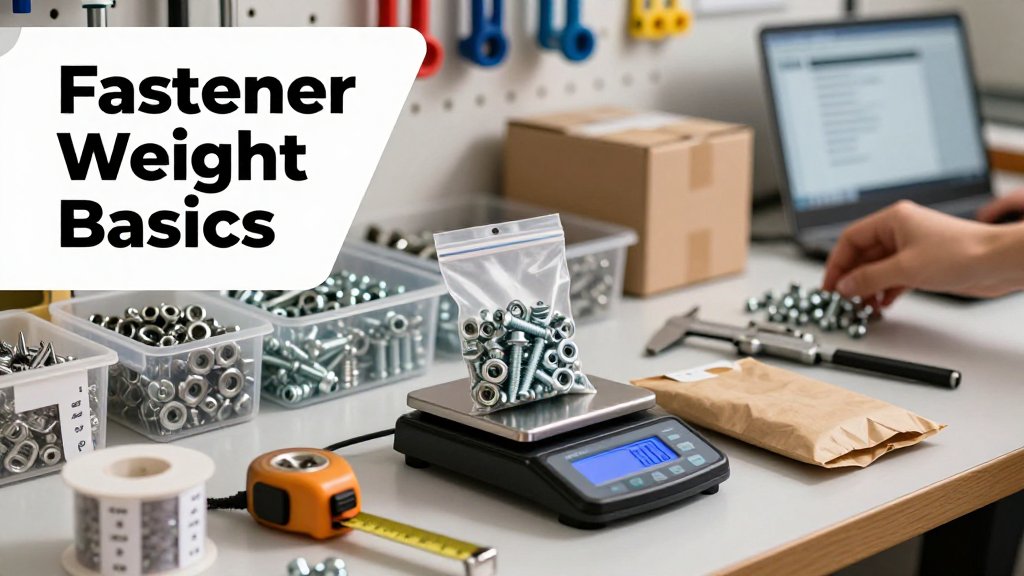
If you have ever priced a box of screws by feel and then watched shipping costs jump at the counter, you already know the problem. Nuts, bolts, and washers look small, but they add weight quickly when you ship them by the handful or the thousand. In this cheat sheet, you will get realistic per-piece weight ranges, fast bulk math for common quantities, and a simple no-scale workflow for estimating totals. Pack with fewer surprises and label shipments with confidence.
Hardware weight basics that make shipping accurate
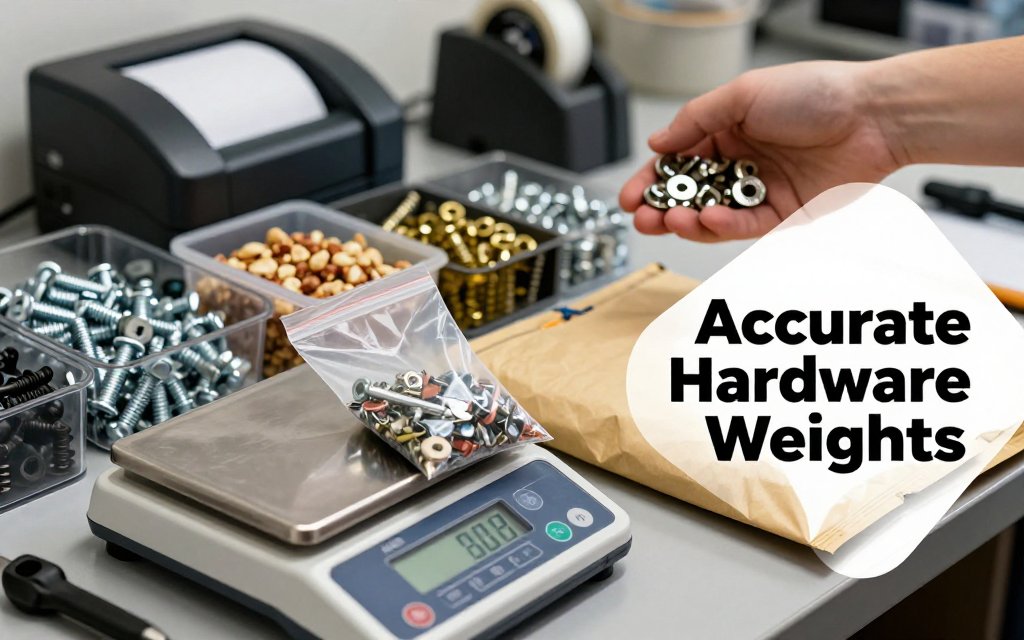
A real example from a small-shop shipping day: you pack 50 mixed bolts and nuts for a customer, print a label at “8 oz,” and feel good about it. At the counter (or on a carrier scan), it tips into the next ounce tier because the “free” extras were heavier than your mental math. The most common culprits are simple: you counted only the bolts, forgot the washers, tossed in a spare nut per order, and used a slightly thicker padded mailer than last time. With hardware, the parts are dense, the quantities add up fast, and a small undercount turns into real postage differences once you multiply it across weekly orders.
Here is the quick mental model that keeps estimates sane: fastener weight is basically density times volume, plus “hidden” add-ons. Density is your material choice (steel, stainless, brass, aluminum). Volume is driven by diameter and length first, then by head style (a tall socket cap head has more metal than a low button head). Add-ons are everything you did not count at first glance, like flat washers, lock washers, nuts, threadlocker patches, and the tiny poly bag that somehow weighs a few grams when you ship 25 of them. A practical expectation range helps: small machine screws (M3 to M4) often land around 0.5 to 2 g each, M5 to M6 screws can be 2 to 8 g each, and chunky 1/4 in to 5/16 in bolts can easily be 10 to 25 g each depending on length and head.
Why two “same size” bolts can weigh different
Material density is the big one. Aluminum is light, steel is heavy, and brass is usually heavier still. If you switch from aluminum to steel, assume roughly 3x weight for the same volume, because aluminum is about 2,700 kg/m³ while many steels are around 7,850 kg/m³ (close enough for shipping estimates). You can sanity check those numbers on a metal density chart. Stainless steel is usually in the same neighborhood as carbon steel, so “stainless” does not automatically mean heavier, it just means you should not assume a weight savings. Brass hardware (common in leatherwork, jewelry fixtures, and decorative knobs) can surprise people because it feels premium and it is dense, so a handful can jump your package weight faster than you expect. This density thinking also helps with other materials you ship, like resin, where volume-to-grams planning is everything in convert mold volume to grams calculations.
Next comes geometry and design details that look “close enough” until you multiply by 100. A socket cap screw has a tall cylindrical head, so it typically weighs more than a hex bolt of the same thread size and length, and both usually outweigh a button head or low-profile pan head. Thread length matters too: a fully threaded bolt has more metal than a partially threaded bolt with a long smooth shank cut down. Coatings are smaller but real: zinc plating, black oxide, or a thick hot-dip style coating can nudge weights upward, especially in bulk. The most expensive mistake is forgetting accessories. If your order is “10 bolts,” but you ship each bolt with a nut, two washers, and a small poly bag, those extras can add 5% to 25% on small shipments. Ten M6 washers at about 1 g each is already 10 g, which is over a third of an ounce all by itself.
Rule of thumb: estimate the metal first, then add the “boring stuff.” For small hardware orders, count every nut and washer, then budget a little extra for bags and labels. Those tiny add-ons are what push you over.
The shipping label trap: packaging weighs more than you think
A padded-mailer story that repeats in every maker business: 200 M5 screws seem light in your hand, so you assume the package will be “a few ounces.” You scoop them into an inner zip bag, slide that into a 6 in by 9 in padded mailer, seal it, add a label, and now you are not just paying for screws. You are paying for plastic, paper, adhesive, and padding. The weight jump feels unfair because you did not “add product,” but shipping math does not care what the grams are made of. If you ship the same screws in a rigid small box with extra void fill, you might add even more weight than you expect. This is why two shipments with identical hardware can land in different ounce brackets.
Use a simple packaging allowance that matches real life: “For small parts, add 15 to 40 g for basic packaging unless you have measured it once.” That range covers a lot of everyday setups like a poly bag plus a small padded mailer, or a small carton plus a label and a bit of tape. The best time-saving habit is keeping a note in your phone called “tare weights” with a line for each mailer type you actually use, like “6x9 padded mailer + label = 26 g” and “small box + label + tape = 48 g.” Once you have those baselines, hardware estimating becomes repeatable instead of a guess. You can even write the packaging weight on the box of mailers with a marker so you do not have to hunt for the note mid-fulfillment.
A simple no-scale workflow that prevents most mistakes is: decide material first (steel, stainless, brass, aluminum), then estimate a per-piece gram range, then multiply by quantity, then add washers and nuts as separate line items, then add your saved packaging number. If you do not know the per-piece range yet, weigh once later and write it down, or use a photo-based estimator like Scale for Grams to get a quick starting point for a pile of parts when you are away from your bench scale. Finally, protect yourself against rounding surprises by building in a buffer for tiny extras like spare parts or thicker tape. Hardware orders are repeat customers, so a little upfront tracking turns into faster label printing and fewer “why did this cost more?” moments.
Screw, nut, and bolt weight per piece ranges
Common metric fasteners: realistic grams per piece
If you ship small hardware, the fastest way to get “close enough” is to think in ranges, not perfect specs. A bolt’s weight changes with head style (hex vs socket head), material (steel vs stainless), and even tiny dimension tweaks between standards. A zinc-plated steel bolt can be a bit heavier than plain steel, and a flange-head bolt can jump noticeably because the head has more metal. For shipping labels, you only need a realistic estimate that keeps you from underpaying postage. Treat the numbers below as bare fastener weights, not including the poly bag, label, or bubble mailer, and round up if you are near a rate break.
Here are practical anchors for screw weight in grams and bolt weight per piece, based on common metric hardware people actually buy and ship. For a baseline, a DIN 933 style M4 x 20 hex bolt is about 3.87 g each, M5 x 12 is about 2.87 g each, M6 x 30 is about 7.51 g each, and M8 x 40 is about 18.7 g each (those are per-piece values when you convert from per-1000 tables). If you want a single “default” number for a listing, use the midpoint of the range and then add packaging. The DIN 933 weight table is a handy reference when you need a sanity check. (aspenfasteners.com)
Nuts and washers are where people often undercount weight, especially in “mixed kit” bags. A typical M3 hex nut often lands around 0.33 to 0.55 g each, M4 around 0.7 to 1.1 g, M5 around 1.1 to 1.8 g, and M6 around 2.3 to 3.1 g, depending on the specific standard and thickness. (duplexfastener.com) For flat washers, one useful real-world check is carton weight data: an M6 steel flat washer carton listed as 6,000 pieces at 12.10 lb works out to about 0.9 g per washer before packaging variation. (fastenersuperstore.com) Same diameter, each additional 10 mm often adds about 10% to 35% depending on size.
Cheat sheet weights are for bare steel parts only. If your hardware is stainless, coated, or has a flange head, assume heavier. For postage labels, round up and add 5-15 g for the bag.
Fast grams-to-ounces conversion for small parts shipping
The conversions worth memorizing are the ones you will use every time you create a label. Anchor 1: 1 oz ≈ 28.35 g. (kylesconverter.com) Anchor 2: 100 g ≈ 3.53 oz (because 100 ÷ 28.35 ≈ 3.53). Anchor 3: 1 kg ≈ 2.205 lb. (calculatorsoup.com) Once you have those, you can eyeball a bag of fasteners and decide whether you are in “under 4 oz,” “under 8 oz,” or “close to 1 lb” territory. That is the difference between an easy, profitable shipment and a surprise postage adjustment.
Quick shipping math example (useful for label tiers): If one screw is ~2.5 g, then 20 screws ≈ 50 g (about 1.8 oz). Now add the bag and label, maybe another 3 to 10 g depending on how you pack. For heavier bolts, the totals climb fast: 10 pieces of an M6 x 30 at about 7.5 g each is about 75 g, which is roughly 2.6 oz, before the mailer. (aspenfasteners.com) For tiny socket head screws, an M3 x 10 can be near 1 g each, so 100 screws can be close to 100 g, which is about 3.5 oz, plus packaging. (en.metcalc.info)
For mixed parts (like “10 bolts + 10 nuts + 20 washers”), estimate by building a mini recipe: (bolt grams × count) + (nut grams × count) + (washer grams × count). Then add a packaging buffer and round up. Example: 10 M5 x 12 bolts at ~2.9 g is ~29 g, 10 M5 nuts at ~1.5 g is ~15 g, and 20 M5 washers at ~0.4 g is ~8 g, totaling ~52 g of metal. Add 10 g for a small poly bag and padded mailer, and you can safely label around 62 g (about 2.2 oz). If you are right on the edge of a postage tier, choose the next higher tier. Underpaying costs time and can delay delivery.
Bulk estimating: per 1000, per kilogram, and no scale methods
Bulk hardware weights get accurate fast if you use the same repeatable pattern every time: pick a realistic per-piece weight, multiply by the piece count, then add packaging and a safety buffer. Example: you estimate an M3 x 10 mm pan-head screw at 1.3 g each. A bag of 250 screws is about 325 g of metal (250 x 1.3). If you ship in a small zip bag (2 g), a 6 x 9 in padded mailer (around 25 g), plus a label and a strip of tape (5 g), your pre-buffer total is about 357 g.
For inventory and shipping labels, build yourself a tiny “hardware weight calculator” you can reuse. Keep a note (or spreadsheet) with these columns: item name, per-piece grams, pieces per order, hardware grams, packaging grams, and final ship weight. You can get the per-piece number from a supplier listing (often “1,000 pcs weighs X kg”), from one measured order you trusted, or from a photo-based estimate using the Scale for Grams iOS app as a quick check. > Save one known-correct shipment as your baseline. Reuse its per-piece grams for the same fastener, then only change the piece count and the packaging choice for the next order. That baseline approach removes most of the guesswork over time.
Pieces per kilogram and fasteners weight per 1000 shortcuts
Sellers love quoting “per 1,000 pieces” because it is a tidy way to describe bulk. You can flip that into two numbers that make shipping easy: grams per piece, and pieces per kilogram. The math is simple: if 1,000 screws weigh 2.4 kg, then the group is 2,400 g total. Each screw is 2.4 g (2,400 g ÷ 1,000). Pieces per kilogram is the reverse: 1,000 g ÷ 2.4 g ≈ 416.7, so call it about 416 pieces per kg (round down for safety). Once you know pieces per kg, you can sanity-check counts fast: 2 kg of that screw is about 832 pieces, before packaging.
If all you have is a “box weight,” treat the packaging like a one-time subtraction, then reuse the per-piece number forever. Example: a supplier box is labeled 3.10 kg for 1,200 screws, but you can tell it includes a thick carton and dividers. If you estimate packaging at 0.25 kg, the hardware is about 2.85 kg, or 2,850 g. Per screw is 2,850 g ÷ 1,200 ≈ 2.38 g each. Next time you ship 75 screws, you start at 75 x 2.38 ≈ 179 g, then add your mailer or box. This is also a good place to round up a hair, like using 2.4 g each, so you do not get surprised by a heavier production batch.
How do I estimate hardware weight without a scale?
“If you cannot weigh it, estimate one piece, then scale up and pad the result.” Start with any credible per-piece input: a supplier spec like “1,000 pieces weigh 2.4 kg,” a past shipment you trust, or a photo-based estimate (Scale for Grams can help you get a quick gram-range from a picture when you are stuck). Multiply by your piece count, then add a realistic packaging number. Rule of thumb: poly bag 1 to 3 g, small padded mailer 20 to 35 g, small carton 120 to 200 g, plus 5 to 15 g for label and tape.
What safety buffer should I add for shipping labels?
“A small buffer beats a returned package, so build it into every label.” For dense hardware, I like a 5% to 10% buffer after packaging, with a minimum of 10 g (about 0.35 oz) on anything under 250 g. Example: you estimate 357 g total for 250 screws in a padded mailer, add 10% (36 g) and you print the label at 393 g, or just round to 400 g. If your carrier bills by whole ounces, round up to the next ounce after you buffer. Rule of thumb: if you are regularly within 20 g, you are doing great for bulk estimates.
How do I convert between grams, ounces, and pounds for fasteners?
“Use exact conversions once, then memorize a few handy approximations for speed.” Exact factors are: 1 oz = 28.349523125 g and 1 lb = 453.59237 g (these are listed in NIST conversion factors). Practical shortcuts: 30 g is about 1 oz, 450 g is about 1 lb, and 1 kg is about 2.2 lb. For fasteners, I like converting everything to grams first (because your per-piece math is easier), then converting the final ship weight to ounces or pounds only at the very end.
Need to weigh something fast, even when a scale is not nearby? Download Scale for Grams and get an AI-powered weight estimate from a photo in seconds. It is a quick way to sanity-check small parts shipments, tighten up labels, and reduce last-minute postage changes. Grab it here: iOS. Try it on your next batch of fasteners and ship with more certainty.
Scale for Grams
Need to Weigh Something?
Download Scale for Grams and get an AI weight estimate from a photo in seconds.