Pennyweight Pricing Trap: Convert DWT Before You Sell
Getting quoted in pennyweight (dwt) can quietly shave money off your payout if you think in grams. This guide shows exactly how dwt compares to grams, how buyers price scrap gold, and the simple conversions that keep you from getting underpaid.
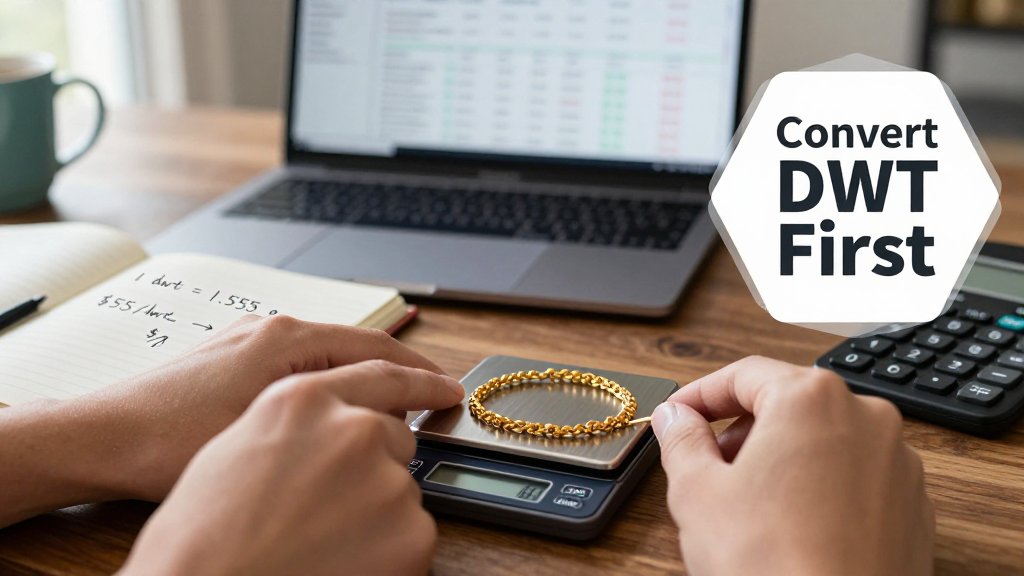
Selling gold or jewelry can feel straightforward until a buyer quotes a price in pennyweight (dwt) while you are thinking in grams. That unit mismatch is where people lose money, often because the conversion is easy to misread in the moment. This article shows the one dwt-to-grams conversion you need, how to compare offers on an apples-to-apples basis, and a quick sanity check you can do at home so you walk in confident and prepared.
What a Pennyweight (DWT) Really Means
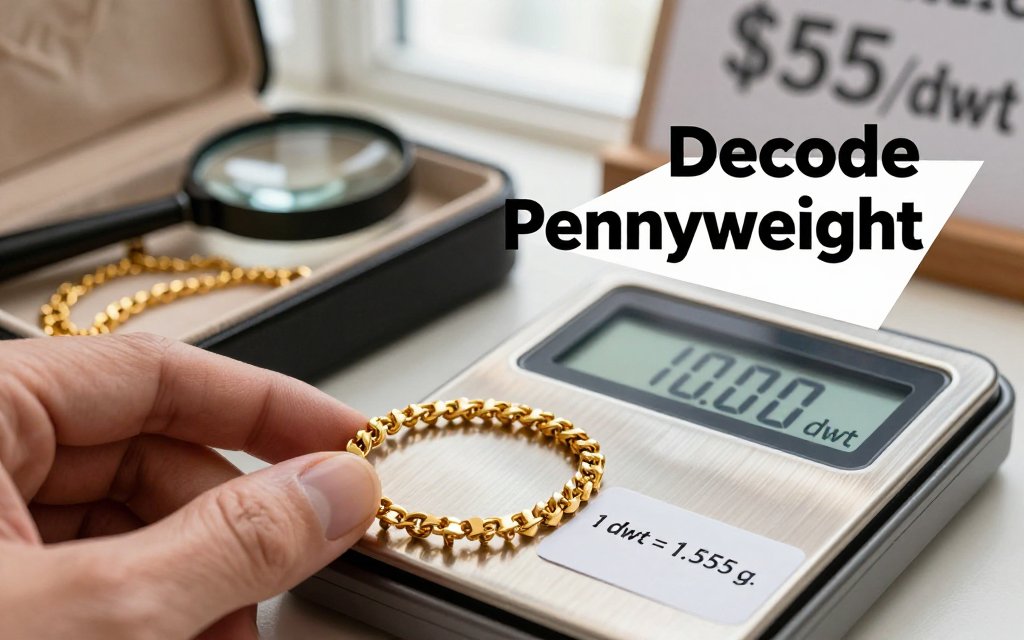
You are cleaning out a jewelry box, you find an old bracelet, and you stop by a local gold buyer on your lunch break. The buyer smiles and says, “I can pay $55 per dwt.” That sounds amazing, because you are used to seeing gold talked about in grams online, and $55 per something tiny must be a great deal, right? The trap is that “something tiny” is not a gram. It is a pennyweight, and a pennyweight is heavier than most people assume. If you compare a dwt price to a grams price without converting, you can accidentally accept a lower payout than you expected.
Pennyweight is abbreviated “dwt” (you will also see “pwt” sometimes), and it is a unit used in the troy weight system, the same family of units used for precious metals like gold and silver. You still see pennyweight in jewelry shops, scrap buyers, pawn counters, and older jewelry-making workflows. Here is the one-sentence definition you can quote and reuse: A pennyweight (dwt) is a troy-weight unit for precious metals equal to 1/20 of a troy ounce, which is exactly 1.55517384 grams. Once you know that, “price per dwt” stops feeling mysterious, and it becomes just another number you can translate into grams and compare fairly.
Pennyweight vs grams: the one number to memorize
Memorize this hook and you will dodge a lot of bad comparisons: “1 pennyweight (dwt) equals 1.555 grams.” More precisely, 1 dwt equals 1.55517384 g. The reverse matters just as much: “1 gram equals 0.643 dwt” (more precisely, about 0.6430 dwt). The mental-math trick is simple: multiply dwt by 1.555 to get grams, and divide grams by 1.555 to get dwt. Example 1: a 10 dwt bracelet weighs 15.55 g (10 x 1.555). Example 2: a 20 g chain is about 12.86 dwt (20 / 1.555). If someone offers $55 per dwt, that is about $35.37 per gram ($55 / 1.555), which might be fine or not, but at least you are comparing apples to apples.
Rounding is where people get sloppy. For quick decisions, 1 dwt is 1.555 g is usually enough, but for higher-value metal, even a small rounding difference can add up. If you are selling multiple pieces, convert each item to grams and write the grams on a sticky note (for example: “ring 3.11 g,” “chain 18.40 g,” “earrings 1.96 g”). Then you can compare buyers who quote in dwt versus buyers who quote in grams, without guessing. If you do not have a physical scale handy, a photo-based estimate can help you sanity-check whether a “this is only 4 dwt” claim even makes sense before you drive across town. That same habit helps with food portions and shipping weights too, and you can apply it to packages with estimate gear weight from photos style math.
If you hear “price per dwt,” pause and convert it to price per gram before you say yes. DWT is not a tiny gram unit. It is 1.555 grams, so the payout math shifts fast.
Troy weight vs avoirdupois ounces, why it causes confusion
The second trap is the word “ounce.” Jewelry metals are usually weighed in troy units, while most household scales, kitchen recipes, fitness food labels, and shipping labels use avoirdupois ounces (the regular ounce most Americans mean). Two anchor facts keep you grounded: 1 troy ounce equals 31.1034768 g, and 1 regular ounce (avoirdupois) equals 28.349523125 g. Pennyweight is directly tied to troy weight, not kitchen ounces, because 20 pennyweight equals 1 troy ounce. You can see these relationships laid out in the NIST troy unit table, which is a helpful reference when someone insists their “ounce” math is correct.
Here is how the confusion shows up in real life. Suppose a small bag of scrap jewelry reads 0.50 oz on a kitchen scale. That is 0.50 avoirdupois ounces, which is about 14.17 g (0.50 x 28.3495). If you mistakenly treat that as 0.50 troy ounces, you would assume about 15.55 g (0.50 x 31.1035). The difference is about 1.38 g. If the metal value you are mentally using is, say, $60 per gram, that error is roughly $83 of value (1.38 x 60). You do not need perfect arithmetic every time, you just need the right unit system so your “great price” is actually great for the weight you are handing over.
A practical seller habit is to force every quote into the same lane before you negotiate. Ask one clarifying question: “Is that per dwt or per gram?” Then confirm what “ounce” means if ounces come up at all, because a troy ounce and an avoirdupois ounce are different weights. Finally, write down the conversion once, so you do not redo it under pressure: 20 dwt equals 1 troy ounce, 1 dwt equals 1.555 g, and 1 g equals 0.643 dwt. With those three lines, you can evaluate a bracelet, a chain, or a mixed scrap lot in under a minute, and you will not be dazzled by a unit that only sounds cheaper or more generous.
How DWT Pricing Can Undercut Your Payout
The pricing trap usually starts with a number that sounds big. A buyer says, “We pay $60 per dwt,” and your brain compares that to another quote like “$40 per gram.” If you do that comparison without converting, you can accidentally pick the worse offer, even though it sounds higher. The underpayment happens because pennyweight (dwt) is smaller than a gram. One dwt is about 1.555 grams, so “$60 per dwt” is not $60 per gram. This is the same kind of unit mix-up that can mess up baking recipes and shipping labels, except here it directly changes your payout in dollars.
Here is a realistic scrap gold setup to keep the math grounded. Say you bring in a broken 14K gold chain plus a small 14K charm. You weigh everything at home and get 12.0 g total (or you estimate close to that). At the shop, the buyer notices a non-gold spring ring clasp and removes it, so the net gold-bearing weight becomes 11.5 g. The buyer also tells you their payout is “85% of melt value,” which sounds fair, but it only helps you if the melt value calculation is correct and the unit quote matches the unit of weight they are using. Small unit confusion can swing the offer by well over $100 on a small lot.
Compare quotes correctly: price per dwt to price per gram
To compare offers, convert everything to price per gram first. Pennyweight numbers sound bigger, but 1 dwt is only 1.555 g. Do the conversion before you decide who is paying more.
Use this quick conversion rule (and write it on your notes app): price per gram equals price per dwt divided by 1.555. That 1.555 factor comes from the pennyweight definition used in precious metals trading, and you can confirm it in pennyweight conversion basics. Now the punchy example: if a shop offers $60 per dwt, that is about $38.58 per gram ($60 ÷ 1.555 = $38.58). If another buyer offers $40 per gram, the $40 per gram offer is better, even though $60 sounds bigger at first. Once you convert, the “big number” loses its power.
You can also spot the underpayment by comparing what you expected versus what the unit actually means. If you mistakenly treat $60 per dwt as if it were $60 per gram, you might expect a 12.0 g lot to pay about $720 (12.0 x $60). But the real comparison is $38.58 per gram, not $60. Using the correct conversion, that same 12.0 g would be about $462.96 (12.0 x $38.58). That is a $257.04 gap caused by a single unit mix-up. Nobody has to “cheat” for you to lose money here, the math does it automatically if you do not standardize the quote.
Scrap gold walk-through: from melt value to payout
Now layer in karat and payout percent, because that is where two quotes can look “the same” but land very differently. Start with net weight in grams: 11.5 g (after removing the clasp). Convert karat to purity: 14K is 14 out of 24, which is about 58.5% pure gold. Fine-gold content is 11.5 g x 0.585 = 6.73 g of pure gold (rounded). Next, frame spot price in a way that matches your math. If spot is about $75.50 per gram for pure gold (24K), the melt value of your lot is 6.73 g x $75.50 = about $508.12. This number is the starting line, not the finish line.
Finally, apply the buyer’s payout percent and any deductions. If the shop truly pays 85% of melt, a reasonable target payout would be about $431.90 ($508.12 x 0.85). If another buyer pays 70% of melt, the payout drops to about $355.68, even if they use friendly language at the counter. This is also why “$60 per dwt” can be misleading without context. A buyer could quote $60 per dwt on gross weight, apply 70% behind the scenes, and subtract a $25 fee, which can turn your expected $400-plus payout into something closer to $300. You do not need to accuse anyone, you just need every step written down in the same units.
A simple checklist before you accept an offer
Use this as a quote comparison checklist. The goal is to stop unit mixing, stop “melt value” being a mystery, and stop surprise deductions at the end. You are not being difficult, you are making sure the quote you heard is the payout you get. One extra tip: do not let “ounces” float around without a label. In precious metals, troy ounces are common, but regular ounces exist too, and swapping those silently changes the math.
Once you have the unit, the net weight, the karat, and the payout percent, you can convert everything to price per gram and compare offers in under a minute. If you do not have a physical scale handy, getting even a rough gram estimate before you walk in helps you stay calm and do the conversion without pressure. That is exactly where a photo-based estimator like Scale for Grams can be useful, since it helps you sanity-check “about 12 g” versus “maybe 18 g” before anyone else starts steering the conversation. The win is not perfect precision, it is avoiding the unit trap and knowing what questions to ask before you sell.
Convert DWT, Estimate Weight, Sell With Confidence
You do not need to be a math person to protect yourself from pennyweight pricing. You just need one conversion you trust and a habit of translating any quote into the unit you understand best (usually grams). The key number is: 1 dwt = 1.55517384 g. If a buyer offers $35 per dwt, that is about $22.50 per gram ($35 ÷ 1.555). If another buyer offers $24 per gram, that is about $37.30 per dwt ($24 × 1.555). Now you can compare offers apples to apples in 10 seconds, instead of guessing which quote is “better.”
Weigh jewelry at home without a scale, quick reality checks
A real scale is still the gold standard, but you have more options than you might think. First, borrow a kitchen scale from a neighbor or use the one you already bake with. Switch it to grams, then use the tare function with a small bowl or cup. Weigh each piece separately, especially if you have a mix of chains, rings, and broken clasps. Remove anything that is obviously not gold, like loose stones or a giant non-metal pendant. Even a basic kitchen scale that reads in 1 g steps is good enough to keep you from walking in blind with “maybe it is 10 dwt?” vibes.
If you sell often, a small jewelry scale that reads 0.01 g can pay for itself quickly, because you stop accepting fuzzy weights. If you do not have any scale at all, use a photo-based estimate as a reality check before you visit buyers. Scale for Grams can estimate weight from a photo, which is useful for spotting a quote that is wildly low, not for replacing a calibrated scale. For best results, include one consistent reference object in every photo (same coin, same card, same small ruler), use bright even lighting, and photograph each item separately so the app is not guessing how many pieces overlap.
FAQ: pennyweight conversions and selling scrap gold
Confidence at the counter usually comes from asking simple unit questions out loud. You are not being difficult, you are preventing a misunderstanding that costs you money. Keep your notes in your phone and use the same process every time: confirm the unit, confirm the purity basis (10k, 14k, 18k), and confirm whether anything is deducted (stones, springs, non-gold parts). If the buyer talks fast, slow it down by repeating the number back with the unit attached. Here are the questions that stop most pricing traps before they start:
How do I convert pennyweight (dwt) to grams, and grams to dwt?
Use these two formulas and write them exactly like this in your notes. DWT to grams: grams = dwt × 1.55517384. Grams to dwt: dwt = grams ÷ 1.55517384. Example: a ring listed as 3.0 dwt is 4.6655 g (3.0 × 1.55517384). A small bag of scrap that weighs 10.0 g is about 6.43 dwt (10.0 ÷ 1.55517384). Converting yourself lets you compare two offers even if each buyer uses a different unit.
Is a pawn shop price per dwt the same as price per gram?
No, they are not the same number, even though they measure the same metal. Because 1 dwt = 1.55517384 g, a “$30 per dwt” quote equals about $19.29 per gram ($30 ÷ 1.555). Flip it the other way: $20 per gram equals about $31.10 per dwt ($20 × 1.555). This is why unit confusion is expensive. Always convert the quote into one unit before you react to it. If the shop will not state the unit clearly, treat that as a red flag.
What is the difference between troy ounces and regular ounces when selling gold?
Gold is typically priced in troy units, not regular kitchen ounces (avoirdupois). One troy ounce is 31.1034768 g, while one regular ounce is 28.3495 g, so the numbers are not interchangeable. There are also 20 dwt in 1 troy ounce, which ties pennyweights to precious-metal pricing. If someone quotes “per ounce,” ask “troy ounce or regular ounce?” and confirm the grams. For a quick reference, troy ounce grams are listed as 31.1034768 g.
Need to weigh something fast before you sell? Download Scale for Grams and get an AI-powered weight estimate from a photo in seconds, which is perfect for quick checks when you do not have a scale nearby. Use it to sanity-check your item, then compare buyer quotes with more confidence. Get the app here: iOS.
Scale for Grams
Need to Weigh Something?
Download Scale for Grams and get an AI weight estimate from a photo in seconds.