Shipping Label Weight Rounding Rules, Avoid Postage Adjustments
Carrier weight tiers are unforgiving: being off by even 0.1 oz can trigger USPS postage adjustments or postage due. This guide explains the rounding reality behind common shipping services and gives you a practical, packaging-included workflow to estimate weight accurately, even without a physical scale.
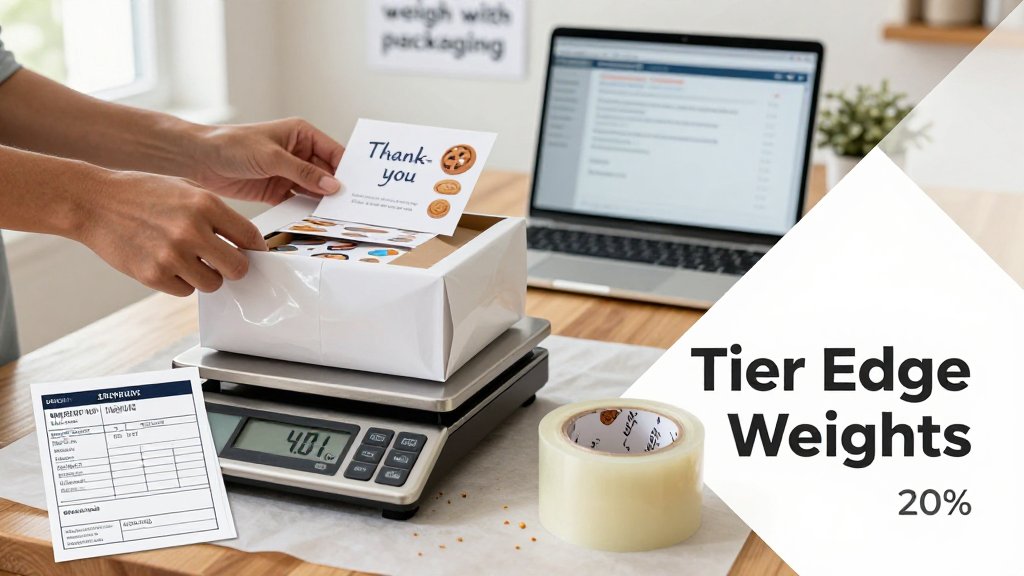
Nothing stings like paying for postage twice because a package came in a fraction of an ounce heavier than you expected. Weight rounding rules vary by carrier, and the biggest surprises usually come from packaging, not the product itself. In this guide, you will learn how common weight tiers work, where rounding misconceptions cause adjustments, and a simple workflow to choose the correct bracket every time. Even if you do not own a scale, you will be able to ship with confidence and fewer costly corrections.
Do carriers round shipping label weights or not
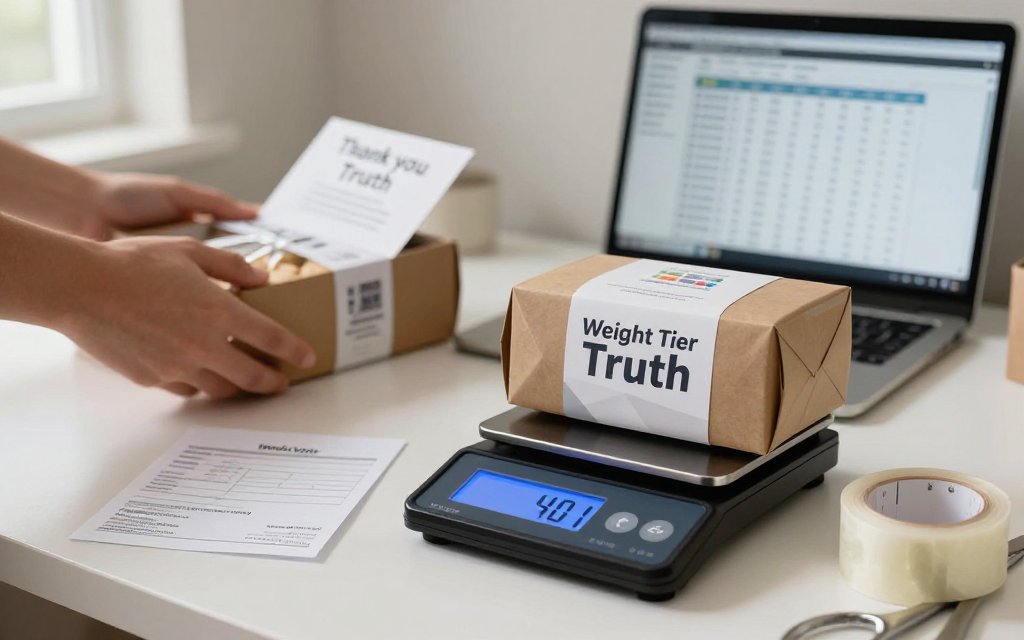
A lot of shipping label drama comes from one unglamorous fact: you are not really paying for “4 ounces” or “1 pound.” You are paying for a weight tier. If your package crosses a tier boundary, even by a hair, the price jumps to the next tier. That is why a cookie box that “basically weighs 4 oz” can still get hit with a postage adjustment later. Picture a small bakery order: 3 cookies in a tuck-top box, a little thank-you card, then a poly mailer and tape. It feels tiny, but tiny adds up fast when the carrier is looking for an exact number.
When people say “rounding,” they usually mean one of two things. (1) The shipping platform rounds what it shows you on screen (for example, displaying 4.0 oz when the stored value is 4.04 oz). (2) The carrier uses “billing weight,” meaning your measured weight is mapped to the correct tier, and the tier is what determines postage. That second one is what matters. If your actual weight is 4.01 oz and the tier you paid for ends at 4.00 oz, it is not treated like 4 oz in practice. It is treated like “over 4 oz,” which lives in the next tier.
The simple rule: tiers matter more than rounding
Here is the rule worth taping to your label printer: if your actual weight lands above the tier limit, you pay the next tier, even if it is 0.01 oz. Carriers do not “be nice” because it is close. Also, carriers do not care what your selling platform estimated, what you meant to enter, or what you weighed at home last week. If your label says 4 oz but the package scans at 4.2 oz, you can get billed the difference after the fact. This is one reason USPS and other carriers have automated verification systems, and why “postage adjustments” show up days later.
The most common triggers are boring but predictable: you entered only the product weight (not the packaging), you switched to a heavier mailer at the last minute, you added a bonus insert (stickers, a coupon card, extra tissue paper), or the item changed slightly after packing. Baked goods can gain or lose moisture, especially if you pack warm cookies and the box “sweats” a little. Jewelry makers run into this too: a tiny pair of earrings might be 0.2 oz, but a padded mailer, gift box, polishing cloth, and shipping label can push the shipment over the next ounce tier. If you are also the kind of person who eyeballs ingredients, bookmarking a quick reference like coffee tablespoons to grams can help you build a better intuition for small weight differences.
Treat every shipping label like a tight weight budget. Weigh the fully sealed package, then give yourself a cushion of at least 0.2 to 0.5 oz under the tier cutoff so tape, labels, and small inserts cannot push you over.
Where the surprises happen: ounces, thresholds, and scan weights
USPS is a classic place where “I thought they rounded” turns into “why did I get adjusted?” because the brackets are often set in ounces, then switch to pounds. For USPS Ground Advantage, packages under 1 lb are priced in ounce tiers, then anything above 15.999 oz is treated as 1 lb and priced in 1 lb steps (2 lb, 3 lb, and so on). USPS even spells out that under-1 lb pricing uses the 4 oz, 8 oz, 12 oz, and up to 15.999 oz increments in its own materials about USPS tiered ounce increments. That is why 6.3 oz does not “round to 6 oz,” it typically prices as the 8 oz tier.
In real packing terms, the danger zones are right around 4 oz, 8 oz, 12 oz, 15.999 oz, and 1 lb. If your cookie mailer weighs 3.98 oz, adding one extra sheet of bubble wrap (or even a longer strip of tape) can nudge it to 4.05 oz, which bumps it into the “over 4 oz” tier. The same logic applies at 8.01 oz, 12.01 oz, and 16.01 oz (which is over 1 lb). Carriers also rely on scan weights captured at acceptance, sort facilities, or automated equipment, so the number that decides your final bill might be taken later, not at your kitchen table.
Common mistake to avoid: weighing only the product. Shipping weight is the finished, label-ready package: product + inner box + padding + tape + label + the outer mailer. As a concrete example, a small jewelry order might be 18 g (0.63 oz) for the necklace, but add a 22 g gift box, a 14 g padded mailer, and 6 g of tissue and tape, and you are already around 60 g (2.12 oz). If you are trying to stay under a 4 oz tier, that is fine, but if your “lightweight” package was already 3.9 oz, those little extras are exactly what cause adjustments. The safest workflow is to pack first, weigh second, then buy postage for the tier you actually landed in (plus a cushion).
What triggers USPS postage adjustments and postage due
A USPS postage adjustment usually starts with something totally normal: you buy a label online (Etsy, Shopify, Pirate Ship, or USPS Click-N-Ship), print it, and hand the package to USPS. Later, USPS runs your parcel through processing where it gets weighed and measured again. If USPS records a higher weight or a bigger package than what you paid for, the label is considered short-paid. That can trigger an adjustment charge back to whoever bought the label, or it can show up at delivery as postage due. The tricky part is timing: your buyer might already have the item, and you are just now seeing the extra charge hit your account.
Most adjustments are boring math, not punishment. A common example is jewelry: your bracelet is 3.9 oz on your kitchen scale, so you buy the 4 oz tier. Then you add a rigid gift box, a padded mailer, and a longer strip of tape. Now the real shipped weight is 4.2 oz, which bumps you into the next pricing step. USPS also verifies package characteristics automatically, and discrepancies in weight, dimensions, or package type can be detected and billed later, which USPS describes in its Ground Advantage weight tiers rules (including ounce-based breakpoints under 1 lb and rounding up past cutoffs).
USPS compares the weight and size you entered on the label with what its equipment measures in processing. If the numbers do not match, the system can create an adjustment, debit or credit, after acceptance.
Postage due is the same problem, it just lands differently. If the label was bought through an online account, USPS often charges that account after the fact. If there is no easy account to bill (for example, a handwritten postage setup, a mismatched class, or a label that fails validation), the carrier may attempt delivery and collect the difference from the recipient. That is how a “surprise $3.00 due” moment happens at the door. For small businesses, that is bad for reviews. For friends and family shipments, it is just awkward. Either way, the root cause is almost always the shipped package being heavier, larger, or packaged differently than what the label claims.
Platform reality: Etsy, Shopify, and Pirate Ship weight discrepancies
On Etsy, Shopify, and Pirate Ship, the “postage adjustment weight” scenario is usually this: you chose a service and entered a weight that fit a cheaper tier, then USPS later records a higher weight and bills the difference back to the platform account. That billing can show up days later because it is generated after USPS processing, not at the counter. Etsy shipping weight rounding can add confusion too. A UI might show a clean number like “4 oz,” but the service you selected still has strict cutoffs. If your parcel is 4.01 oz, it is not “basically 4 oz” anymore. It is in the next tier, and the platform is the messenger when USPS charges for that mismatch.
The fastest way to understand adjustments is to memorize the real-world triggers and build a small buffer into your process. If you are shipping close to a cutoff, treat it like baking by weight: a “little extra” counts. The same mindset helps fitness portion tracking too, because a scoop that is “close enough” can be 10 to 15 g off. Shipping is just less forgiving because the cutoff is priced in tiers. If you regularly ship items that hover around 4 oz, 8 oz, 12 oz, or just under 1 lb, assume you will cross the line sometimes, unless you standardize packaging and tape habits.
If you get an adjustment, treat it like a receipt mismatch, not a mystery. Pull the order, confirm what weight and dimensions you entered, and compare it to what you actually used. If you dropped off at a USPS counter and got an acceptance receipt, keep it, because it can show the acceptance weight and sometimes helps when you dispute an obvious error. Also look for hidden “package type” mismatches, like buying a label as a soft poly mailer and then shipping in a rigid box. Platforms can only pass along what USPS reports, so your best defense is good records: photos of the packed box on a scale, saved packing templates, and consistent supplies so the numbers stay repeatable.
The packaging math most people skip
Packaging weight is where “I was sure it was under” turns into an adjustment. A bubble mailer can add about 0.5 to 1.5 oz depending on size and thickness. A small carton plus void fill (kraft paper, air pillows, or foam) often adds 2 to 6 oz. Tape feels weightless until you layer it. Two extra wrap-arounds of 2-inch packing tape can add a noticeable fraction of an ounce, especially on small parcels near 4 oz or 8 oz. Now picture a protein powder bag: you seal it, realize powder dust is leaking, and add two more tape bands plus a second poly bag. That “just to be safe” moment can push you past a tier.
Watch for the two mistakes combo: (1) estimating packaging based on the empty mailer or box, and (2) forgetting the little paper stuff that still counts. A 0.2 oz label sheet plus a 0.3 oz packing slip does not sound like much, but on a 3.8 oz shipment it is the difference between comfortably under 4 oz and nervously over it after tape. For makers who ship earrings, chains, or small resin pieces, the fix is simple: pack first, then weigh the final sealed parcel, then buy the label. If you do not have a scale handy, a photo-based estimate can help you decide whether you are playing too close to the cutoff, so you can choose a heavier tier on purpose instead of paying for an adjustment later.
How to estimate package weight without a scale
You do not need a perfect weight to avoid USPS surprises. You just need to land in the right bracket with enough cushion that real world packing changes (an extra strip of tape, a thicker mailer, a bigger thank you card) do not push you over the line. The easiest way to do that is to stop thinking “What does my item weigh?” and start thinking “What does my finished shipment weigh?” That mindset helps everyone here: a home cook mailing 1 dozen brownies, a jewelry maker shipping a ring, or a small shop printing 20 labels in Shopify or Etsy after dinner.
The bracket-first workflow for Ground Advantage weight tiers
Start by choosing the exact packaging you will actually use, not “something similar.” A 6 in by 4 in by 2 in box with crinkle paper can weigh 2 oz to 4 oz by itself, while a poly mailer might be under 1 oz. Once the packaging is decided, estimate the item weight, then add the packaging weight on purpose. Example: you ship a necklace that weighs 0.2 oz, but you use a small jewelry box (1.3 oz), a microfiber pouch (0.3 oz), a rigid mailer (1.0 oz), and a business card (0.1 oz). Your shipment is about 2.9 oz, so you buy the 4 oz tier, not “1 oz” because the necklace is tiny.
Next, compare your estimate to the next cutoff and decide if you need a buffer. My rule of thumb: if you are within about 0.3 oz to 0.7 oz of a cutoff, pay for the next tier unless your packaging is extremely consistent. The classic trap is chilled baked goods. Without ice packs, a brownie box might be brownies (12 oz) + box and padding (6 oz) = 18 oz (1 lb 2 oz). Add two small ice packs (8 oz total) and you are at 26 oz (1 lb 10 oz). If you “play it tight” and buy 1 lb 8 oz or a 1 lb label out of habit, an automated scan can bump you into the higher bracket and trigger an adjustment.
Using a photo weight estimation app for fast estimates
A photo weight estimation app fits nicely into this bracket-first routine because it helps you get a fast “good enough” number when a scale is not handy. If you are batch listing products (like 30 pairs of earrings), traveling and packing orders in a hotel room, or double-checking a Shopify saved weight that feels suspiciously light, taking a quick photo estimate can keep you in the right tier. Best practices matter: use bright, even lighting; keep the camera angle consistent; include a reference object if the app supports it; and estimate the fully packed shipment (item plus box, padding, inserts, and tape) instead of the item alone. That is how a home cook can sanity check a brownie mailer before printing labels, and how a jewelry maker can catch that a “tiny ring” becomes a heavier shipment once it is boxed and protected.
If your estimate lands right on the edge, do not argue with the edge. Buy the next tier. The cost difference is usually smaller than the time you lose fixing an adjustment, replying to a customer, or reprinting labels.
FAQ: Does USPS round up ounces on shipping labels
For USPS Ground Advantage packages under 1 lb, pricing works by tiers, not by rounding to the nearest ounce. If your shipment is even slightly above a tier limit, it prices at the next tier (for example, 12.1 oz prices at the next tier up). USPS describes these ounce tier increments and gives an example in the ounce pricing increments section of the Domestic Mail Manual. Practical takeaway: if you estimate 3.9 oz, 7.9 oz, 11.9 oz, or 15.9 oz, treat it like a danger zone and round up your purchased tier, especially if mailers vary.
FAQ: What are the most common USPS weight brackets in ounces
The easiest mental model is “ounces first, then pounds.” For many small parcels sent with Ground Advantage under 1 lb, you will run into the common ounce cutoffs at 4 oz, 8 oz, 12 oz, and 16 oz (1 lb). After that, labels usually step through pound-based tiers, like 2 lb, 3 lb, and so on. The biggest danger zones are right near 4 oz, 8 oz, 12 oz, and 16 oz because a tiny overage can push you into a higher price tier. Tip: set your default product weights in Etsy or Shopify so the packed order lands at least 0.5 oz to 1.0 oz below your chosen cutoff.
FAQ: Why did I get a Pirate Ship or Etsy postage adjustment
Most postage adjustments come down to one of four things: the actual weight was higher than the label you bought, the package type did not match (box versus flat rate, or thick rigid mailer entered as a regular envelope), the dimensions pushed the price up, or someone swapped packaging mid-fulfillment. Quick checklist: re-create the packed shipment weight you assumed (item, inserts, padding, tape); confirm the packaging choice in your order notes matches what you entered on the label; then update saved weights in Etsy or Shopify for that SKU so tomorrow’s labels do not repeat the same mistake. If you ship kits, remember that “free extras” add ounces fast.
Need to weigh something fast before you buy a label? Download Scale for Grams to get an AI-powered weight estimate from a photo in seconds. It is a quick way to sanity-check your package weight, especially when packaging can push you into the next tier. Grab the app on iOS, try it on your next shipment, and reduce the odds of a postage adjustment.
Scale for Grams
Need to Weigh Something?
Download Scale for Grams and get an AI weight estimate from a photo in seconds.