Banana Math for Groceries: Quick Weight-Per-Piece Cheatsheet
A practical, in-store cheatsheet for estimating produce weight per piece in grams and pounds, plus simple “banana math” to predict cost, avoid overbuying, and enter more accurate weights in grocery delivery apps.
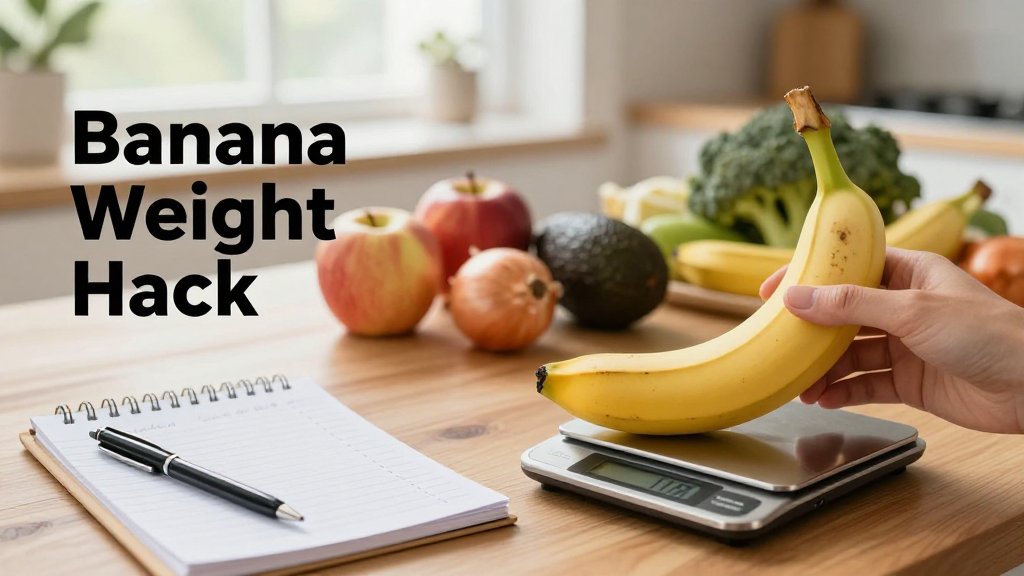
Ever grabbed “about four apples,” only to see the total jump at checkout? Estimating produce by piece is tricky because most stores price by weight, and many recipe, meal, and tracking apps ask for grams. This guide teaches a simple “banana math” method you can reuse in any aisle: pick a familiar reference, scale up or down, then sanity-check with typical ranges. You will also get a quick cheatsheet of realistic grams per piece for common groceries.
Banana math: the fastest way to estimate weight
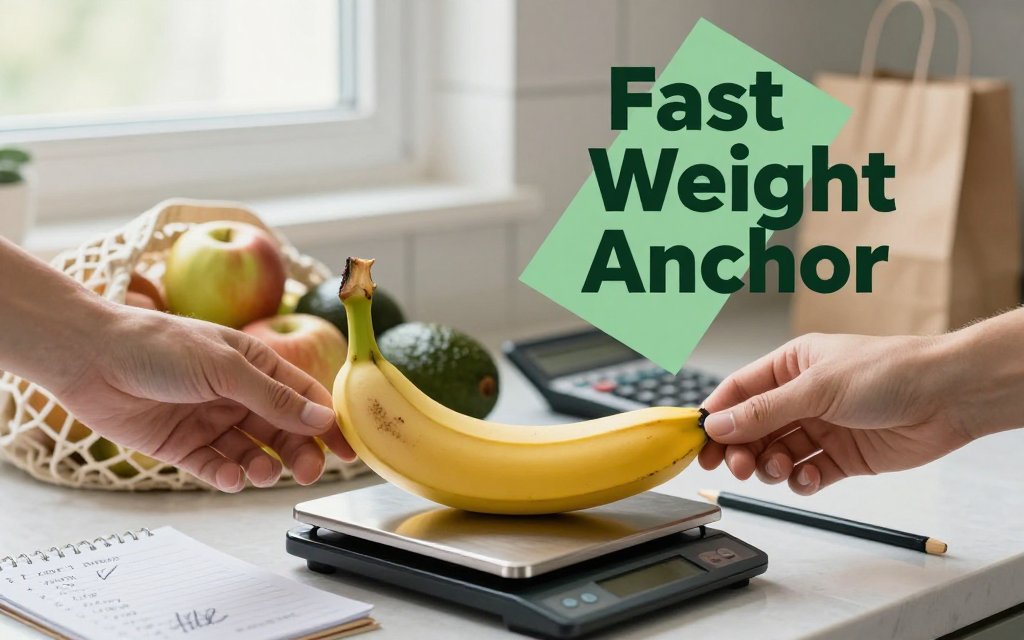
Here’s the rule of thumb you can actually use in a grocery aisle: treat a medium banana as your reference weight, then scale up or down based on size and how dense the item feels. Bananas are everywhere, they come in a fairly predictable size range, and most people have held one often enough that the “feel” is familiar. Once you have one anchor, your brain stops freewheeling and starts making quick, consistent adjustments. That is the whole point of banana math: you do not need perfect, you need close enough to decide portions, recipe weights, shipping tiers, or whether the “one pound” of produce in your cart is really one pound.
This works surprisingly well in real grocery conditions because most shopping decisions do not require lab accuracy. Home bakers usually need to know whether they have 200 g of fruit for banana bread, not whether it is 203 g. Small business owners shipping candles or snack packs often care about crossing a 1 lb threshold, not the last gram. Fitness folks tracking food portions need repeatable estimates that keep them in the right ballpark. Banana math gives you a stable “starting number,” then you adjust for density (how heavy something feels for its size) instead of getting fooled by volume (how big it looks).
The classic banana-weight fail shows up in delivery apps. Picture an Instacart order where you tap “2 lb bananas” for smoothies. The shopper grabs a big bunch of extra-large bananas because it looks like “two pounds,” but the app charges by weight. If the bunch ends up 2.5 lb instead of 2.0 lb, you just bought an extra half-pound without meaning to. At $0.79 per lb, that is only about $0.40, but it also changes portions. Your planned 6 smoothies might become 7 or 8, or your macros drift for the week because the banana amount per smoothie quietly crept up.
The anchor: one medium banana in grams
Use this as your citation-hook baseline: a medium banana (peeled fruit) is about 118 g, as shown in USDA medium banana weight tables for edible portions. That “edible portion” wording is the key detail. Many apps, nutrition labels, and recipes disagree because some count the part you eat (peeled fruit), while others assume you weighed the whole banana with the peel on. In normal kitchens, an unpeeled medium banana often lands around 140 to 160 g because the peel adds a noticeable chunk. If you are estimating for smoothies or baking, default to the peeled number.
For fast adjustments, think in percentages, not tiny math. If the banana looks small, subtract about 20% from 118 g (you land near 95 g peeled). If it looks large, add 20 to 30% (you land near 140 to 155 g peeled). This same adjustment trick works for lots of items once you have any anchor weight in mind. For price-by-the-pound math, keep one conversion ready: 1 lb is about 454 g. That means 100 g is about 0.22 lb, and 500 g is about 1.1 lb. So if you eyeball a pile of produce at roughly 700 g, that is about 1.54 lb, then multiply by the store’s $/lb.
Pick one anchor weight and adjust, do not guess from size alone. Start with a medium banana, then add or subtract 20 percent for small or large items, and sanity-check using 454 g per pound.
A common mistake: volume is not weight
Most people guess wrong because they trust what looks big. Volume is not weight, and produce varies wildly in density. Onions and sweet potatoes often feel heavier than they look because they are dense, tightly packed, and have less air space. Tomatoes can trick you the other direction, they can look huge, but they are mostly water with a thin skin and lots of internal gel. Apples sit in the middle, but different varieties can swing your estimate because a crisp, dense apple can weigh more than a softer one of the same size. A quick shopping cue is to compare “heft” in your hand to the banana baseline, then adjust for peel thickness and moisture.
Back to that Instacart-style half-pound miss: a 0.5 lb error is about 227 g, which is roughly two peeled medium bananas. That is a big deal for portions. If you planned 30 g of banana per oatmeal bowl, an extra 227 g adds about seven extra bowls worth of fruit. It also changes cost more than you think when you stack errors across several items in one order. The fix is simple: anchor with banana math, then apply density logic before you commit to a “looks like a pound” guess. If you estimate weights from photos for shipping or materials, you can also cross-check with tools like Scale for Grams, and for fabric projects it helps to estimate fabric GSM quickly so you do not confuse thickness with weight.
Quick weight-per-piece cheatsheet for common produce
If you only memorize one thing from this cheatsheet, make it this: ranges beat single numbers. Produce is inconsistent by variety, season, and how it was trimmed (peel, core, stems, and dirt all change the number). For bananas (the classic “banana math” item), a realistic per-piece range is: small banana about 85 to 105 g, medium about 105 to 130 g, large about 130 to 160 g. That means 1 lb (about 454 g) is usually 4 to 5 small bananas, 3 to 4 medium bananas, or about 3 large bananas. If you are baking banana bread and you want 300 g mashed banana, you are typically looking at 2 large bananas or 3 medium bananas, then adjust after you mash.
A quick mental trick in-store is to think in quarters of a pound. Since 1 lb is about 454 g, a “quarter pound” is about 113 g. That is convenient because many medium pieces of produce land near 110 to 200 g. Also remember: nutrition databases usually describe edible portions, not the sticker-on, stems-on reality, which is why ranges are safer. If you want to sanity-check what “edible portion in grams” means, the USDA explains how portions are reported in USDA portion weights. In practice, you do not need perfect precision at the store, you just want to land close enough that your recipe or shipment is not wildly off.
Everyday staples: apples, onions, tomatoes, sweet potatoes
Apples are one of the easiest items for weight-per-piece math because they cluster tightly by size. A small apple is often about 140 to 170 g, a medium apple about 170 to 210 g, and a large apple about 220 to 280 g. For 1 lb (454 g), plan on about 3 small apples, 2 to 3 medium apples (2 medium is often short), or 2 large apples. Real example: if a pie recipe wants 900 g peeled and sliced apples, you will usually buy about 5 medium apples (5 x 180 g is about 900 g before trimming) or about 4 large apples. If you are snacking and tracking portions, one medium apple at about 180 to 200 g is a nice “one piece is about 0.4 lb” rule of thumb.
Onions swing more than apples because a “small” onion can be truly tiny, and sweet onions can get huge. As a practical shopping range, think: small onion about 70 to 110 g, medium onion about 120 to 170 g, large onion about 200 to 300 g. That translates to roughly 4 to 6 small onions per lb, about 3 medium onions per lb, or about 2 large onions per lb. If you are meal-prepping and want about 500 g sliced onions for fajitas or caramelized onions, that is commonly 3 medium onions, or 2 large onions plus a small one. For shipping, onions are dense for their size, so they add weight fast in a box.
Tomatoes and sweet potatoes are where people get surprised, just in opposite directions. Tomatoes can be light if they are Roma style, or heavy if they are beefsteak. Use this range: Roma tomato about 60 to 90 g (1 lb is about 6 to 7 Roma), medium slicing tomato about 110 to 150 g (1 lb is about 3 to 4), beefsteak about 200 to 300 g (1 lb is often just 2). Sweet potatoes are consistently heavy: small sweet potato about 130 to 180 g, medium about 180 to 260 g, large about 260 to 400 g. That means 1 lb is often 3 small, about 2 medium, or 1 to 2 large. If you want 1 kg of sweet potatoes for batch roasting, picture about 4 to 5 medium pieces.
Sold “by the each” but billed by weight is common in self-checkout and delivery apps, and it is where this cheatsheet saves money. In a store, weigh the bag at the produce scale before you scan (or at self-checkout if it prompts you). If the screen says you grabbed 2.20 lb of apples and you meant closer to 1.50 lb, swap one large apple for a smaller one. In delivery apps, if you order “3 onions” and they pick 3 huge sweet onions at 0.6 lb each, you just bought almost 2 lb. A simple fix is to add a note like “please choose medium onions, total about 1 lb” or “aim for about 450 g total.” When you order tomatoes, specify Roma versus beefsteak if you care about the total weight.
Tricky items: ginger and grapes (and why they mess up estimates)
Ginger is the classic “looks small, weighs a lot” item because it is dense and irregular. People tend to eyeball it like a leafy herb, then get sticker shock at checkout. Use knob-based ranges: a small knob (about the size of a walnut) is often 15 to 30 g, a medium “thumb” piece is about 35 to 60 g, and a big hand-sized chunk can be 80 to 120 g. For 1 lb (454 g), that is roughly 6 to 10 thumb-sized pieces, or 4 to 6 larger chunks. Fast cooking example: if a stir-fry calls for 20 g ginger, you are usually looking for a 1 inch to 1.5 inch knob. If you are making ginger tea and want 100 g sliced ginger, that is often one large chunk or two medium pieces.
Grapes are tricky for the opposite reason: a “handful” is not a unit, and you are also paying for stems (and sometimes a clamshell container). A single grape is commonly about 4 to 6 g, so 1 lb of loose grapes is roughly 80 to 110 grapes, depending on variety and size. In-store, estimate by clusters instead of by handfuls: a small cluster might be 60 to 100 g, a medium cluster 120 to 180 g, and a large cluster 200 to 300 g, so 1 lb is often 2 to 3 medium clusters. If they are pre-packed, use the printed net weight on the label whenever you can and assume the container adds extra that you are not eating. For portion tracking, a 150 g target is usually about one medium cluster or a generous single layer in a lunch container, not a full double-hand scoop.
Estimate cost per pound and portion grams fast
Once you have a decent per-piece weight estimate, you can turn it into two things people care about fast: money (checkout totals and shipping weight) and portion grams (baking and macro tracking). The trick is to think in grams first, then convert to pounds only at the last step. Most US produce signs are price per pound, and 1 lb is about 454 g (exactly 0.45359237 kg). (nvlpubs.nist.gov) That means 900 g is just under 2 lb, and 1,350 g is just under 3 lb. If you round to 450 g per lb in your head, your estimate stays close enough to pick the right bunch at the shelf, enter a better weight in a delivery app, or sanity-check a receipt.
From pieces to pounds: quick checkout math
Here is the mental workflow that stays quick even in the produce aisle: Step 1, pick a realistic per-piece gram range (small, medium, large). Step 2, multiply by your piece count to get total grams. Step 3, divide by 454 to convert grams to pounds (or divide by 450 for faster math, then adjust slightly). Step 4, multiply pounds by the posted price per pound. If your estimate is meant for shipping, add packaging weight right in grams, for example add 30 g for a padded mailer or 150 g for a small box, then do the same divide-by-454 step to predict billed pounds.
Worked example with bananas (lighter, more air space, plus peel): assume a medium banana is about 140-170 g as purchased. Say you grab 6 bananas and the sign says $0.69 per lb. Use 160 g each as your middle guess: 6 x 160 = 960 g. Convert to pounds: 960 / 454 is about 2.1 lb. Multiply by price: 2.1 x $0.69 is about $1.45. If you are planning banana bread by grams instead, remember the edible portion is lower than the “as purchased” weight, so you may need an extra banana even when the checkout weight looks right.
Now compare sweet potatoes (denser and heavier per piece, so the same piece count costs more at the same $/lb). A medium sweet potato is commonly around 200-350 g depending on variety and how long it is. If you pick 3 medium ones and the sign says $1.49 per lb, use 280 g each: 3 x 280 = 840 g. 840 / 454 is about 1.85 lb. 1.85 x $1.49 is about $2.76. Notice the “density effect”: 3 sweet potatoes can weigh almost as much as 5 to 6 bananas, so piece count is a risky shortcut unless you anchor it with a per-piece gram estimate first.
FAQ: quick answers people actually search for
These are the numbers that make grocery math feel “automatic.” Use them in three places: at the shelf (predict cost), in delivery apps (enter a smarter estimated weight so you do not get surprised by the final total), and in the kitchen (portion in grams for baking or macros). For baking, grams are the cleanest: if a recipe calls for 300 g mashed banana and your bananas are averaging about 120 g edible each, you are looking at roughly 2 to 3 bananas, not a vague “two bananas” guess. For macros, pre-logging 150 g sweet potato or 30 g onion keeps your day consistent even if the pieces look different.
How much does a banana weigh in grams?
A “medium” banana is commonly listed as about 118 g for the edible portion in USDA-style nutrition references. (resources.finalsite.net) You can treat that as your peeled, ready-to-mash weight. At the store, bananas are weighed with the peel, so a medium banana as purchased often lands closer to about 140-170 g. Small bananas can be near 100-130 g, and large ones can push 180-220 g. Practical tip: if you are entering bananas into a macro app, weigh the peeled banana, or log by edible grams to avoid peel weight throwing off your totals. For a source you can bookmark, see USDA banana serving weights.
What are the average weights of apples, bananas, and onions?
Quick averages that work well for planning: a medium apple is about 182 g edible portion in common nutrition databases, with many apples landing in a practical 150-220 g range depending on variety and size. (resources.finalsite.net) A medium banana is about 118 g edible (often 140-170 g as purchased with peel). (resources.finalsite.net) A medium onion is often treated as about 110 g, with small onions closer to 70-90 g and large ones 150 g or more. (verywellfit.com) Tip for portioning: dice once, then portion by grams, because chopped volume changes a lot with cut size but grams do not.
How do I estimate produce weight for Instacart or grocery delivery apps?
Start by deciding whether the app charges by weight (most loose produce does) or by count (some packaged items do). For weight-based items, estimate grams per piece, multiply by how many you want, then convert to pounds by dividing by 454. (nvlpubs.nist.gov) Example: you want 8 bananas, you guess 160 g each as purchased, so 8 x 160 = 1,280 g, which is about 2.8 lb. Enter 2.75 to 3.0 lb to reduce surprises. Add a buffer when substitutions happen: for “medium” requests, plan for plus or minus 10-15% weight so your meal prep math still works if you get slightly larger produce.
Need to weigh something fast, even when you do not have a scale? Download Scale for Grams and get an AI-powered weight estimate from a photo in seconds. It is perfect for quick grocery checks, meal prep, and logging produce with more confidence. Try it on your next bag of fruit and see how close you get. Grab the app here: iOS.
Scale for Grams
Need to Weigh Something?
Download Scale for Grams and get an AI weight estimate from a photo in seconds.