No-Scale Baking: Teaspoon-to-Grams for Salt and Yeast
Baking without a scale is doable if you treat teaspoons as estimates, not facts. Here are reliable teaspoon-to-grams conversions for salt and yeast, how Diamond Crystal vs Morton changes results, and a quick photo-based workflow to sanity-check small-ingredient weights.
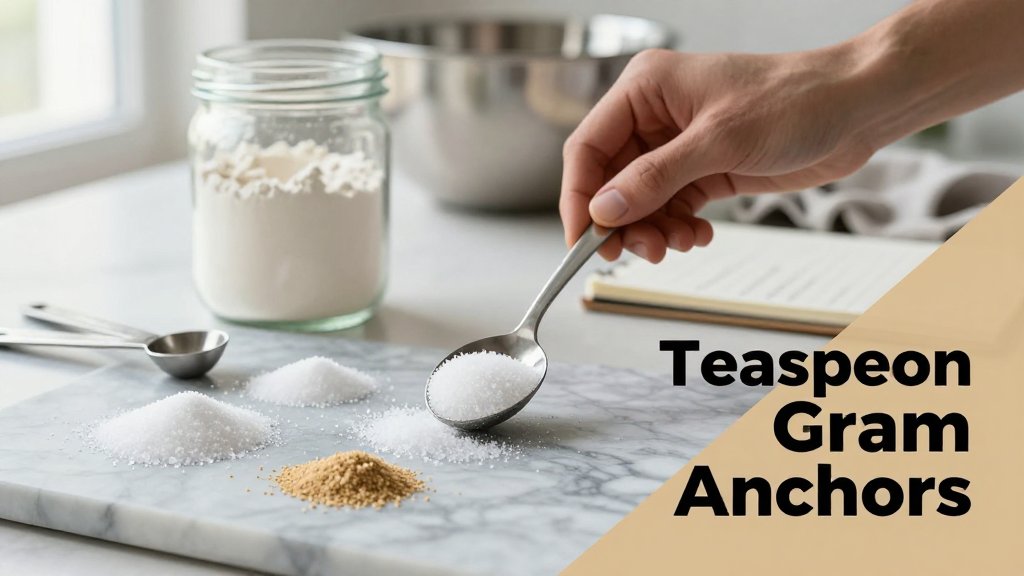
You follow the same bread recipe twice, then suddenly it tastes too salty, or the dough barely rises. Nothing changed, except the salt brand or the yeast you grabbed from the pantry. When you do not have a scale, those tiny differences can wreck a bake. This guide shows how to bake accurately anyway, using teaspoon-to-grams ranges for salt and yeast, brand-aware conversion tips, and a quick phone photo check to confirm micro-ingredients before they hit the bowl.
Teaspoon to grams conversions that actually work
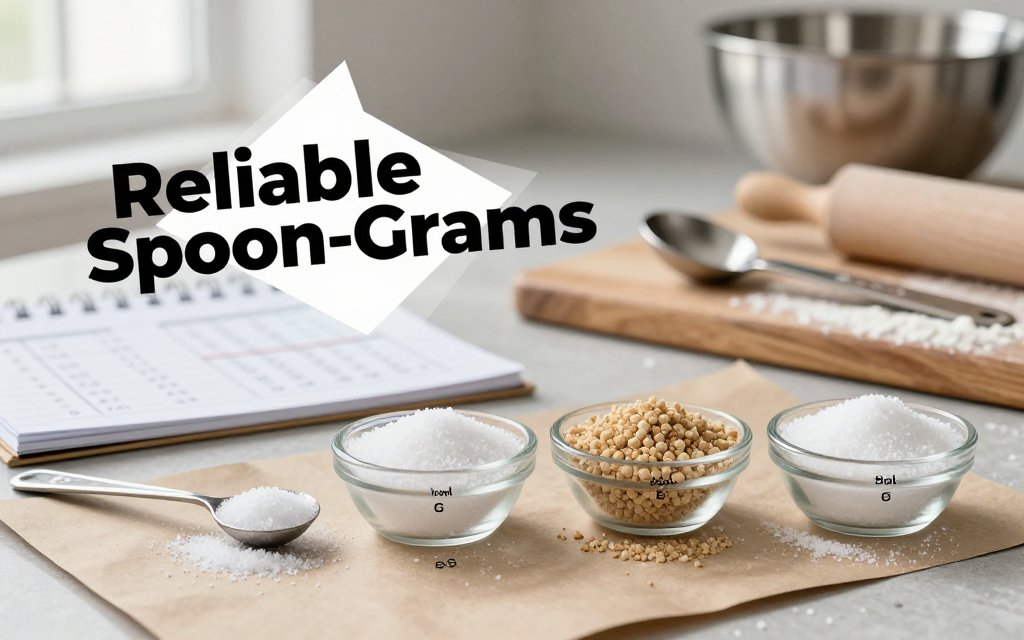
Teaspoons measure volume, grams measure mass, so the moment you try to swap one for the other, you are dealing with density and how much air is trapped between particles. That is why a “teaspoon of salt” can land anywhere from “barely seasoned” to “why is this bread salty?” even if you use the same spoon. Tiny ingredients also magnify tiny habits: fine crystals settle tighter than flaky ones, humidity makes powders cling and compact, and a heaping scoop can quietly add 20% to 50% more than a leveled spoon. If you are baking by weight but stuck without a scale, use the anchors below as practical estimates, not as promises.
(thecalculatorsite.com)Salt: grams per teaspoon by type and brand
Salt is the classic teaspoon offender because “salt” is not one ingredient on the shelf. Fine table salt (often iodized) is dense and packs tightly, so it weighs more per teaspoon. Kosher salts are larger flakes and can be wildly different from each other: Diamond Crystal is light and airy, while Morton is denser with flatter crystals that settle closer together. Many published recipes quietly assume one brand of kosher salt without naming it, which is how two bakers can follow the same recipe and end up with two very different loaves. If you remember only one idea, remember this: kosher salt is not one thing, it is at least two different worlds.
Directly quotable anchors you can use (all assume a leveled US teaspoon): table salt is about 6.0 g per teaspoon with a realistic error band of about 5.5 g to 6.5 g depending on how fine it is and how aggressively you scoop. For kosher salt, use brand-aware anchors: Diamond Crystal kosher salt is about 2.8 g per teaspoon (roughly 2.5 g to 3.1 g), and Morton coarse kosher salt is about 4.8 g per teaspoon (roughly 4.4 g to 5.2 g). Those numbers are consistent with major baking references like the ingredient weight chart, which also shows how far apart these salts are by weight.
(cuporgram.com)A practical rule that saves batches: if a recipe says “kosher salt” and you only have Morton, start with about 3/4 of the listed volume and adjust next bake. Example: a dough calls for 2 teaspoons kosher salt. If the author meant Diamond Crystal, that is about 5.6 g total (2 x 2.8 g). If you measure 2 teaspoons Morton instead, you are closer to 9.6 g (2 x 4.8 g), which is enough to make a sandwich loaf taste noticeably salty. To tighten your range without a scale, fluff salt in the box, spoon into the teaspoon, then level with a straight edge. Avoid scooping by stabbing the spoon into the container, because it compacts fine salt and turns “1 teaspoon” into a stealth heap.
(ucanr.edu)I have ruined a loaf by dumping in “1 tsp kosher salt” with the wrong brand. If you cannot weigh it, level your spoon, hold back a pinch at first, and write down what you did so next time is better.
Yeast: instant vs active dry per teaspoon
Yeast conversions are usually closer than salt, but still worth getting right because a gram or two changes rise time. A good anchor comes from packet math: a standard packet is 7 g and is commonly treated as 2 1/4 teaspoons, which puts 1 teaspoon of dry yeast at about 3.1 g. Instant yeast granules tend to be a bit finer and can weigh slightly more per teaspoon if they settle densely, so use about 3.0 g to 3.2 g per teaspoon for instant. Active dry has larger particles and more air space, so a practical range is 2.8 g to 3.1 g per teaspoon. Instant yeast usually goes straight into the flour; active dry is more likely to be dissolved (or “bloomed”) first if your recipe expects it.
(fleischmannsyeast.com)Two more teaspoon troublemakers deserve quick, weight-based anchors because overdoing either can taste harsh. For a leveled teaspoon, baking soda is about 4.6 g (roughly 4.3 g to 4.9 g if humidity or packing changes the fill), and baking powder is about 4.0 g (roughly 3.7 g to 4.3 g). If you have ever tasted a “soapy” muffin or bitter cookies, it is often too much soda or powder, not “bad vanilla.” If you are tracking food portions for fitness without a scale, pair these micro-ingredient anchors with palm-to-grams macro tracking so your daily numbers stay consistent even when your tools are not.
(thebakingcalculator.com)If you are living the no-scale life regularly, it helps to split your strategy in two: use teaspoon-to-grams anchors for micro-ingredients (salt, yeast, leaveners), then use a photo-based estimator for everything else where a 5 g swing is not catastrophic. That is where Scale for Grams fits in nicely for everyday tasks that extend beyond baking, like estimating a cookie dough ball for portioning, a small padded mailer for shipping labels, or a bead bundle for a jewelry order. It is built to estimate weights from photos and can report in grams, ounces, and kilograms. For this section’s mental picture, imagine a close-up photo showing large, hollow kosher salt flakes next to tiny yeast granules, both sitting in identical teaspoon bowls to highlight why “same spoon” does not mean “same grams.”
Why salt and yeast brands change recipe results
Brand and type differences can swing a small ingredient by 30 to 50 percent when you measure by teaspoons, and that is plenty to wreck both flavor and fermentation. Salt can jump from pleasantly seasoned to harsh and tight. Yeast can push a dough from slow and flavorful to fast, gassy, and hard to handle. The frustrating part is that you can do everything else “right” and still get a different loaf, simply because one teaspoon is not a fixed weight when crystals and granules take up different amounts of air.
The mechanics are simple and annoyingly human. Crystal shape changes how much empty space sits between grains. Flaky salt has big air gaps, so it looks like “a full spoon” but weighs less. Denser salt settles, so the same spoon weighs more. Then there is the accidental “packed scoop”: you dip into a box, the spoon scrapes the side, and the salt compresses without you noticing. Yeast does the same thing when it clumps or when a fine grind packs tighter than a coarser grind. Even tapping your spoon on the counter can quietly turn a level teaspoon into a heavier one.
Diamond Crystal vs Morton: the hidden salt multiplier
The most common failure mode looks like this: you bake the same sandwich bread every week, you run out of your usual kosher salt, you grab a different box, and you keep using the same teaspoon measure. Suddenly the dough feels tighter during mixing, the crust browns faster, and the slice tastes aggressively salty. With Diamond Crystal kosher salt, the crystals are light and airy. With Morton kosher salt, the crystals are denser. King Arthur Baking’s ingredient weight chart shows this clearly by volume: 1 tablespoon Diamond Crystal kosher salt is 8 g, while 1 tablespoon Morton kosher salt is 16 g. If you do the teaspoon math, that is roughly 2.7 g per teaspoon versus 5.3 g per teaspoon, close to double for the same “1 teaspoon.”
A practical way to stop the salt whiplash is to create a “house baseline” for your spooning style. Grab your teaspoon and fill it your normal way (dip, swipe level, no extra tapping). Do that three times in a row and weigh each scoop if you can, even a cheap kitchen scale helps because salt is heavy enough to register. If you do not have a scale, you can still use this trick later when you do get one, or when you use a photo-based estimator like Scale for Grams on iPhone to sanity-check small amounts. Write down the three results and pick the middle number as your baseline teaspoon for that specific salt brand. Then adjust recipes to match that baseline, instead of guessing every time you swap boxes.
Yeast measurement mistakes that cause dense or overproofed dough
Yeast problems usually come from two places: a heaping spoon and tired yeast. A typical reference point is that 1 teaspoon of dry yeast is around 3 g. If your “teaspoon” is actually a rounded, slightly heaped scoop, it is easy to land at 4 to 5 g without meaning to. That extra 1 to 2 g does not sound like much, but it can speed fermentation enough that your timing cues stop matching the recipe. Picture a Friday pizza routine: you mix at 6 p.m., expecting a slow room-temperature rise, but by 7 p.m. the dough has ballooned, feels sticky, and tears when you stretch because it is already overproofing. That is not you forgetting technique, it is the yeast dose quietly jumping by 33 to 67 percent.
Old yeast causes the opposite headache, and it tricks you into adding more. If yeast has been open in a warm pantry for months, it can lose strength. The dough rises slowly, you wait and wait, then you end up baking a loaf that looks fine but eats dense because it never built enough gas. Before you blame flour or kneading, do a quick reality check: stir 1 teaspoon yeast into about 1/4 cup warm water (think bath-warm, not hot) with a pinch of sugar. If it does not foam convincingly within 10 minutes, replace it. Once you are using fresh yeast, focus on consistency: level the spoon with a straight edge, avoid dipping into compacted yeast, and keep notes like “1 teaspoon equals my usual half packet.” One standard packet is 7 g, about 2 1/4 teaspoons, which is a handy anchor for troubleshooting.
Finally, use checkpoints so yeast amounts stop surprising you. Dough temperature matters because warmer dough ferments faster. If your mixed dough is warm to the touch (especially above the mid-70s F), even a normal teaspoon of yeast can act like “extra yeast.” Watch the dough, not the clock: you want visible expansion, a smoother surface, and small bubbles at the edges, not just a timer beep. For long cold ferments, reduce yeast on purpose. If a same-day dough uses 3 g yeast for 500 g flour (about 0.6 percent), a 24 to 72 hour fridge rise might need only 0.5 to 1.5 g (about 0.1 to 0.3 percent), which can be as little as 1/8 teaspoon to 1/2 teaspoon depending on your spooning. If your dough repeatedly races ahead, cut the yeast by 25 to 50 percent next batch and keep everything else the same so you can actually learn what changed.
How to bake accurately without a scale
A practical workflow for teaspoon to gram accuracy
Start by deciding what “accurate enough” means for the recipe in front of you. For tiny ingredients like salt, yeast, and chemical leaveners, I like a clear target (grams) plus a tolerance range you can live with. For most home baking, plus or minus 0.2 g to 0.5 g is a realistic goal when you are working from teaspoons and want repeatable results. That tolerance matters because a “small” extra heap can be half the dose. In a one-dozen cookie batch, that can change flavor noticeably, and in a same-day dough it can change timing, rise, and texture.
Next, lock in your measuring technique, because technique is where most teaspoon errors happen. Use actual measuring spoons (not a random spoon from the drawer), then fill them by spooning ingredient into the spoon and leveling it off with a straight edge (the back of a butter knife works). Avoid scooping directly from a jar or bag, which compacts fine grains and almost always gives you a heavier teaspoon. If you need 1/4 teaspoon, measure 1/2 teaspoon and split it visually into two small piles on a plate, then use half. That sounds fussy, but it is often more consistent than trying to “barely fill” a 1/4 teaspoon.
Precision matters most when a recipe is small-batch or fast moving. Think: salt in a half batch of chocolate chip cookies, yeast in a 60 to 90 minute pizza dough, or baking soda in pancakes where a little extra can taste soapy. This is where a phone photo estimate can save a bake. After you measure, pour the ingredient onto a clean, consistent surface (a white plate or cutting board), place a familiar reference nearby (a US quarter or a credit card), take a well-lit overhead photo, and run it through Scale for Grams. Use the estimate as a sanity check, not as a lab instrument. If the app reads noticeably higher than your target grams, you probably have a heaping spoon and should re-level.
How many grams is 1 teaspoon of kosher salt, Diamond Crystal vs Morton?
A level teaspoon of Diamond Crystal kosher salt is about 3 g, while a level teaspoon of Morton kosher salt is about 5 g, because Morton’s crystals are smaller and pack more densely. That 2 g difference is big in baking, it can turn “pleasantly seasoned” into “too salty,” especially in cookies, quick breads, and muffin batters. If your recipe only gives teaspoons, the safest no-scale move is to convert to grams and stay consistent with one brand. Epicurious has a helpful salt conversion chart that shows these teaspoon weights side by side.
How many grams is 1 teaspoon of instant yeast or active dry yeast?
For quick conversions, treat 1 teaspoon of instant yeast as about 3.1 g, and 1 teaspoon of active dry yeast as about 3 g. The difference is small enough that your measuring accuracy usually matters more than the yeast type for this specific teaspoon-to-gram step. For smaller doses, 1/2 teaspoon is roughly 1.5 g, and 1/4 teaspoon is roughly 0.75 g. If a recipe says “1 packet,” that is typically 7 g total, which is why you often see packet amounts described as about 2 1/4 teaspoons. In short ferments, even 0.5 g extra can noticeably speed up the rise.
How do I convert teaspoons to grams accurately without a kitchen scale?
Pick one trusted gram target, then make your teaspoon behave like a repeatable tool. Use leveled measuring spoons, fill by spooning into the spoon (no scooping), and tap the spoon once gently to settle, not repeatedly. Write down your working conversions on a sticky note, for example, 1 teaspoon Diamond Crystal kosher salt = 3 g and 1 teaspoon dry yeast = 3 g, then stick with the same brands. For tight-margin ingredients (salt, yeast, baking soda), add a photo-based check: spread the measured ingredient on a plate, snap a bright overhead photo, and use Scale for Grams to catch accidental heaps before they hit the bowl.
Need to weigh something fast, even when you do not have a kitchen scale? Download Scale for Grams and get an AI-powered weight estimate from a photo in seconds. It is a simple way to double-check small ingredients like salt and yeast, right when accuracy matters most. Grab the app here: iOS, then snap a picture and bake with more confidence.
Scale for Grams
Need to Weigh Something?
Download Scale for Grams and get an AI weight estimate from a photo in seconds.