Laundry Detergent Dosage in Grams, Stop Overusing
Most detergent caps nudge you to overpour. This guide gives a grams-based dosing range for HE and standard washers by load size, soil level, and water hardness, plus a simple way to estimate grams from a photo when you do not have a scale.
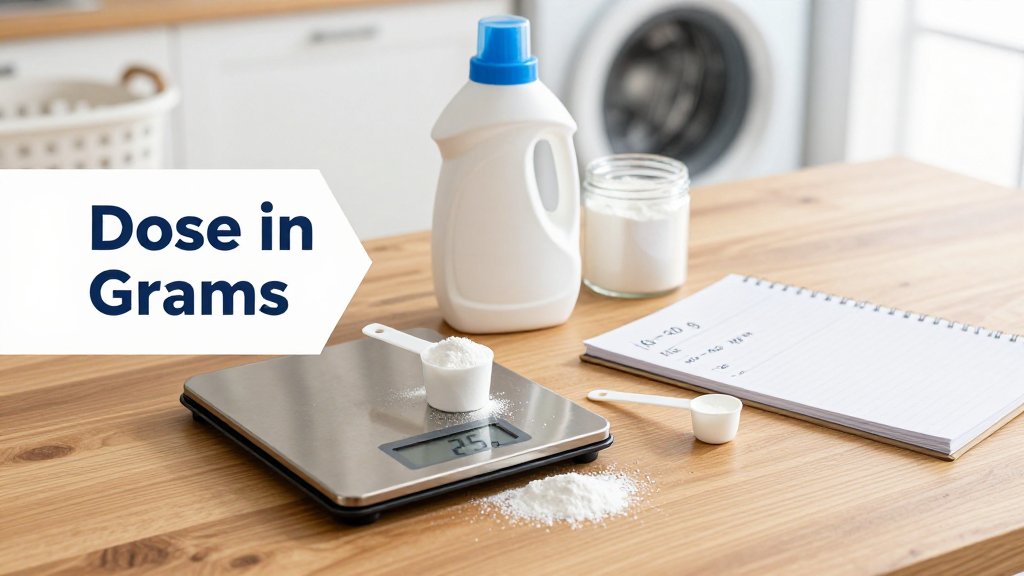
Too much detergent seems harmless until your washer starts overflowing with suds, your towels smell musty, and your clothes feel stiff from hidden build-up. The fix is not a stronger detergent, it is the right dose. In this guide, you will learn a simple grams-first way to measure laundry detergent so you can match your load size, water hardness, and detergent type without guesswork. You will also get an easy workaround for measuring when you do not have a scoop or a kitchen scale.
How many grams of detergent per load
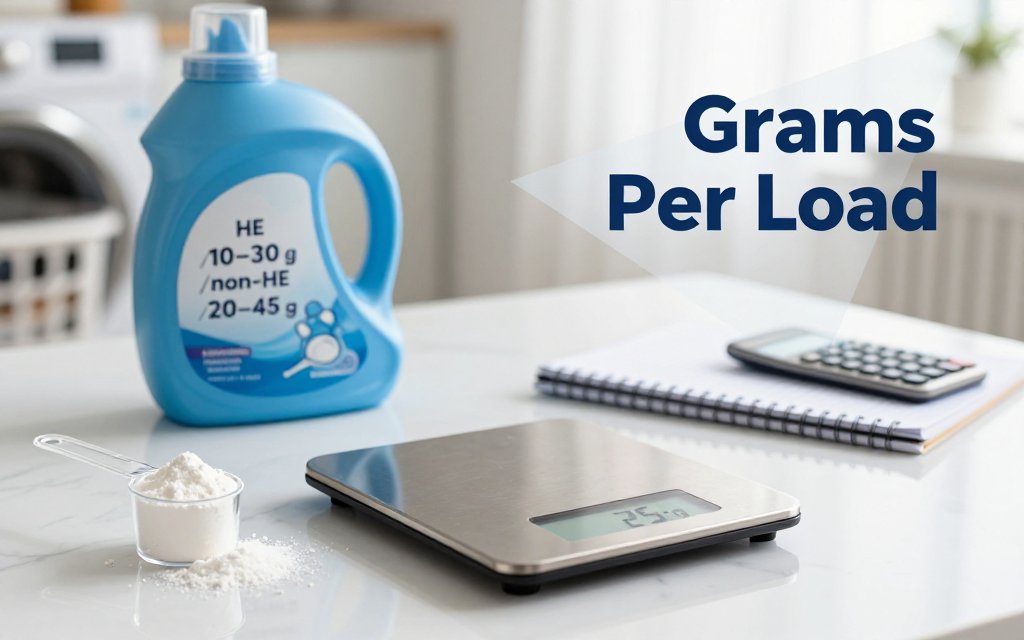
If you want one simple rule you can actually repeat, dose laundry detergent in grams, not cap lines. For most households, grams solve three common problems at once: you stop overpouring, you get consistent results across different detergents, and you can adjust logically without guessing. A practical baseline looks like this: modern HE (high-efficiency) washers usually clean well at about 10 to 30 g per load, while non-HE and many traditional top-loaders often land around 20 to 45 g per load because they use more water. Think of those as working ranges, not strict limits. You can start in the middle, then nudge up or down based on load size and soil level.
A simple grams-first baseline that actually works
Lead with the answer, then make it usable: for most modern HE washers, a typical range is about 10 to 30 g of detergent per load. For non-HE washers and classic deep-fill top-loaders, 20 to 45 g is a realistic range (especially if you select a higher water level). The reason your friend swears by “half a cap” and you need “two caps” is concentration. Some liquids are 2x, 4x, or even more concentrated, powders may include different fillers, and enzyme blends vary by brand. That is why the label dose is best treated as a ceiling, not your starting point. Real example doses that work in day-to-day life: 25 g for a full mixed load, 15 g for a small everyday load, and 30 g for gym clothes after a muddy run.
Here is the quick conversion concept that saves money and frustration: tablespoons and cap lines are not standardized, and grams depend on the detergent’s density. One brand’s “line 1” can be a different volume than another brand’s “line 1,” and even if the volume matched, the weight can still differ. Consumer testing outlets have been blunt that many people overdose simply because modern detergents are concentrated; a Consumer Reports dosing tip notes you often need only a small measured amount for a normal wash. The easy grams-first workaround is to weigh what your own tablespoon or cap line holds one time, write it down, and reuse that number.
> Pick a middle dose, then adjust in 5 g steps. If clothes feel slick, stiff, or overly scented, you likely overdosed and the rinse could not remove it. Consistency matters more than chasing the perfect number.
Load size and soil level: the only two dials most people need
A practical adjustment method that stays simple is: choose a mid-dose for your machine type, then move only one variable at a time. Start at 20 to 25 g for an HE washer or 30 to 35 g for a non-HE top-loader, then adjust by 5 g. Heavy soil means visible dirt, sweaty uniforms, muddy socks, greasy kitchen towels, or anything that actually changes the wash water. For that, add 5 g. Small loads or lightly worn clothes (office day, quick errand outfit) can usually subtract 5 g. This keeps you out of the trap of doubling detergent “just in case,” which often backfires because there is a point where more detergent is not more clean, it is just more residue that the rinse has to remove.
Repeatability is the hidden win. Pick one measuring tool and learn its grams once, instead of switching between a cap, a random spoon, and a laundry-room cup. For example, if your usual scoop of powder is 18 g level and 24 g heaped, that single fact makes your dosing consistent for months. You can even mark your scoop with a piece of tape: “level = 18 g.” The same logic works for liquid detergent. Weigh an empty dosing cup, tare it, pour to your preferred line, and record the grams. Now you have a reliable “home recipe” for laundry, just like baking by weight, and you can tweak it by 5 g when loads change.
If you want one more reality-based tweak, treat water hardness as a small modifier, not a third dial that takes over your life. Hard water can reduce cleaning efficiency, so you might need an extra 5 g, especially with powders that struggle to dissolve in cool cycles. The feedback loop is simple: if you see white streaks on dark clothes, feel a slippery film, or notice towels getting less absorbent, that usually points to too much detergent or poor rinsing, so reduce by 5 g and consider an extra rinse. If clothes still smell sour after drying, that is often underdosing for the soil level, so add 5 g next time. Small steps beat big swings.
Weighing detergent is easiest with a small kitchen scale, but you can still get close if you do not have one handy. A quick photo-based estimate can help you sanity-check amounts, especially if you are portioning detergent into jars for a rental, a dorm, or a small business laundry station. Scale for Grams, our iOS app, estimates weight from photos so you can get a fast grams estimate for everyday items, including piles of powder or a dose in a cup, then refine once you can verify. The habit carries over to other projects that live and die by weight consistency, like portioning meal prep, checking shipping weights, or cutting metal for jewelry. If you also work with sheet silver, bookmark sterling sheet gauge grams to see the same grams-first mindset applied to materials planning.
Detergent tablespoons to grams, and ounces too
If you have ever stared at a scoop or cap and thought, “How many grams is this, approximately?”, you are not alone. The tricky part is that tablespoons are volume, while grams and ounces are weight. Detergents can be fluffy or compact, concentrated or diluted, and even the same product can pour differently depending on humidity, clumping, and whether you level the spoon. The goal here is not lab precision. The goal is a close, repeatable dose that keeps clothes clean without burning through detergent (and money) faster than you need to.
Common conversions people ask for every week
Start with powdered detergent because it is the one most people try to spoon into “tablespoons.” A realistic, usable range for many powdered laundry detergents is about 7 to 12 g per 1 tablespoon. A level tablespoon of a fine, dense powder might land near 10 to 12 g. A fluffier powder, or a spoon that is not packed, can land nearer 7 to 9 g. Practical example: if your detergent is roughly 10 g per tablespoon, then 2 tablespoons is about 20 g, and 3 tablespoons is about 30 g. If you always scoop heaping tablespoons, assume you are at the top of the range.
Liquids behave differently. Many liquid detergents often fall roughly 12 to 18 g per 1 tablespoon, mainly because they are denser than airy powders, and some are more concentrated than they look. If you are using a bottle cap, this is where people overshoot, because cap lines can represent doses for heavy soil or extra large loads. For ounces, use one reliable anchor: according to the NIST ounce conversion, 1 oz (avoirdupois) is about 28.35 g. That means 15 g is about 0.53 oz, and 30 g is about 1.06 oz. If you think in ounces, you can picture 30 g as “about an ounce” and move in half ounce steps.
A tablespoon is a fixed volume, not a fixed weight. Detergent powders can trap air, liquids can vary in concentration, and “heaping” vs “level” changes the dose a lot. Use ranges, then calibrate your specific scoop once.
Pods are the easiest case because they are basically a fixed dose. Treat a pod like a “unit,” not like tablespoons. A simple rule of thumb is 1 pod for small to medium loads, and only consider 2 pods for very large loads or genuinely filthy laundry, depending on what the label says for your specific pod. If your washer is a high efficiency machine and your water is soft, you often need less than you think. If you notice lingering scent, suds, or a slippery feel on athletic fabrics, that is usually a sign you can step down a dose, not up.
How to calibrate your specific detergent once, then stop guessing
Do one quick calibration and you will never have to do tablespoon math again. Pick the tool you actually use, a tablespoon, the included scoop, or your bottle cap. Fill it exactly the way you normally do (level, heaping, or to a cap line). Then weigh that amount in grams once. If you have a kitchen scale, perfect. If you do not, using a photo based estimator like the Scale for Grams app can still get you close enough for detergent dosing, especially if you keep the same lighting and fill level each time. Your goal is consistency: you want “my usual scoop” to mean a repeatable number of grams.
Once you have the number, label it so you do not have to remember. A strip of masking tape on the container works: “1 level tbsp = 9 g” or “cap to line 1 = 25 g.” This also prevents a common mistake: people pour to cap line 3 for a normal load, even though that level is often more like a heavy soil dose. If your calibration says your tablespoon equals 10 g, dosing becomes fast: 10 g for a tiny quick wash, 20 g for a typical load, 30 g for bulky towels. You just move in clean 10 g steps without overthinking.
If you like thinking in ounces, write both units on the tape for instant translation. Example: “30 g (about 1.06 oz).” That makes it easy to stay consistent even if someone in your household defaults to imperial. This is the same habit that helps home bakers and small shippers: you pick one unit system, set a couple of anchors, and repeat the process without drift. For detergent specifically, the win is simple. You avoid “mystery scoops” that creep bigger over time, you use up detergent at a predictable rate, and you get cleaner rinses because you are not accidentally dosing for heavy soil on every normal Tuesday load.
How to measure detergent without a scoop
Losing the scoop is annoying because detergent is not like flour, where you can usually eyeball it and recover. Caps and drawer “max” lines also feel unreliable since two detergents can be totally different strengths, and a thick liquid sits higher than a fine powder. If you care about washer health and consistent results, the goal is repeatability, not perfection. Pick a method you can repeat every time, then adjust in small gram-sized steps based on what you see: suds level, rinse feel, and whether towels stay fresh after drying. Think of it like baking by weight, where the same input gives you the same output load after load.
Fast, repeatable measuring tricks when you have no scale
Make your own “scoop” from something you already trust. A single measuring spoon set (1 tbsp and 1 tsp) or a small cup that always lives in the detergent bin is the simplest fix. Decide what one “dose” is for your washer and detergent, then count repeats. Example: if your normal HE dose is about 15 g, and your chosen cup holds roughly 10 g of your powder when leveled, you do 1 full cup plus a half cup for most loads. Mark the cup with a permanent marker at your preferred level, and do not switch cups unless you re-check the amount. Consistency beats guessing with random mugs.
HE machines are especially sensitive because they use less water, so extra detergent has fewer rinse gallons to escape in. Too much can cling to fabric, trap body oils, and slowly create that “clean but not fresh” smell, especially in towels and workout gear.
Quick check: if you see lingering suds late in the cycle, or fabrics feel slick or stiff after drying, cut your next dose by 5 g. Then re-evaluate after two more loads.If your water is hard, do not jump straight to double detergent. Increase in small steps of 5 to 10 g, and consider a water-softening booster (washing soda or a hardness-targeted additive) before you keep climbing.
If you want grams-based dosing but do not own a kitchen scale, a photo estimate can be a practical workaround. With Scale for Grams (iOS), you can portion detergent into the same small cup each time, snap a photo, and get an estimated weight in grams so you can repeat it later. This is also handy when you are refilling a travel container for a laundromat, or when you are batching small loads for a guesthouse or Airbnb and want the same 15 g dose every bag. As a reality check, major detergent guidance also warns that excess suds can cause poor washing and residue buildup, which is why staying on the low, repeatable side usually wins. See Tide’s too many suds troubleshooting page for a clear explanation of why over-sudsing backfires.
What are the signs you are using too much laundry detergent
Look for symptoms that show detergent is not rinsing away. Common signs include: lots of suds late in the wash, a slippery or “waxy” feel on leggings and towels, white streaks on dark clothes, and a sour or musty odor that returns fast after drying. Your washer can show it too, with gunk in the gasket or a sticky detergent drawer. Decision rule: reduce your usual dose by 5 g for the next 2 loads. If the smell improves and fabrics feel less coated, you were overdosing.
How much detergent should I use in an HE washer in hard water
Start with a modest baseline, then climb slowly. For many HE detergents, a practical starting point is about 15 g for an average load, then adjust based on soil level and water hardness. In hard water, increase by 5 g (try 20 g) instead of doubling. If stains and odors still hang on, add another 5 g (25 g) or add a water-softening booster rather than continuing to pour more detergent. If you need more than 25 to 30 g often, you may be fighting hardness and overloading, not a “not enough soap” problem.
How can I weigh detergent without a scale or scoop
Use a repeatable container, then translate it to grams once and stick with it. Pick one small cup or spoon, level it the same way every time, and store it inside the detergent bin so it never disappears. Then estimate grams by using a photo-based tool like Scale for Grams: portion detergent into your standard cup, take a photo, and record the gram result (for example, “my cup level is 12 g”). From there, dosing is simple math: 1 cup (12 g) plus half a cup (6 g) gets you close to an 18 g target without guessing cap lines.
Need to weigh something fast, even when you cannot find a scale? Download Scale for Grams and get an AI-powered weight estimate from a photo in seconds. It is a quick way to sanity-check detergent doses and other small household measurements. Grab the app here: iOS. Try it today, then use your grams-first routine to keep suds under control and laundry fresh.
Scale for Grams
Need to Weigh Something?
Download Scale for Grams and get an AI weight estimate from a photo in seconds.