Packed Brown Sugar: The 75 Gram Cookie Trap
Brown sugar is one of the easiest ingredients to mis-measure because a “cup” can mean anything from fluffy and loose to firmly packed. This guide explains the packed vs loose weight gap, gives practical cup-to-grams ranges, and shows how to estimate grams without a physical scale so your cookies bake the way you expected.
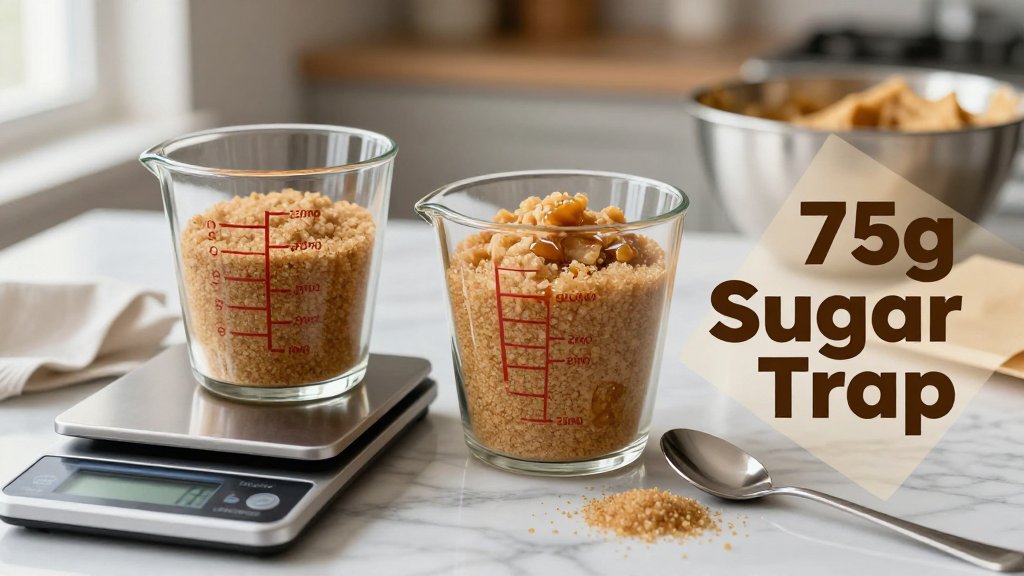
A “cup of brown sugar” sounds like a simple measure, yet it can quietly wreck a batch of cookies. Pack it tightly and you may add dozens of extra grams, changing spread, chew, and moisture in ways that feel mysterious until you see the numbers. In this article, you will learn the real-world grams range for packed versus loose brown sugar, how to tell what a recipe actually expects, and quick ways to estimate grams when you do not have a kitchen scale.
Packed vs loose brown sugar, why grams swing
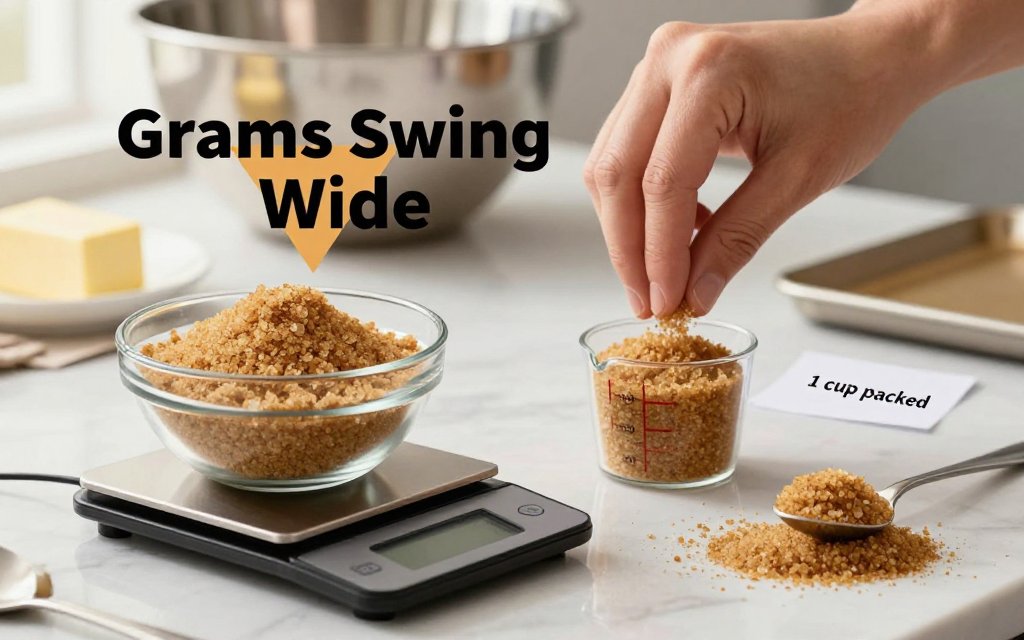
Your cookie recipe says “1 cup packed brown sugar,” you grab a measuring cup, and it feels foolproof. The problem is that cups measure volume, not weight, and brown sugar is basically tiny crystals plus moisture plus trapped air. Press it down and you squeeze out air pockets, which increases density, which increases grams. Leave it fluffy and you can be dramatically under the recipe’s intended sugar. For a reality check, King Arthur Baking lists ingredient weight chart values of 213 g for 1 cup of packed brown sugar. That 213 g target is what many “1 cup packed” cookie recipes are built around.
The 75 gram cookie trap in plain terms
Here is the conclusion upfront: if your recipe expects packed brown sugar and you scoop it loose, you can be short by around 75 g on a “1 cup” callout (or about 35 to 40 g on a 1/2 cup). That is the 75 gram cookie trap. On paper it sounds minor, but in a cookie dough where sugar is a major structural ingredient, it changes everything. The most common symptom pattern is cookies that spread too much and bake up thinner, with paler color, less chew, and a drier bite that goes stale faster the next day. Bakers often blame the oven or butter temperature, but the real culprit can be a fluffy cup of brown sugar.
Why does a sugar shortfall show up as spreading and pale color? Brown sugar is hygroscopic, it attracts and holds water, so the right amount keeps dough moist and helps it stay thicker for longer in the oven. Sugar also helps set the cookie’s structure as it dissolves and then re-crystallizes, so less sugar can mean less “hold,” especially in the first half of baking. Browning takes a hit too. With less sugar and less moisture retention, you often get a lighter surface and a less glossy finish. If your recipe uses 1 cup packed brown sugar (about 213 g), but your loose scoop lands closer to the mid-130s to 150s in grams, you can accidentally remove a large chunk of the recipe’s designed sweetness and chew.
If a recipe says packed brown sugar, treat it like a weight target, not a casual scoop. Press it firmly, or you may remove enough sugar to change spread, color, and chew in one batch.
What “packed” actually means in your measuring cup
“Packed” is not a vibe, it is a physical standard. Practical definition: press brown sugar into the measuring cup until it compacts, fills corners, and holds the cup’s shape when you invert it onto a plate. You should not see obvious air tunnels along the sides. The top can be level, but the key is compression, not just scraping flat. Contrast that with “spoon and level,” where you lightly spoon brown sugar into the cup and sweep off the excess. Spoon and level is great for flour, but it leaves brown sugar fluffy, which is exactly how you fall into the under-sweetened, over-spread cookie problem.
A simple kitchen routine makes packed cups more repeatable. Break up clumps first so you are not trapping marble-sized air gaps between chunks. Then add brown sugar in 2 to 3 additions, pressing each addition down with your fingers or the back of a spoon before adding more. Finish by pressing around the edges where the cup wall meets the sugar, since that is where gaps hide. If you want a sanity check for your own technique, treat 1 packed cup as about 213 g, and treat 1/2 cup packed as about 106 g. You do not need to hit those numbers perfectly, but getting close keeps your cookies consistent from batch to batch.
Moisture level is the hidden variable that can push the grams up or down even when you “pack” correctly. Fresh, soft brown sugar compresses tighter and often weighs more per cup because it behaves like damp sand. Brown sugar that has dried out (crumbly, dusty, or rock-hard) tends to leave more voids even when you press, and it dissolves differently in dough. That can make cookies grainier and less chewy, even if the cup looks full. If your sugar is hard, soften it before measuring: a short microwave burst with a damp paper towel in the container can help, or sealing it overnight with a small moisture source. Consistent sugar texture makes the packed measurement more meaningful.
If you bake by weight, the fix is obvious: skip the cup and weigh the grams your recipe intends. If you are traveling, cooking in a rental, or portioning food without a physical scale, your next best move is to use a quick estimate method and then adjust carefully. That is also where a photo-based approach can help you reality-check what is in your bowl before it goes into the mixer, especially for small amounts like a 35 to 40 g “missing” half-cup. For portion tracking beyond baking, you can pair these habits with palm-based macro tracking tips so your day-to-day gram estimates stay consistent even when your kitchen tools vary.
Cup to grams brown sugar conversions that work
If you bake by weight, cup-to-grams charts can feel like they are arguing with each other. They kind of are. Brown sugar is compressible, clumpy, and moisture-sensitive, so the same “1 cup” can land in very different gram totals depending on how firmly you pack it, how fresh it is, and even how much you crush the clumps. The goal of this quick reference is not laboratory precision. It is repeatable, practical numbers you can use on a Tuesday night cookie batch, or when you are portioning ingredients for meal prep and you just need a solid estimate without grabbing a physical scale.
Here is the simplest way to stay consistent: pick one “default” packed conversion and stick to it unless your recipe gives grams. For example, King Arthur Baking lists 1 cup packed brown sugar as 213 g in its ingredient weight chart, while many other baking charts round to 200 g or 220 g. (kingarthurbaking.com) Those numbers can all be “right” because they represent different packing pressure and moisture. Your best move is to use a realistic range, then choose a single target inside that range for day-to-day baking.
Packed brown sugar grams per cup, realistic range
For packed brown sugar (light or dark), a tight, usable range is 200 to 230 g per cup, and a practical “use this unless you know better” target is 220 g per cup. That target makes the math fast and lands you near the middle of what most home bakers actually do. (kingarthurbaking.com) Quick scaling: 1/2 cup is about 110 g, 1/3 cup is about 70 to 75 g (220 g divided by 3 is about 73 g), 1/4 cup is about 55 g, 3/4 cup is about 165 g, and 1 cup is about 220 g. If your “packed” is more like a gentle press, expect to drift closer to 200 g per cup.
How to use that range without over-promising: treat 220 g as your default, and treat the range as your safety rails. If a cookie recipe calls for 1/3 cup packed and you scoop loosely, you might accidentally land near 60 to 65 g instead of 70 to 75 g. That is enough to change spread and chew because sugar affects moisture retention and how fast edges set in the oven. On the flip side, if you really crank down on the cup, you can push the same “1/3 cup” toward the high end and end up with a sweeter dough that browns faster. Consistency matters more than chasing one magic number.
Unpacked brown sugar grams per cup, realistic range
Unpacked (loose) brown sugar is where charts really diverge because “loose” describes a technique, not a fixed density. A realistic range is 150 to 190 g per cup, depending on whether you spoon it in like fluffy snow or pour it and tap the cup on the counter. This is why two people can both swear they used “1 cup,” yet one person’s bowl is 40 g heavier. Quick scaling using that loose range: 1/2 cup about 75 to 95 g, 1/3 cup about 50 to 65 g, 1/4 cup about 40 to 50 g, 3/4 cup about 115 to 140 g, and 1 cup about 150 to 190 g. (lifeloveandsugar.com)
A quick note on “sifted” brown sugar: it is basically always a loose measure. Sifting breaks clumps and aerates the sugar, which increases volume without adding much mass. That means a “1 cup sifted brown sugar” instruction will almost always weigh less than a “1 cup packed brown sugar” instruction, even if the cups look equally full. If a recipe is old-school and only gives cups, look for keywords. “Packed,” “firmly packed,” or “well packed” means use the packed numbers. “Sifted,” “loosely filled,” or “crumbled” means start with the unpacked range and watch the dough texture (too dry, add a splash of liquid; too wet, chill or add a spoonful of flour).
Use ranges like guardrails, not handcuffs. For most baking, treat packed brown sugar as 220 g per cup and loose brown sugar as 170 g per cup, then stay consistent across batches so your results match.
If you need a fast sanity check and you do not have a kitchen scale in reach, take the most repeatable path you can: write your chosen conversion on the recipe card, measure the same way every time, and adjust only if the recipe also lists grams. For small businesses and makers, the same mindset helps with portioning and labeling, even when the ingredient is “just” brown sugar. A 15 g swing is not dramatic in a big batch, but it can be noticeable in small-batch cookies, frosting, or snack portions. And if you are using the Scale for Grams iOS app to estimate weights from photos, think of it as a quick cross-check to catch a wildly under-packed 1/3 cup before it turns into a batch that bakes differently than last time.
How to measure brown sugar without a scale
If you are stuck without a kitchen scale, you can still measure brown sugar in a way that keeps your cookies, muffin tops, and oatmeal bakes consistent. Use this quick decision process: first, decide if the recipe expects packed brown sugar (most classic US baking does). Second, pick a grams target you can trust so your “cup” is not a mystery. A widely used reference point is 1 cup packed brown sugar at about 213 g, as shown in King Arthur Baking’s ingredient weight chart. Third, if you can, sanity check the portion with a photo-based gram estimate so you avoid the big “too little vs too much” swing that changes texture fast.
A simple approach when a recipe only says “1 cup”
Read the ingredient line like a tiny set of instructions. If it says “1 cup brown sugar, packed,” pack it firmly. Fill your dry measuring cup in handfuls, then press down with your fingers or the back of a spoon until it holds the cup’s shape, and level the top. If it only says “1 cup brown sugar,” many older US cookie recipes still assume packed, because brown sugar is traditionally measured that way. Already added it and you are second guessing? Look at the dough. Dry, sandy, and crumbly often means you came in light. Shiny, greasy, and loose can mean you overshot. A practical fix: if you think you are short by about 75 g, add about 1/3 cup packed and mix gently just until combined.
Use a phone photo to estimate grams and stay consistent
If you want a fast double check without running to buy a scale, a photo-based estimate is a solid backup. With Scale for Grams (iOS), the workflow is simple: put the brown sugar in a bowl or your measuring cup, set it in good, even light, then snap a photo and get an estimated weight in grams, ounces, or kilograms. This is especially helpful mid-recipe when you need to know if that “packed cup” is closer to 145 g or 213 g, or if you are portioning brown sugar for meal prep (for example, 15 g per oatmeal jar) and want each container labeled the same. For a cottage bakery, it helps you reduce big errors like a 50 to 90 g swing, not chase lab precision.
FAQ: Packed brown sugar measurement questions
These answers are written to be used in real life, not just read. If you are baking, the goal is repeatability, so your “one cup” today matches your “one cup” next weekend. If you are doing non-baking tasks, like filling pantry containers, portioning sweetener for coffee stations, or assembling dry-mix jars you plan to sell, consistency also protects your labels and your cost math. Use the numbers below as targets, then adjust based on what you see: if your brown sugar is very dry and crumbly, it may pack less tightly. If it is very fresh and moist, it can pack heavier. A quick photo estimate can keep you in the safe zone.
How many grams are in 1 cup of packed brown sugar?
A reliable target for 1 cup of packed brown sugar is about 213 g. In everyday kitchens, you will see small variation because “packed” depends on how firmly you press and how moist the sugar is, but 210 to 220 g is usually the right neighborhood. Practical next step: pack it until the surface is firm, then level it. If your recipe is sensitive (cookies, brownies, bar cookies), aim for about 213 g and do not rely on a fluffy scoop. If you suspect you measured light, add brown sugar in 15 g to 25 g increments and mix gently.
How many grams are in 1 cup of unpacked brown sugar?
For 1 cup of unpacked (loosely filled) brown sugar, a practical working range is about 145 g to 170 g, depending on how clumpy, moist, and settled it is. If you need a single number to move forward, use about 155 g for “unpacked,” then adjust based on results. Practical next step: if a recipe is turning out dry and you measured brown sugar loosely, switch to packing or increase your amount by about 50 g to 75 g per cup called for. For portioning, decide your grams per container first, then fill to match that target each time.
If my recipe does not say packed, should I pack brown sugar?
In most classic US baking recipes, yes, you should assume brown sugar is packed unless the author clearly says “unpacked,” “loosely packed,” or gives a gram weight. Brown sugar is one of the few dry ingredients that is traditionally pressed into the cup, and many recipe writers treat “packed” as implied. Practical next step: look for clues. If the recipe also lists weights (like 213 g), follow the grams. If it is an older volume-only cookie recipe, pack it. If you already baked and the cookies spread too much and seem greasy, you may have overpacked. Next batch, reduce by about 25 g per cup and compare.
Need to weigh something fast, especially when a recipe only gives cups? Download Scale for Grams and get an AI-powered weight estimate from a photo in seconds. It is a quick way to sanity-check ingredients like packed brown sugar before they throw off your dough. Grab the app here: iOS, then snap a photo and bake with confidence.
Scale for Grams
Need to Weigh Something?
Download Scale for Grams and get an AI weight estimate from a photo in seconds.