How Much Perfume Is Left, Use Weight Math
If you cannot see the fill line in an opaque perfume bottle, you can still estimate what is left using simple weight math. Learn how to separate bottle weight from juice weight, convert grams to ml, and get a quick estimate even without a physical scale using a phone photo weight estimate.
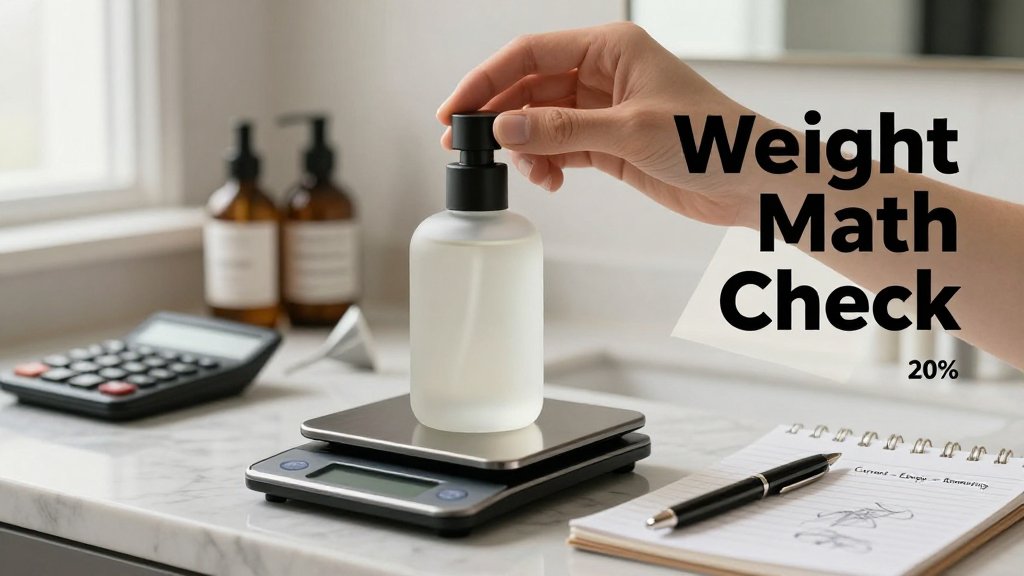
Opaque perfume bottles are beautiful, but they make it frustrating to know when you are about to run out. Guessing can lead to surprise empty spritzes, overbuying backups, or wasting product you could have planned around. In this guide, you will learn a simple weight-based method to estimate how much perfume or cosmetic product is left, even when you cannot see inside. We will cover the basic math, what numbers to record, and a reliable backup approach when you do not have a physical scale.
How to tell how much perfume is left
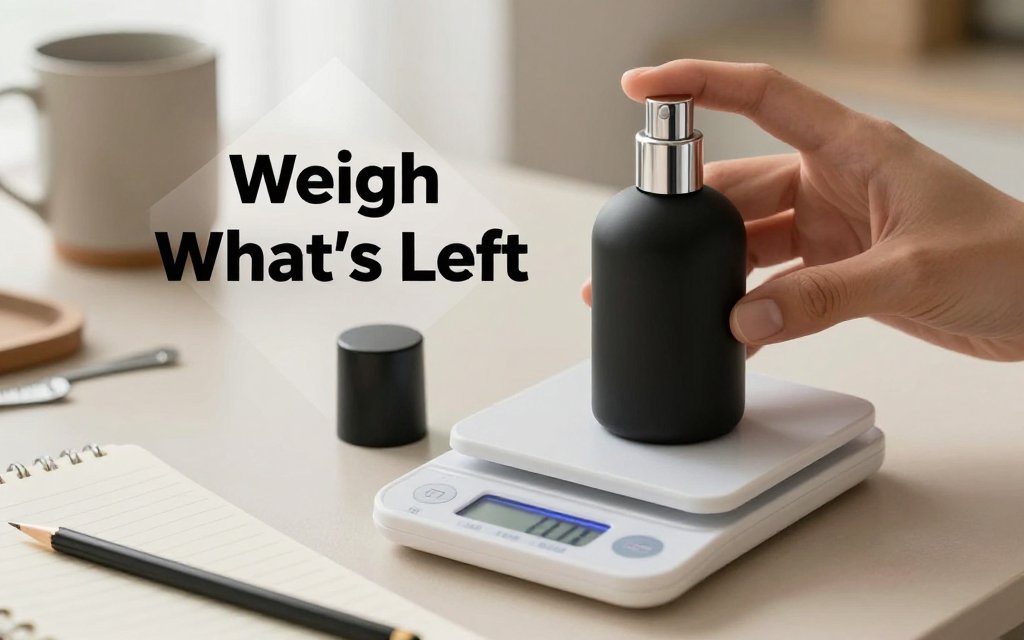
If you cannot see the fill line (opaque bottle, painted glass, thick gradient, metal sleeve), the simplest reliable way to estimate what is left is to use weight. Here is the whole idea in one sentence: total bottle weight minus empty bottle weight equals the liquid weight. This method is boring in the best way because it is repeatable, it is fast, and it works even when the bottle is completely non-see-through. Set expectations, though. Weight tells you how heavy the remaining liquid is in grams, not automatically how many milliliters are left, and the conversion is only an estimate unless you know the exact density of that formula.
The one formula that works for opaque bottles
Remaining perfume weight (g) = Current bottle weight (g) minus Empty bottle weight (g). That is the same basic approach resellers use when listing partial bottles, because “shake it and guess” is wildly inconsistent. Shaking depends on bubble size, viscosity, and how the atomizer tube sits inside the bottle. Weight does not care. A quick micro-example: your bottle weighs 210 g right now. You know the empty bottle (same cap and sprayer setup) weighs 170 g. 210 minus 170 equals 40 g of liquid remaining. If you keep taking weights the same way every time, you can also track usage, like 40 g this month and 33 g next month.
The most common mental trap is mixing up milliliters (mL) and grams (g). Bottles are sold by volume (50 mL, 100 mL), but your scale reads mass (grams). Perfume is usually mostly ethanol with some water and aromatic compounds, so it is often lighter than water per milliliter. Ethanol itself is about 0.789 g/mL at room temperature, which is why many people use “roughly 0.8 g per mL” as a quick conversion when they need a ballpark. (godavaribiorefineries.com) If you had 40 g of liquid left and you assume 0.8 g/mL, that is about 50 mL (40 divided by 0.8). If you assume 0.9 g/mL, it is about 44 mL. Either way, the weight method is still the cleanest starting point.
To do this well, you need a trustworthy empty-bottle weight. If you still have the original listing (or you are buying a partial), look for notes like “empty weight” or “bottle only” and confirm what was included. Communities often track these measurements for popular bottles because glass thickness, magnetic caps, and decorative collars vary a lot. One easy shortcut is to look up your exact bottle in a community catalog like perfume remaining-by-weight estimates, then compare your current weight to the reference data. Their basic workflow is “weigh your bottle in grams, find your exact bottle variant, then estimate what remains,” powered by community measurements. (fragcalc.com)
What to record before you do any math
Consistency beats perfection here. Decide what counts as “the bottle” and never change it mid-stream. Cap on or cap off, sprayer attached, decorative collar on the neck, even a dangling charm, all of it matters. The most common mistake is comparing a current weight taken with the cap to an empty-bottle weight taken without the cap. Depending on the design, that mismatch can easily swing results by 10 g to 40 g, which can look like a huge amount of missing perfume even when nothing changed. Also watch out for stickered labels or thick barcode stickers on the base. If someone removed them before recording the empty weight, your math will be off by a few grams.
A practical routine: weigh the bottle three times, write down the middle number, and repeat on the same counter. If your scale only shows whole grams, that is still good enough for most real-life decisions, like “do I have enough left for a trip?” or “is this partial worth listing?” If you are shipping, weigh without the box for the remaining-perfume math, then weigh again with the box and packing materials for postage. If you do not have a physical scale at the moment, a photo-based estimator like Scale for Grams can help you get a quick approximation, but treat it as a rough check, not a resale-grade measurement.
Weigh twice, once with the cap and once without, then pick one method and stick with it. Consistency matters more than perfection. A 20 g cap mismatch can look like 25 mL disappeared.
Once you get in the habit, weight math becomes a quick-reference skill that transfers to other “hard to see inside” items. Jewelry makers use the same logic for metal and findings, and small sellers use it to sanity-check package weights before buying postage. If you like that kind of verification mindset, you will also enjoy bullion coin weight tests, since coins have the same principle of “known reference weight, then compare.” For perfume specifically, the best time to record your empty-bottle weight is when the bottle is truly empty. Put it in your notes as “Empty bottle: 170 g with cap” and you will never have to guess again.
Estimate remaining fragrance in bottle by weight
Weight math is the easiest way to estimate what is left in an opaque or dark bottle, and it is also the method most resale buyers trust because you can show your numbers. The idea is simple: total bottle weight minus empty bottle weight equals the weight of liquid remaining. For example, you weigh your bottle (cap on, as you will ship it) and get 182 g. You find out the empty bottle weighs 142 g. That means about 40 g of fragrance is left. People compare notes on this approach in threads like calculate perfume left by weight, because it works even when you cannot see the fill line at all.
For listings, be clear about what you weighed. “Perfume bottle weight” is the gross weight (glass, sprayer, collar, cap, and the liquid). “Net contents” is the fragrance only, usually stated in ml on the box. If you are selling a bottle with the cap and sprayer included (almost always), weigh it that same way so your buyer gets a real world estimate. If you are using a kitchen scale, put a small bowl on the scale, tare to 0, then set the bottle in the bowl so it does not tip. If you do not have a physical scale handy, a photo-based estimator like Scale for Grams can still give you a usable gram estimate, which is often enough for a “roughly 50% full” type call.
Missing data is normal, especially with discontinued scents or bottles you got secondhand. If you cannot find the empty bottle weight, you can still build a reasonable estimate by working backward from what you know. Example: the label says 100 ml, and you have good reason to believe it was nearly full when you received it. If your current total weight is 182 g, and you assume a full 100 ml would weigh about 85 g (using 0.85 g/ml as a middle-of-the-road density), the empty bottle might be around 97 g. That estimate will not be perfect, but it narrows your range. In a resale description you can state “estimated by weight math” and include a plus or minus range, like plus or minus 5 to 10 ml for heavy glass bottles.
Perfume bottle weight vs ml, convert grams to ml
Milliliters (ml) measure volume, grams (g) measure mass, so you only convert between them if you assume a density. Alcohol-based spray perfumes often land around 0.80 to 0.90 g/ml, so 10 g is often roughly 11 to 12.5 ml. Here is the conversion you can actually use in a listing: ml remaining = grams of liquid remaining ÷ density. Using the earlier example, if you have 40 g of fragrance left and you pick 0.85 g/ml, then 40 ÷ 0.85 = about 47 ml remaining. That is a concrete number you can communicate, and it is usually more helpful to buyers than “half bottle.”
Density is why “net contents 50 ml” and “bottle weighs 150 g” are not directly comparable. The bottle is mostly glass and hardware, while the 50 ml is only the liquid volume. If you want a slightly more conservative estimate for typical spray perfumes, some packaging and filling guides cite a density in the high 0.8s to low 0.9s. For example, one guide notes a typical fragrance density estimate around 0.88 to 0.93 g/ml, which would make your ml result a bit smaller for the same grams. Oils and thicker roll-ons can be closer to 0.95 to 1.05 g/ml, so if you are weighing a perfume oil, beard oil fragrance, or a balm-like solid perfume, do not use an alcohol-spray assumption.
How to get empty bottle weight when you do not have it
Start with the easiest win: search for an empty bottle listing of the exact same fragrance and size, then use its stated weight as your empty bottle estimate. “Exact” matters because glass thickness and decorative caps swing the results a lot. A 50 ml minimalist bottle might be under 120 g empty, while a 50 ml collector style bottle with a heavy cap can be 200 g or more empty. If it is from your own collection, the best long-term trick is to weigh the bottle when it is new (or when it is clearly full), write the total weight on a piece of tape on the bottom, then weigh again later and subtract. That gives you a repeatable method without hunting for data every time.
If you cannot find the exact empty bottle, use a close proxy from the same brand line and size, since many flankers share the same glass mold. To reduce error, weigh two similar empties (for example, two 100 ml bottles from the same collection) and average them, then use that averaged empty weight as your best guess. Averaging can smooth out small differences like a slightly heavier collar or a different cap insert. Finally, be transparent in your listing: “Estimated remaining: about 45 to 50 ml based on total weight 182 g and estimated empty weight 142 g.” Buyers who ship packages by weight and makers who portion ingredients in grams recognize that kind of math, and it reads as careful rather than vague.
How to weigh perfume without a scale
If you are trying to list a partial bottle, pack for a trip, or decide if you have enough for the week, you can get a usable estimate without owning a physical scale. The practical workflow is: (1) get an estimated total weight of the bottle as it sits today, (2) subtract an estimated empty bottle weight (the “tare”), and (3) keep the result in grams because that is the cleanest number to share. If you also want milliliters, convert grams to mL using a density assumption, since grams and mL are not interchangeable for fragrance the way they are for water.
Phone photo weight estimate for cosmetics, fast reality check
A photo-based estimate (like Scale for Grams on iOS) is most useful for a quick ballpark: drafting a resale listing before you do more homework, checking if your travel bag is getting heavy, or deciding if that foundation bottle will make it through the next 7 days. Treat it like a “close enough to plan” number, not lab-grade measurement. For better results, shoot in bright, even light, keep the camera straight above the bottle, and use a plain background so the bottle outline is clear. If you can, include a common reference object in the same photo (a credit card, a coin, or a standard lip balm tube) so the app has a size cue.
Do a fast reality check before you trust the estimate. Take two photos from the same height and angle and see if the weights land close together. Then decide on one “standard setup” and stick to it, because small changes create big swings. For example, always measure with the cap on, or always with the cap off, but do not mix and match between weeks. If you are comparing two bottles (say, a 100 mL Dior Sauvage bottle and a 50 mL travel spray), photograph them separately in the same lighting. Consistency matters more than perfection when you are only trying to answer, “Do I have roughly 20 g left, or am I basically empty?”
FAQ: Weight math for perfume and cosmetic bottles
Opaque bottles are the tricky ones because you cannot eyeball the fill line. If you cannot weigh the bottle on a real scale, use layered backups: estimate total weight by photo, estimate empty weight by looking up the empty bottle weight from your own notes (best), or by weighing a similar empty bottle you already finished (good), or by subtracting a known full bottle estimate (okay). You can also do a “sound check” by gently tilting to hear how much slosh you get, and a “flashlight check” by shining a strong phone light at the edges for thin glass. In a listing, I would write it like: “Estimated 42 g remaining (about 40 to 50 mL). Method: photo weight estimate minus known empty bottle weight.”
How do I estimate remaining product in a bottle in grams?
Estimate remaining grams as: estimated current bottle weight minus empty bottle weight. Example: your photo estimate says the bottle is about 210 g today. You previously noted the empty bottle (with atomizer and cap) is about 168 g. 210 g minus 168 g gives about 42 g of product left. If you want mL, you need density because mass and volume differ; one example fragrance oil measurement shown in perfume grams-to-milliliters conversion comes out near 0.98 g per mL, so 42 g would be in the neighborhood of low 40s mL. In a listing: “42 g remaining (estimate), roughly 40 to 45 mL depending on density.”
Is cosmetic bottle net contents by weight vs volume the same thing?
No. “Net contents 50 mL” is a volume claim, while “net wt 50 g” is a mass claim, and they only match when the product density is 1.00 g per mL (roughly water-like). Many cosmetics are not water-like. Alcohol-based sprays and lightweight hair products can be noticeably lighter per mL, and thicker oils and syrups can be heavier per mL. For perfume and body sprays, the safest resale wording is to keep your estimate in grams remaining, then add an estimated mL range with a note that the conversion depends on density. That note prevents arguments later because you did not promise an exact volume.
How accurate is opaque perfume bottle level estimation by weight?
Accuracy depends on two things you often cannot control: how good your empty bottle weight is, and how close your density assumption is. If your empty bottle estimate is off by 5 g (easy to do if you forgot whether the cap was on), your “remaining” number is off by the same 5 g. Then, converting grams to mL adds another layer because different formulas sit at different grams-per-mL. For opaque bottles, I handle this by giving a range and stating the method. Example: “Estimated 30 to 40 g remaining, roughly 30 to 45 mL, based on photo weight estimate and known empty bottle weight, opaque bottle so fill level cannot be visually confirmed.”
Need to weigh something fast, even when you do not have a scale nearby? Download Scale for Grams and get an AI-powered weight estimate from a photo in seconds, perfect for quick checks at home or on the go. Try it today and make your next refill decision with more confidence. Get the app on iOS and see how easy weight estimates can be.
Scale for Grams
Need to Weigh Something?
Download Scale for Grams and get an AI weight estimate from a photo in seconds.